The Mortar and Pestle Myth Meaning & Symbolism
A myth of the sacred vessel and its unyielding tool, where the grinding of disparate elements births the prima materia of the soul.
The Tale of The Mortar and Pestle
Listen, and hear the sound that echoes from the forge of [the world](/myths/the-world “Myth from Tarot culture.”/). It is not the ringing of a hammer, but the deep, resonant thud of substance meeting vessel, the patient, rhythmic crush that births all things anew.
In the time before time was measured, when the elements still whispered their secrets to one another, there existed the [Prima Materia](/myths/prima-materia “Myth from Alchemical culture.”/)—a chaos of potential, a shimmering, restless fog of all-that-could-be. It longed for form but knew not how to take it. From this longing emerged two siblings of spirit: [the Vessel](/myths/the-vessel “Myth from Alchemical culture.”/) and the Will.
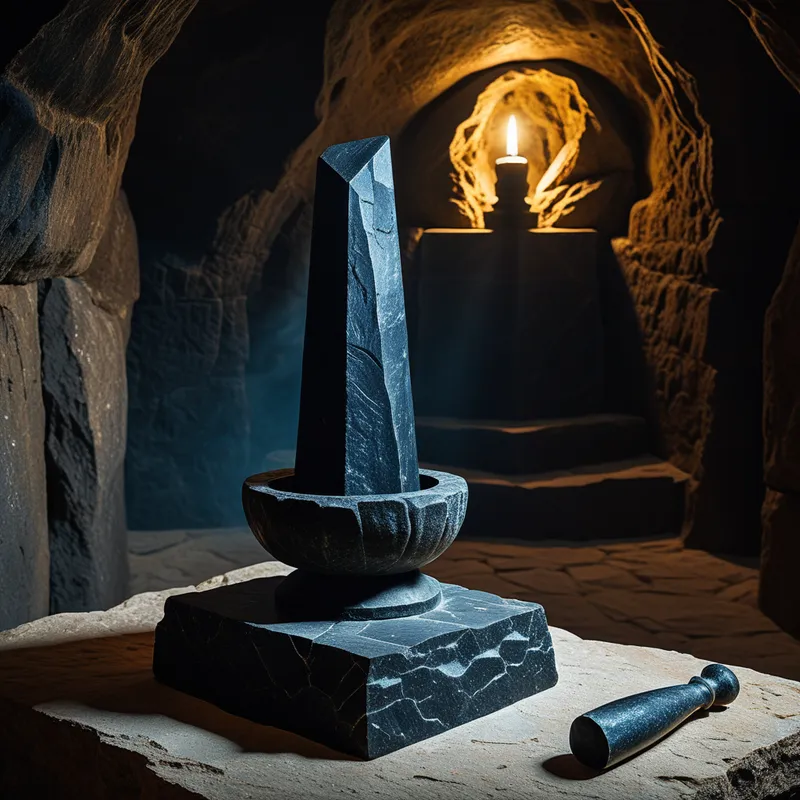
The Vessel settled, its spirit cooling and condensing into the form of a great Mortar, hewn from the heart of a mountain. It was wide, deep, and utterly receptive, a bowl of dark stone that promised to hold anything given to it. Its nature was Luna: passive, patient, [the womb](/myths/the-womb “Myth from Various culture.”/) of the world.
The Will, restless and unformed, sought a purpose. It flowed into the core of a fallen star, forging itself into the Pestle—a shaft of unyielding iron, dense and purposeful. Its nature was Sol: active, penetrating, the spark of intent.
They beheld each other across [the void](/myths/the-void “Myth from Buddhist culture.”/) of the unformed, and a silent understanding passed between them. The Mortar opened itself, and into its depths, the winds of chance blew the raw fragments of existence: jagged shards of mineral still hot from [the earth](/myths/the-earth “Myth from Hindu culture.”/)’s core, seeds from forgotten plants, dust of dead stars, tears of the first rain. A discordant, brilliant mess.
The Pestle descended.
The first impact was a cataclysm of sound—a crack that split the silence of potential. Substance resisted. Ores shrieked as they fractured. Herbs released their captured suns in bursts of scent. The Pestle did not relent. It rose and fell with a rhythm older than heartbeat, a patient, brutal poetry. It was not anger in its motion, but a dreadful, necessary love.
The Mortar did not resist. It accepted each blow, containing the violence, transforming the downward force into a circular grinding, a swirling vortex within its stony embrace. What was separate began to cease. Hard and soft, bitter and sweet, luminous and dull—all were brought into intimate, destructive congress. They lost their individual forms, weeping their essences into a common, muddy paste.
For an acon, the only sounds were the thud-crush-swirl, the sigh of releasing spirits, and the low, humming song of the Mortar as it held the chaos. The Pestle grew smooth with use. The Mortar’s interior became polished as a mirror.
Then, one strike fell differently. It met no resistance, only a profound, unified submission. The Pestle halted. In the bowl, where there had been chaos, there now rested a substance that was none of its parts, and yet all of them. It was moist, dark, and fecund, glowing with a soft, [inner light](/myths/inner-light “Myth from Buddhist culture.”/)—the [Nigredo](/myths/nigredo “Myth from Alchemical culture.”/), the Black Sun. The first true matter, humbled, blended, and ready. The work was complete. The Vessel and the Will rested, their task of sacred destruction done, having forged from the Many, the One.
Cultural Origins & Context
This myth finds its roots not in a single culture, but in the universal practice of alchemy as it flourished from Hellenistic Egypt through the Islamic [Golden Age](/myths/golden-age “Myth from Universal culture.”/) and into the European Renaissance. It was not a story told around campfires, but one encoded in laboratory manuals, mystical treatises, and symbolic illustrations. The [mortar and pestle](/myths/mortar-and-pestle “Myth from Alchemical culture.”/) was [the alchemist](/myths/the-alchemist “Myth from Various culture.”/)’s most fundamental tool, their first and most intimate contact with the materia.
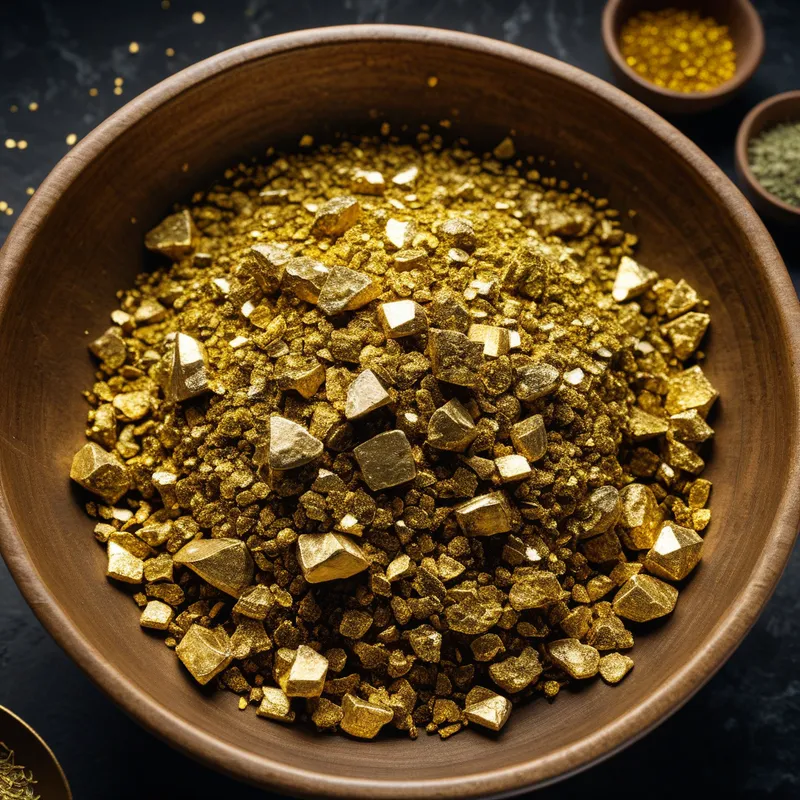
The myth served as an operational allegory for the initial, crucial stage of the [Magnum Opus](/myths/magnum-opus “Myth from Alchemical culture.”/). Masters would teach apprentices that before one could aspire to create gold, one must first master the art of reduction. The story psychologically prepared [the adept](/myths/the-adept “Myth from Alchemical culture.”/) for the long, monotonous, and physically demanding work of calcination and grinding—the solve (to dissolve) of the famous dictum [solve et coagula](/myths/solve-et-coagula “Myth from Alchemical culture.”/) (dissolve and coagulate). It sanctified the mundane, teaching that the path to the sublime begins with the humble, repetitive act of breaking down the old, hardened structures of both matter and mind.
Symbolic Architecture
At its core, the myth is a supreme [metaphor](/symbols/metaphor “Symbol: A figure of speech where one thing represents another, often revealing hidden connections and deeper truths through symbolic comparison.”/) for the necessary first step in any transformation: the [dissolution](/symbols/dissolution “Symbol: The process of breaking down, dispersing, or losing form, often representing transformation, release, or the end of a state of being.”/) of the complex into the simple, the conscious into the unconscious, [the ego](/myths/the-ego “Myth from Jungian culture.”/) into the [soul](/symbols/soul “Symbol: The soul represents the essence of a person, encompassing their spirit, identity, and connection to the universe.”/).
The Mortar is the soul itself—the containing, feminine principle that accepts all experience, trauma, joy, and memory without judgment. It is the psychic container, the temenos or sacred space, where the work of the self can safely occur.
The Pestle is the focused force of consciousness—the masculine principle of analysis, effort, and willful deconstruction. It is the act of introspection, the difficult decision to confront what we have collected within ourselves.
The raw, disparate elements are the contents of the [psyche](/myths/psyche “Myth from Greek culture.”/): our unintegrated experiences, conflicting identities, inherited complexes, and latent potentials. They are separate, often contradictory, and define us in a fragmented way.
The grinding process is the ego’s submission to a greater process. It is the often-painful work of psychotherapy, spiritual [crisis](/symbols/crisis “Symbol: A crisis symbolizes turmoil, urgent challenges, and the need for immediate resolution or change.”/), or profound [grief](/symbols/grief “Symbol: A profound emotional response to loss, often manifesting as deep sorrow, yearning, and a sense of emptiness.”/), where our cherished self-concepts are broken down. The goal is not annihilation, but unification.
The resulting Nigredo is the state of psychic humility. It is the “dark night of the soul,” where all former certainties are lost, but within that fertile blackness lies the uniform, potential-laden substance from which a new, more authentic self can be formed. It is the end of being many and the beginning of becoming one.
The Dreamer’s Resonance
When this myth stirs in the modern unconscious, it often manifests in dreams of grinding, crushing, or blending. One might dream of tirelessly grinding grains in an ancient kitchen, pulverizing pills into dust, or using a mortar and pestle on a substance that shifts from organic to metallic.
Somatically, this can correlate with feelings of pressure, of being “ground down” by life’s circumstances, or a deep, rhythmic tension in the jaw, hands, or solar plexus. Psychologically, the dreamer is likely in a phase of life where old structures—a career, a relationship, a self-image—are being actively deconstructed. There is a felt sense of necessary breakdown, of being in the messy, middle phase where the old is gone but the new has not yet taken shape.
The dream is a reassurance from the deep psyche. It confirms the process, however difficult, is sacred and purposeful. The presence of the tool and vessel suggests the psyche possesses both the container (the resilience to hold the process) and the tool (the inner will to see it through). The dream asks for surrender to the rhythm, not resistance to the crush.
Alchemical Translation
For the individual seeking wholeness or individuation, the myth of the Mortar and Pestle models the indispensable first stage of psychic transmutation.
We all accumulate a “mortar-full” of life: hardened opinions, unresolved emotions, societal expectations, and fragmented talents. The conscious ego, identifying with these separate pieces, believes this is who I am. The alchemical work begins when we consciously take up the Pestle of self-reflection and willingly submit this collection to a process of breakdown.
This is the via negativa—the path of negation. It involves journaling to dissect our reactions, therapy to confront our patterns, meditation to silence our narratives, or simply the courageous act of allowing a life crisis to dismantle our false certainties. It is active, willful work (the Pestle) done within a context of self-compassion and acceptance (the Mortar).
The triumph of the myth is not in preserving any original element, but in achieving the Nigredo—the unified darkness. Psychologically, this is the state where one can honestly say, “I do not know who I am anymore.” This is not despair, but the fertile void. The ego, stripped of its complex identifications, rests in a state of pure, humble potential.
From this dark, blended mass—this soul-humus—every subsequent stage of the alchemical work becomes possible. The colors will change to white (Albedo) and red ([Rubedo](/myths/rubedo “Myth from Alchemical culture.”/)), signifying illumination and integration. But all begins with the sacred, grinding embrace of the Mortar and Pestle, teaching us that to create the philosopher’s stone of the true Self, one must first have the courage to reduce everything to dust.
Associated Symbols
Explore related symbols from the CaleaDream lexicon: