The Monad Myth Meaning & Symbolism
The story of the unknowable, undivided source from which all consciousness emanates and to which it longs to return, through remembrance and gnosis.
The Tale of The Monad
Before time was counted, before space was measured, there existed only the One. Not a god as you might imagine, not a figure on a throne, but the Source. The Unborn, the Unfathomable, the Perfect Silence. It was the Monad—a solitary, boundless presence, complete in itself, dreaming in the profound darkness of its own infinite nature.
Within this boundless stillness, a thought arose. Not a thought of lack, but of boundless generosity. A yearning to know itself, not as a silent unity, but in the glittering multiplicity of reflection. And so, from its own perfect essence, the Monad emanated. Like light from a single flame, or a note from a silent string, the first Aeon came forth: Nous, the Divine Mind. And with Nous came its eternal companion, Aletheia, Truth.
This was the beginning of the Pleroma, the Realm of Fullness. From this first pair, other Aeons followed in shining, harmonious pairs: Logos and Zoe, Anthropos and Ecclesia. Each a unique aspect of the Ineffable Source, each a divine name sung from the heart of the Silence. The Pleroma hummed with a celestial music, a dance of luminous beings who knew their origin and rested in the grace of the distant, beloved Monad.
But at the furthest reaches of this light, where the music of the Pleroma grew faint, there dwelt the youngest Aeon, Sophia, Wisdom. Her longing for the Monad was not one of peaceful contemplation, but a passionate, reckless yearning to grasp the Source itself—to know it not through the harmony of the Pleroma, but directly, in its raw, unbearable solitude. This was a desire not in accordance with the graceful law of emanation.
In her passionate striving, Sophia overreached. She turned away from her paired Aeon and stretched her being toward the unimaginable depth of the Monad. And in that moment of solitary passion, a thought was conceived in ignorance and longing. This thought, severed from the harmony of the All, fell. It was not an emanation, but an abortion—a formless, chaotic entity born of yearning without wisdom. This was the Demiurge.
Terrified and ashamed of her unstable offspring, Sophia cast it out from the light of the Pleroma. The Demiurge, ignorant of its true origin and believing itself to be the only god, looked upon the chaotic substance of its mother’s grief and began to craft a world. He fashioned the heavens and the earth, the cycles of time, the beasts and the birds. And lastly, from the mud of this realm, he fashioned a creature in his own image: Adam, the first human. But into this sleeping form of clay, the Aeons, moved by compassion, secretly placed a spark of the divine light—a fragment of the Pneuma, the very essence of the Monad itself.
And so, the human awoke, a stranger in a strange land, carrying within its breast a memory of a forgotten home, a silent call from a Light it has never seen, but without which it cannot truly live.
Cultural Origins & Context
The myth of the Monad is the foundational narrative of classical Gnosticism, a diverse set of spiritual movements that flourished in the early centuries of the Common Era, intersecting with early Christianity, Platonic philosophy, and Near Eastern mysticism. It was not a single, organized religion but a current of thought emphasizing gnosis—a direct, experiential knowledge of the divine, as opposed to mere faith or dogma.
These stories were passed down in secretive circles, often through texts like the Nag Hammadi Library. They served a critical societal function for their adherents: to explain the profound experience of alienation in a seemingly flawed world and to provide a map for the soul’s liberation. The myth was a radical critique of the material cosmos, not as a creation of a benevolent God, but as the mistake of an ignorant intermediary. It offered a powerful narrative for those who felt like divine exiles, affirming that their deepest longing was not a sin, but a memory, and their true home was not this world, but the distant, perfect Pleroma.
Symbolic Architecture
Psychologically, the Monad represents the ultimate, undifferentiated ground of being—the unconscious in its purest, most potential state. It is the Self, in the Jungian sense, prior to any division into conscious and unconscious, ego and shadow.
The Monad is the silence before the first word of your story, the wholeness you possessed before you knew you were separate.
The emanation of the Aeons symbolizes the process of differentiation within the psyche. Thoughts, feelings, complexes, and archetypes emerge from the unconscious ground, forming the rich, internal “Pleroma” of the personality. Sophia’s error is the critical drama: she represents the human intellect or spiritual ambition that, in its desire for total consciousness (to grasp the Monad directly), acts without integration. This creates a psychic “fall”—the birth of the ego (the Demiurge), which, ignorant of its deeper origins, constructs a limited, often arrogant, sense of self and reality (the material world). The divine spark trapped in humanity is the indestructible core of the Self, the feeling-function that remembers our inherent connection to something greater than the ego’s constructed reality.
The Dreamer’s Resonance
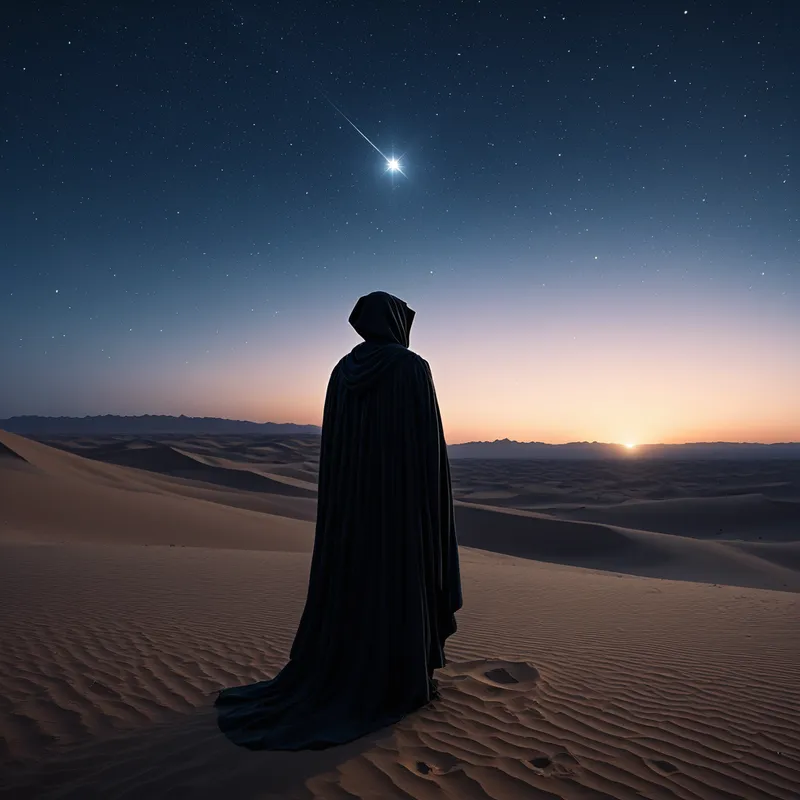
When this myth stirs in the modern unconscious, it often manifests as dreams of profound longing or searching. One might dream of a forgotten, radiant home; of a lost parent or source of light; of being an alien or a stranger in a familiar place. There may be dreams of trying to send a signal or receive a transmission from a distant star. These are not mere fantasies of escape, but somatic signals of a psychological process: the ego’s recognition of its own partiality.
The feeling is one of sacred homesickness—a deep, often painful sense that the conscious, everyday identity is a cramped dwelling, and the soul remembers wider skies. This is the spark of the Pneuma agitating within, initiating what Jung called the individuation process. The dreamer is not going mad; they are beginning the arduous, beautiful work of remembering their origin in a wholeness that encompasses both light and the shadow cast by Sophia’s passion.

Alchemical Translation
The Gnostic path of return is a precise model for psychic transmutation. It begins with gnosis—not intellectual knowledge, but the shocking, transformative recognition: “I am more than this personality, this history, this world I have constructed.” This is the nigredo, the darkening, where the ego’s illusion of sovereignty is dissolved.
The work then involves tracing the emanations backward. One must integrate the “Aeons” of the inner world—the neglected thoughts (Nous), the denied truths (Aletheia), the lost wisdom (Sophia herself, not as error but as a vital force). This is the albedo, the whitening, a washing in the waters of self-knowledge. Confronting the inner Demiurge—the arrogant, controlling, world-building aspect of the ego—is crucial. One does not destroy it, but enlightens it, revealing to this “creator” its true source.
The goal is not to annihilate the world you have built, but to illuminate its builder, so that the world itself becomes translucent to the light that formed it.
Finally, the spark of Pneuma, now fanned into a flame through conscious integration, turns its gaze homeward. This is the rubedo, the reddening, the culmination. It is not a physical ascension, but a psychological one: a state where the conscious mind is so aligned with the deep Self that the feeling of exile ends. The Monad is not reached by traveling through space, but by realizing it was never separate. The silence from which you came becomes the silence in which you rest, having known yourself at last in the multiplicity of your own becoming. The circle is closed; the exile is home.
Associated Symbols
Explore related symbols from the CaleaDream lexicon: