The Moiraifrom Greek Myth Meaning & Symbolism
Three primordial goddesses spin, measure, and cut the thread of life for every being, from mortal to god, embodying the inexorable law of destiny.
The Tale of The Moirai
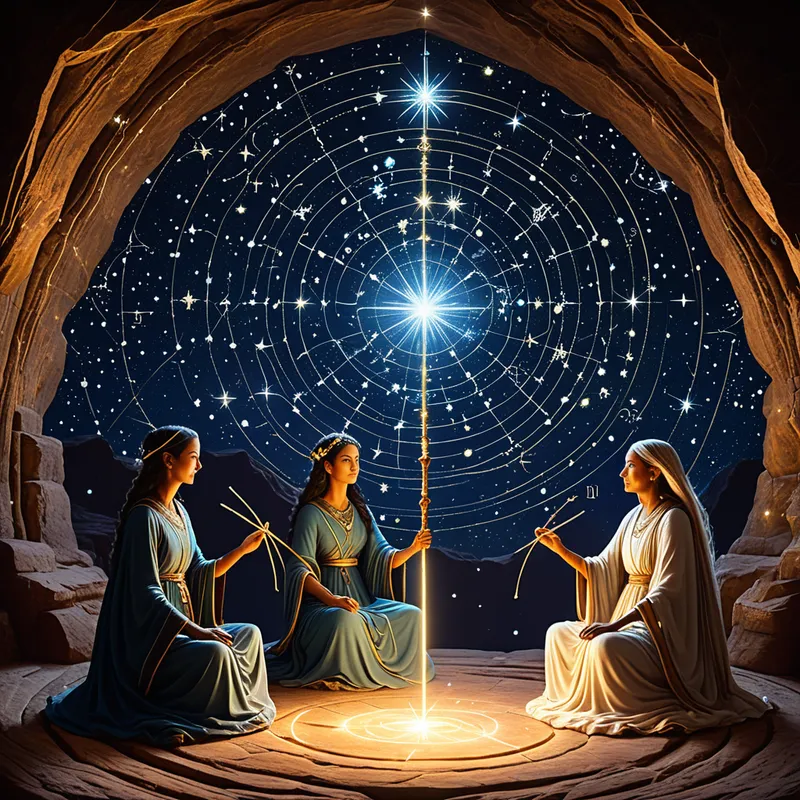
Beneath the roots of the World-Tree, where time is not a river but a root, there is a cavern that breathes with the pulse of the universe. Here, in a chamber lit by no sun or moon, but by the cold, clear light of necessity, they sit. Three sisters, older than memory, older than the gods themselves.
First is Clotho. Her fingers, slender and swift as thought, draw the raw stuff of potential from the void—a shimmering, nebulous cloud. With a touch, she teases it into a single, luminous strand. The thread hums with the first cry, the first breath, the spark of being. It is the moment of conception, the birth of a star, the first note of a song that has never been sung. She smiles, a faint, distant thing, as the thread flows from her spindle.
The thread passes to the second sister, Lachesis. Her eyes are not eyes but pools of silent galaxies. She receives the humming thread and, without haste, measures it against the unrolled scroll of the cosmos. Here, she lays it beside the path of a wandering planet; there, she lets it cross the trajectory of another, already-spun thread. She allocates its portion of joy and sorrow, triumph and trial. Her touch is not cruel, but exact. She inscribes the length, the texture, the inevitable bends and knots. This is the map of a life, drawn in light.
Finally, the thread reaches Atropos. She is the smallest, yet her presence is the heaviest. In her lap rests the shears, their blades forged from the absolute finality of not-being. She waits. She watches the thread, now laden with its measured destiny, play out its song. She feels its vibrations—the crescendos of love, the tremolos of fear, the steady rhythm of days. She does not hurry. But when the final note, pre-ordained by her sister’s measure, trembles in the strand, her hand moves. A sound, softer than a sigh, sharper than the collapse of a universe: snip.
The light winks out. The song ends. The thread, now just a memory of luminosity, falls into the basket at her feet, atop a mound of countless others. And without pause, Clotho draws forth another wisp from the void, and the great wheel turns once more.
Even Zeus, who hurls thunder and shakes the earth, lowers his gaze before them. He may rule the sky, but they are the loom upon which the sky is woven. To plead with them is to plead with gravity. To defy them is to defy the turning of the stars. They are the law that even law must obey.
Cultural Origins & Context
The Moirai, known to the Romans as the Parcae, are not Olympian inventions but chthonic, primordial powers. Their origins likely stretch back to pre-Hellenic, perhaps even Neolithic, conceptions of a distributed, impersonal cosmic order. In Homer, they are already an established, dreaded force, often spoken of in the singular as Moira—“share” or “portion”—the allotted destiny of every being.
They were central to the Greek worldview, a necessary counterbalance to the capricious will of the gods. The society that told their stories was one deeply concerned with limits, with hubris and its consequences. The myth functioned as a profound cultural regulator. It answered the terrifying question of life’s arbitrariness not with chaos, but with a stern, feminine logic. Destiny was not random cruelty; it was measured, spun, and cut—a process, however inscrutable. This provided a framework for acceptance. Heroes like Achilles had a “choice” of fates, but the menu was always set by the Moirai. The myths were passed down by poets and tragedians—Hesiod, Aeschylus, Sophocles—who used the Fates to explore the tension between human agency and pre-ordained limits, the very engine of classical tragedy.
Symbolic Architecture
The Moirai represent the archetypal structure of existence itself. They are not characters with motives, but personified functions of a cosmic principle.
The thread is not the life; it is the pattern of the life. The Moirai do not create the dancer, they weave the stage upon which the dance must occur.
Clotho symbolizes the principle of Beginning, the eruption of the unique individual from the formless potential of the unconscious. She is the spark of consciousness, the initial conditions set at birth—our genetics, our family, our epoch. Lachesis embodies the principle of Unfolding. This is not a fixed script, but a field of possibilities, a measure of “what is allotted.” Psychologically, she represents the life journey, the encounters, choices, and accidents that give form to the initial spark. She is the development of the personality, the accretion of experience. Atropos is the principle of End, the necessary limit that gives shape and meaning to the whole. She is the inescapable reality of death, finality, and completion. Without her shears, life would be an endless, meaningless elongation. She forces the crisis that demands meaning.
Together, they form a triune goddess of Necessity (Ananke). They symbolize the psychic truth that our lives operate within a framework of givens—a “fated” structure of complexes, innate tendencies, and ultimate mortality—within which our freedom and consciousness must navigate.
The Dreamer’s Resonance
To dream of the Moirai, or their symbols (threads, spinning, measuring, cutting), is to encounter the psyche’s own governance system. It often surfaces during life transitions, crises of choice, or confrontations with mortality.
Dreaming of tangled or knotted threads suggests a feeling of being trapped by life’s circumstances, of one’s destiny feeling confused or obstructed. The dreamer may be struggling with a complex web of responsibilities or a past decision whose consequences are still unfolding. A dream of a thread being measured often coincides with a period of self-assessment—a career change, the end of a relationship, a midlife review. The psyche is taking stock, measuring the life lived against the life possible. The most potent dream is of the shears or a cut thread. This does not necessarily presage physical death. More often, it symbolizes the forceful, often painful, end of a psychological state: the death of an identity (the “caregiver,” the “victim,” the “performer”), the severing of a toxic attachment, or the closing of a major life chapter. It is the unconscious enforcing a necessary ending the conscious mind has been avoiding.
Somatically, these dreams can be accompanied by sensations of constriction (the knot), of being weighed or assessed (the measure), or of a sudden, clean release or shock (the cut).
Alchemical Translation
The modern individuation process is not about escaping fate, but about consciously relating to it. The Moirai model the alchemical stages of this sacred engagement.
First, we must Acknowledge the Spinner (Clotho). This is the work of self-knowledge: understanding our innate nature, our core complexes, our “original pattern.” What thread was I given? This is accepting one’s temperament, wounds, and gifts without initial judgment. Then, we Consciously Weave with the Measurer (Lachesis). Here, fate meets free will. While the length and broad contours may be set, the texture, color, and design of the thread are ours to influence through choice, attitude, and reflection. This is the active life, where we take our allotted measure and imbue it with our unique meaning. We partner with destiny.
The ultimate alchemy is to take the shears from Atropos’s hand and, with conscious courage, use them oneself.
Finally, the most profound transmutation: Embodying the Cutter (Atropos). This is not suicide, but ego death. It is the voluntary sacrifice of outworn identities, rigid beliefs, and infantile dependencies. It is the conscious acceptance of necessary endings—of relationships, careers, phases of life—as sacred acts of self-completion. To do this is to integrate the principle of limit, to make mortality a friend and a guide. In doing so, the individual no longer feels victimized by fate but becomes a co-author of its solemn, beautiful necessity. The thread becomes a tapestry, and the one who lives it becomes, in a humble, human way, a weaver at the loom of their own soul.
Associated Symbols
Explore related symbols from the CaleaDream lexicon: