The Mist of Niflheim Myth Meaning & Symbolism
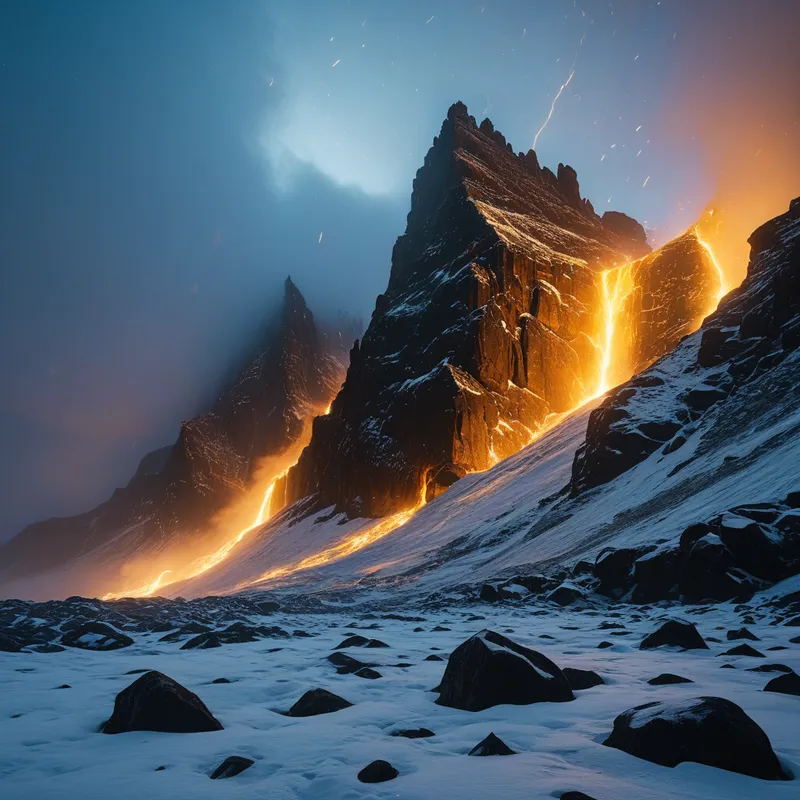
In the Ginnungagap, the searing heat of Muspelheim meets the biting Mist of Niflheim, and from their clash, the first giant and the world are born.
The Tale of The Mist of Niflheim
Listen. Before the sun knew its path, before the winds had names, there was only the Yawning Void—Ginnungagap. A silence so profound it was a sound. A darkness so complete it was a presence.
To the north of this nothing, a realm congealed from that primeval absence: Niflheim, the Home of Mist. It was not a land as we know lands. It was a condition, an eternal principle of cold. From its eleven frozen rivers, the Élivágar, flowed not water, but the essence of frost—a creeping, glittering mist that bit with the teeth of stars and settled into rime as hard as time itself. This was the Mist. It did not move with purpose, for purpose did not yet exist. It simply was: a slow, inevitable exhalation of cosmic cold.
And to the south, an answer formed in the great emptiness: Muspelheim, a realm of unbridled flame and searing light. Its borders were rivers of molten stone; its breath was sparks that would one day become stars.
The Void held its breath. The two absolutes—the utter, active cold of Niflheim and the raging, creative heat of Muspelheim—stretched their fingers toward the center of the Ginnungagap. Where the first tendril of freezing mist met the first wave of radiant heat, a miracle of friction occurred. The mist did not vanish; the fire did not die. They danced a violent, generative dance. The fire’s kiss melted the rime, and the falling drops, warmed by that impossible contact, quickened with life.
From that dripping, steaming confluence in the heart of the void, life stirred. First, the matter of the world itself: the slag and the sediment of the meeting, which became the earth. And from the ice, warmed just enough, emerged a form vast and ancient: Ymir, the first of the frost giants. His sweat, as he slept, bred more giants. The mist and the fire had made a father.
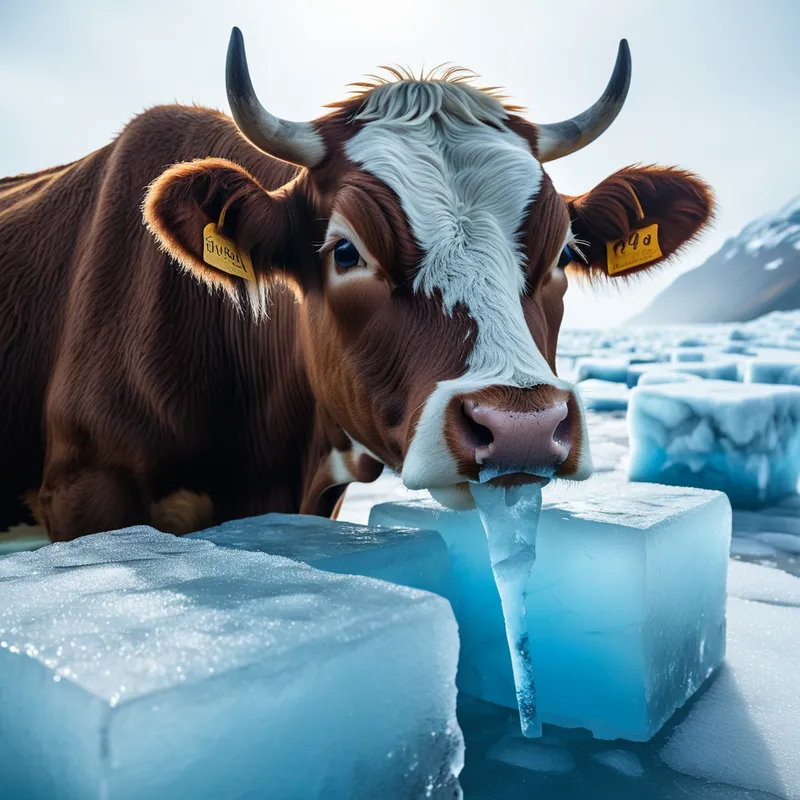
And from the ice of Niflheim came another: Audhumla, a great cow whose milk rivers fed Ymir. She, born of the cold, sought sustenance from it, licking the salty ice blocks. With her warm tongue, she licked for three days. On the first, hair appeared in the ice. On the second, a head. On the third, an entire man, powerful and whole, stepped forth: Buri. From the frozen heart of Niflheim’s mist, licked free by a creature born of the same cold, came the progenitor of the gods.
The mist had done its work. It had provided the raw, frigid substance. The conflict was not a battle, but a courtship. The resolution was not victory, but creation. The world was born not from light alone, but from the essential, aching tension between fire and frost.
Cultural Origins & Context
This myth is not merely a creation story; it is a cosmological map of the Norse mind, preserved in the 13th-century Prose Edda by Snorri Sturluson, drawing from far older oral traditions. For a people intimately acquainted with the life-giving sun and the life-threatening winter, the universe’s origin in a balance of opposing forces was a profound truth. The myth of Niflheim’s mist provided an answer to the most fundamental question: how can something come from nothing?
It was likely told during the long, dark winters, a narrative framework for understanding the environment itself. The mist was not just a poetic device; it was the tangible, freezing fog that crept from the northern seas, the hard frost that killed crops and threatened survival. By placing this familiar, fearsome element at the very beginning of time, the myth dignified the struggle against the cold. It was not an enemy, but a necessary, primordial ingredient. The societal function was one of grounding and orientation. It taught that order (örlög) emerges from chaos through dynamic opposition, and that even the gods themselves are descendants of a process that required the harsh, impersonal reality of the mist.
Symbolic Architecture
The Mist of Niflheim is the archetypal symbol of the Unformed, the Potential, and the Psychically Frozen. It is not evil, but it is profoundly other than life—the necessary inert background against which animation can be perceived.
The mist represents the primordial state of the psyche before the fire of consciousness stirs it—the undifferentiated, cold mass of unlived life, forgotten memories, and frozen potential.
Ginnungagap is the internal void, the sense of meaninglessness or pre-consciousness. The fire of Muspelheim is the eruptive force of desire, spirit, and conscious will. The myth tells us that creation—of a self, a work, a new stage of life—requires this tense meeting. We cannot create from pure, untempered passion (fire alone consumes), nor from pure, detached potential (mist alone is sterile). The giant Ymir, born from the meltwater, symbolizes the first, often chaotic and monstrous, structures of the emerging ego or the burdensome psychic material we inherit. The cow Audhumla, also from the ice, represents the nurturing, sustaining instinct that can, paradoxically, work on the very substance of our coldness to reveal something divine (Buri).
The Dreamer’s Resonance
When the Mist of Niflheim drifts into modern dreams, it manifests as a pervasive, chilling atmosphere of stagnation. The dreamer may find themselves in a grey, soundless landscape where direction is lost. This is not the terror of a monster, but the deeper dread of nullity—the psychic coldness of depression, dissociation, or a life lived on autopilot.
The somatic experience is one of numbness, heaviness, and slowed time. Psychologically, this dream state signals a confrontation with the “frozen” aspects of the self. These are the talents never pursued, the grief never wept, the words never spoken—all preserved in the permafrost of the unconscious. The dream is an invitation, and a necessity. The psyche is presenting its own Ginnungagap, its own void, because the conscious attitude has become too one-sided, too fiery or too rigid. The mist is the compensatory image, calling for the missing opposite to approach so that a new drip of life can form.
Alchemical Translation
The individuation process, the journey toward psychic wholeness, follows the exact pattern of this myth. We begin, often, in a state of inner Niflheim: a cold, foggy confusion about who we are, feeling trapped in frozen patterns of behavior or emotion.
The alchemical work is to courageously invite the fire of Muspelheim—the heat of intense feeling, passionate inquiry, or conscious suffering—into contact with that inner frost.
This is the coniunctio oppositorum. It is not a gentle thaw, but a violent, generative clash. The “giant” that emerges first is often the shadow—the ugly, chaotic, or overwhelming aspect of ourselves previously locked in ice (like Ymir). We must acknowledge and “feed” this giant with attention (Audhumla’s milk) before the deeper work can begin. Then, through sustained, nurturing attention (Audhumla licking the ice), we patiently work on the frozen core of our being. This is the slow, often tedious work of therapy, introspection, or artistic creation—licking away the salty rime of defense and trauma day by day.
What is revealed is Buri, the ancestral god, the authentic, foundational Self that was there all along, imprisoned in the condition of cold. The Mist of Niflheim, therefore, is not something to be eradicated, but the essential raw material of our becoming. Our deepest, most frozen wounds and our most inert potentials are the very ice from which our truest form is slowly, lovingly, and painfully released.
Associated Symbols
Explore related symbols from the CaleaDream lexicon: