The Mirror-Like Wisdom Myth Meaning & Symbolism
A myth of a celestial mirror that reveals all things as they are, teaching the virtue of a mind that reflects without grasping or judging.
The Tale of The Mirror-Like Wisdom
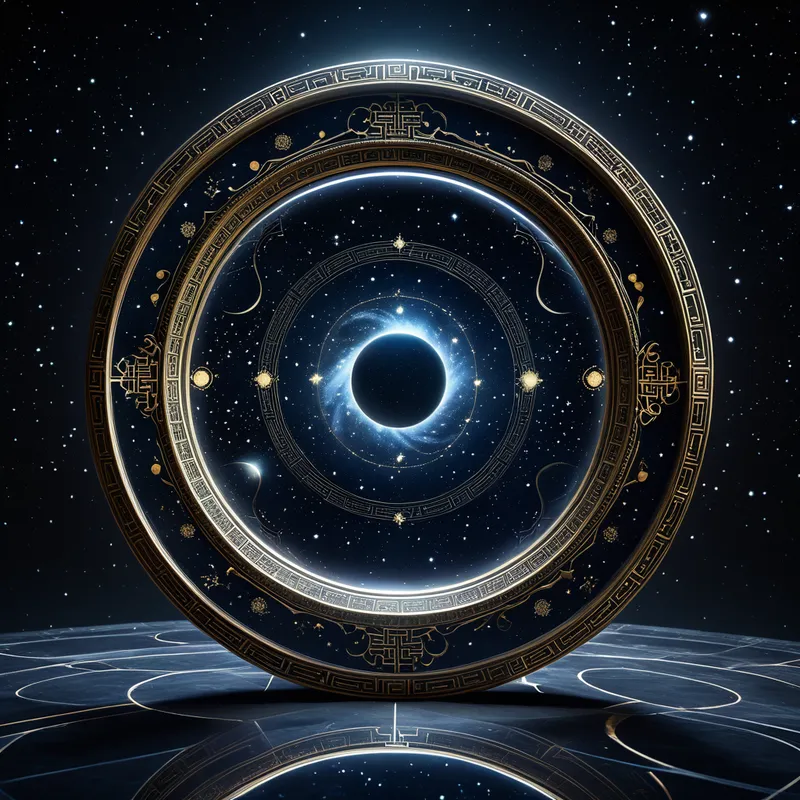
Before the ten thousand things had found their names, in the great stillness that precedes the breath of the Dao, there existed a chamber at the heart of the celestial palace. It was not a chamber of gold or jade, but of perfect, resonant silence. And within it hung the Wuji Mirror.
It was vast, its frame forged from the bones of collapsed stars and its surface a pane of darkest obsidian, deeper than the midnight between worlds. It did not glow. It did not call. It simply was. The Celestial Artisan, an entity whose form was that of shifting smoke and patient erosion, attended to it. Their work was not creation, but the meticulous un-creation of dust. With a cloth woven from the sighs of finished epochs, they would polish the surface, not to make it shine, but to ensure it remained utterly, devastatingly clear.
For eons, [the mirror](/myths/the-mirror “Myth from Various culture.”/) hung, reflecting nothing, for there was nothing to reflect but the pure potential of [the void](/myths/the-void “Myth from Buddhist culture.”/). Then, the Taiji stirred. [Yin and Yang](/myths/yin-and-yang “Myth from Chinese culture.”/) spiraled into being. Stars ignited. Worlds coalesced. And as each new [thing](/myths/thing “Myth from Norse culture.”/) burst into existence, its image flew across the cosmos and came to rest upon the surface of the Wuji Mirror.
Here was the miracle: the mirror received all. The blazing fury of a newborn sun, the silent growth of a mountain root, the fleeting joy of a mortal laugh, the intricate despair of a dying empire—all found perfect, instantaneous reflection. Yet, when the event passed, the image vanished. The mirror held no memory. It cherished no favorite sight, recoiled from no horrific vision. It displayed the glory of a peacock’s fan and the carnage of a battlefield with the same impeccable, silent fidelity.
The other celestial powers grew perplexed, then uneasy. The Mirror of All Things, they called it, but it seemed to them a heartless thing. “Why does it not rejoice in beauty?” asked the Spirit of Festivals, her form bright with lantern light. “Why does it not weep at tragedy?” murmured the Keeper of Lamentations, his robes damp with tears. They petitioned the Celestial Artisan. “Give it a heart! Let it judge, let it prefer, let it remember the good and discard the evil!”
The Artisan, whose movements were as slow as continental drift, ceased their polishing. They spoke, and their voice was the sound of wind over a bare plateau. “To judge is to distort. To prefer is to blind one eye. To remember is to cloud the surface with the ghosts of what was, obscuring the truth of what is.”
To demonstrate, the Artisan summoned a vision: a lush, perfect valley. The spirits sighed with pleasure. Then, upon the mirror, a wildfire swept through the valley, leaving charred desolation. The spirits cried out in horror, their own emotions painting the chamber with grief. But on the mirror’s surface, even as the blackened trees were reflected, a single green shoot was already visible, pushing through the ash. The mirror showed the destruction and the renewal in the same unwavering frame. It held the totality without partiality.
The lesson echoed in the silent chamber. The mirror’s wisdom was not in doing, but in receiving. Not in changing the reflection, but in ensuring the surface was clear enough to reflect it perfectly. Its power was its profound, unshakeable stillness. It became known as the Mirror-Like Wisdom, the mind of the Dharmakaya, which sees all phenomena as they arise and pass without ever being stained by them. And so it hangs still, in the heart of the unseen palace, the silent witness to the ten thousand joys and the ten thousand sorrows, forever clear, forever empty, forever full.
Cultural Origins & Context
The concept of Mirror-Like Wisdom, while most systematically elaborated in Yogacara and Vajrayana Buddhist philosophy, found a profound and resonant home within the syncretic and philosophical streams of later Taoist thought, particularly during the Tang and Song dynasties. It is less a single, codified “myth” with characters and plot, and more a deep, recurring metaphor for the ideal state of consciousness, often discussed by Taoist adepts and philosophical texts.
It was transmitted not by bards to crowds, but from master to disciple in quiet gardens and mountain hermitages. A master might point to a still pond and say, “See how it holds [the sky](/myths/the-sky “Myth from Persian culture.”/)? Yet when [the wind](/myths/the-wind “Myth from Various culture.”/) comes, it loses [the sky](/myths/the-sky “Myth from Persian culture.”/). When the mud stirs, it loses itself. Your mind must become like the ancient mirror at the beginning of heaven and earth.” Its societal function was esoteric and transformative, aimed at the individual’s spiritual cultivation (Xiu Yang). It served as a core instruction for achieving [Wu Wei](/myths/wu-wei “Myth from Taoist culture.”/)—action that arises from a perception unclouded by personal desire, aversion, or intellectual categorization.
Symbolic Architecture
The myth’s power lies in its stark, beautiful [symbolism](/symbols/symbolism “Symbol: The use of symbols to represent ideas or qualities, often conveying deeper meanings beyond literal interpretation. In dreams, it’s the language of the unconscious.”/). The mirror is not a tool for vanity, but an [organ](/symbols/organ “Symbol: An organ symbolizes vital aspects of life and health, often representing one’s emotional or physical state.”/) of [perception](/symbols/perception “Symbol: The process of becoming aware of something through the senses. In dreams, it often represents how one interprets reality or internal states.”/). Its darkness is not [emptiness](/symbols/emptiness “Symbol: Emptiness signifies a profound sense of void or lack in one’s life, often related to existential fears, loss, or spiritual quest.”/), but pure potentiality—the Wuji before the polarities of Yin and Yang emerge.
The mirror does not ask if the image is beautiful or ugly; it only asks if the surface is clear.
The Celestial Artisan represents the disciplined, ceaseless work of introspection and [meditation](/symbols/meditation “Symbol: Meditation represents introspection, mental clarity, and the pursuit of inner peace, often providing a pathway for deeper self-awareness and spiritual growth.”/)—the “polishing” of the mind. The [dust](/symbols/dust “Symbol: Dust often symbolizes neglect, forgotten memories, or the passage of time and life’s impermanence.”/) is our afflictions: our clinging attachments, our rigid judgments, our cherished narratives about ourselves and [the world](/myths/the-world “Myth from Tarot culture.”/). The other celestial spirits symbolize the ordinary, reactive mind that seeks to categorize and control experience, to live in a curated [reality](/symbols/reality “Symbol: Reality signifies the state of existence and perception, often reflecting one’s understanding of truth and life experiences.”/) rather than the true one.
The core psychological representation is the [achievement](/symbols/achievement “Symbol: Symbolizes success, mastery, or reaching a goal, often reflecting personal validation, social recognition, or overcoming challenges.”/) of what modern [psychology](/symbols/psychology “Symbol: Psychology in dreams often represents the exploration of the self, the subconscious mind, and emotional conflicts.”/) might call the observing self or decentered [awareness](/symbols/awareness “Symbol: Conscious perception of self, surroundings, or internal states. Often signifies awakening, insight, or heightened sensitivity.”/). It is the part of [consciousness](/symbols/consciousness “Symbol: Consciousness represents the state of awareness and perception, encompassing thoughts, feelings, and experiences.”/) that can witness thoughts, emotions, and sensations without immediately identifying with them, without being hijacked by them. The mirror-like mind does not suppress the [wildfire](/symbols/wildfire “Symbol: A powerful natural force symbolizing rapid, uncontrollable change, destruction, and renewal.”/) of anger or the blooming of joy; it fully acknowledges their [presence](/symbols/presence “Symbol: Presence in dreams often signifies awareness or acknowledgment of something significant in one’s life.”/), allowing them their natural [life](/symbols/life “Symbol: The symbol of ‘Life’ represents a journey of growth, interconnectedness, and existential meaning, encompassing both the joys and challenges that define human experience.”/) cycle on its surface, without letting them dictate its fundamental [nature](/symbols/nature “Symbol: Nature symbolizes growth, connectivity, and the primal forces of existence.”/).
The Dreamer’s Resonance
When this myth stirs in the modern unconscious, it often manifests in dreams of reflection and clarity—or the terrifying lack thereof. A dreamer may find themselves before a mirror that does not show their face, but instead shows a scene of perfect, objective truth about a life situation. They may dream of cleaning a window with immense effort, scraping away grime to finally see a stunning landscape, symbolizing the clearing of psychic distortion.
Conversely, they may dream of mirrors that are cracked, fogged, or warped, reflecting grotesque or fragmented versions of themselves. This is the somatic signal of a [psyche](/myths/psyche “Myth from Greek culture.”/) clouded by [projection](/myths/projection “Myth from Alchemical culture.”/) and identification. The dream is presenting the conflict between [the ego](/myths/the-ego “Myth from Jungian culture.”/)’s distorted self-image and the soul’s yearning for the clear reflection of the Mirror-Like Wisdom. The psychological process is one of dis-identification—a painful but necessary shedding of the stories we tell ourselves to face the raw, unfiltered data of our existence and our actions.

Alchemical Translation
The individuation process modeled here is the alchemy of perception itself. The “base metal” is the conditioned, reactive mind—the mind that, like the protesting spirits, wants to judge, cling, and avert. The “gold” is the mirror-like awareness.
[The first stage](/myths/the-first-stage “Myth from Alchemical culture.”/) is Polishing ([The Nigredo](/myths/the-nigredo “Myth from Alchemical culture.”/)): This is the dark work. It involves facing the “dust” of our shadow—the repressed emotions, the denied truths, the biases we mistake for reality. This is often experienced as depression, confusion, or a sense of dissolution, as the old, familiar self-image begins to blur.
The second is Reflecting Without Grasping (The Albedo): As the surface clears, one must learn the discipline of pure observation. A feeling arises—rage, grief, ecstasy—and instead of becoming it (“I am angry”), one learns to host it (“Anger is present”). This is not cold detachment, but a profound, compassionate space that allows all things to be as they are.
The ultimate transmutation is not of lead into gold, but of experience into wisdom, without a single atom of experience sticking to the vessel.
The final stage is Spontaneous Right Action ([The Rubedo](/myths/the-rubedo “Myth from Alchemical culture.”/)): From this clear reflection, action arises that is perfectly attuned to the situation, not to the ego’s agenda. This is the embodiment of Wu Wei. The individual becomes a conduit for the Dao, their mind a still mirror in the celestial chamber, reflecting the world with terrifying clarity and responding to it with impeccable, effortless grace. The psyche is no longer a fortress to be defended, but a clear, open space through which the totality of life can flow.
Associated Symbols
Explore related symbols from the CaleaDream lexicon: