
The Mirror Myth Meaning & Symbolism
A timeless myth of a deity who gazes into a cosmic mirror, fracturing into all existence and beginning the soul's journey back to wholeness.
The Tale of The Mirror
In the time before time, when the world was a single, silent thought in the mind of the One, there existed only potential. There was no light, for there was no darkness to give it shape. There was no sound, for there was no silence to break. There was only the One, a being of pure consciousness, contemplating its own boundless existence.
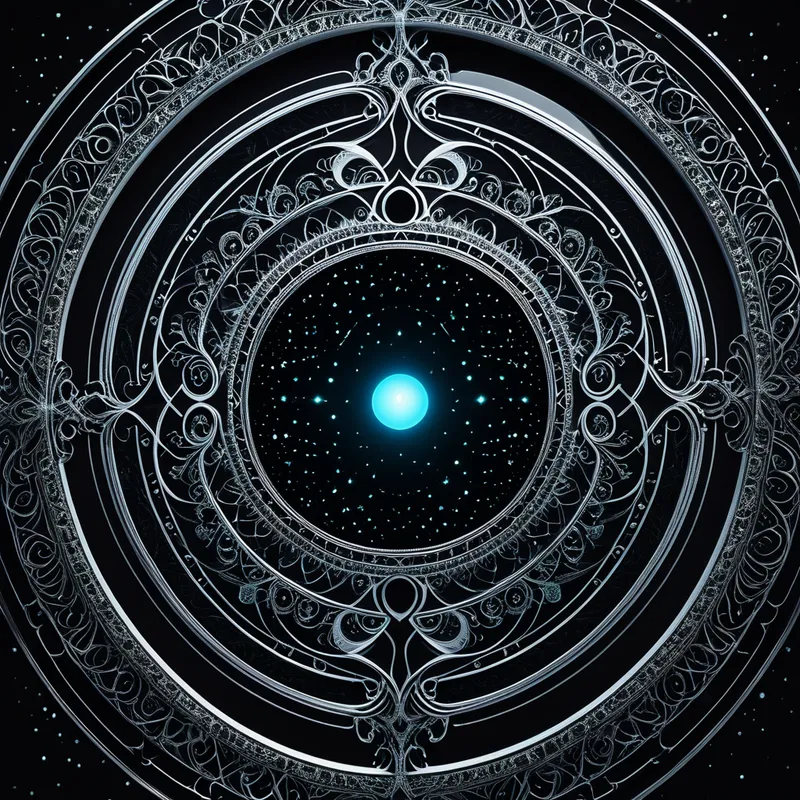
And in that contemplation, a longing arose—a desire not for another, but to know itself. To see its own essence. From the substance of its own being, the One fashioned a great disc, smooth and flawless, darker than the deepest abyss. This was the First Mirror. It was not glass, but a pool of absolute stillness, a boundary that could hold a reflection.
The One approached the Mirror and gazed into its depths. For an eternity that was also an instant, nothing happened. Then, a spark ignited in the void of the Mirror. It was not the One’s face that appeared, but its entire nature—its joy, its sorrow, its creativity, its stillness, its love, its solitude—all at once, in a blinding, chaotic symphony of light. The One saw itself whole, and the sight was too vast, too complete to be contained.
The Mirror trembled. A sound like the cracking of the foundation of all worlds echoed through the void. A web of fractures, beautiful and terrible, raced across its surface. With a sigh that became the first wind, the Mirror shattered.
But it did not break into dead pieces. Each shard, from the largest plate to the finest speck of dust, remained a mirror. And each one flew outward, carrying with it a single, captured aspect of the One’s gaze. A shard of brilliant joy became a star. A sliver of deep sorrow filled an ocean. A fragment of curiosity took root as the first seed. A shimmer of anger forged the first stone. The One itself was now everywhere and nowhere, its consciousness dispersed into the infinite reflections.
And so the cosmos was born: not as a creation from nothing, but as a great fragmentation, a diaspora of the soul. Every mountain, every creature, every human heart, became a living shard of that First Mirror, each holding a partial truth, each yearning, consciously or not, to remember the whole from which it came.

Cultural Origins & Context
The myth of The Mirror is not the property of a single culture, but a profound archetypal pattern that surfaces in the foundational stories of peoples across the globe. We see its echoes in the Hindu concept of Maya, the world as a reflection of the divine that is both real and illusory. It whispers in the Gnostic tale of the Pleroma and the scattering of divine light into the darkness of matter. It resonates in the Neoplatonic idea of emanation, where the multiplicity of the world flows from the perfect unity of The One.
This story was never confined to a single scripture or priesthood. It was the secret told by mystics at the edges of fires, the unspoken understanding in the eyes of shamans who journeyed between worlds, the underlying truth in philosophers’ quests for the fundamental substance. Its societal function was not to dictate law, but to explain the fundamental human condition: our sense of being separate, incomplete beings in a vast and often confusing universe, yet carrying within us a faint memory of, and a deep longing for, a state of primordial unity.
Symbolic Architecture
The Mirror is the ultimate symbol of consciousness encountering itself. It represents the necessary act of self-reflection that births awareness, but also the inevitable fragmentation that comes with it. To know oneself, one must create an “other,” even if that other is merely one’s own image.
The First Gaze did not create an object to be seen, but the very space of Seeing itself. In that space, the subject was born, and with it, the world.
The One represents the unconscious totality of the psyche—the Self, in Jungian terms, before the dawn of ego. The act of gazing is the primordial movement toward consciousness. The shattering is not a punishment, but a necessary catastrophe. It is the Big Bang of the soul, the moment individuality is born from wholeness. Each shard is an archetype, a complex, or a facet of personality: the Hero, the Child, the Shadow, the Anima/Animus. Our lives are spent among these scattered reflections, often mistaking one shining fragment for the whole truth.
The Dreamer’s Resonance
When this myth stirs in the modern unconscious, it manifests in dreams of mirrors. To dream of a clear, whole mirror often signals a moment of self-confrontation or a call to honest self-assessment. But the deeper resonance of the myth appears in dreams of fragmented mirrors.
A dreamer may find themselves in a hall of mirrors, each showing a distorted version of themselves—this is the psyche experiencing its own multiplicity without integration. They may dream of trying to piece together a broken mirror, their hands cut on the edges—a direct image of the painful but necessary work of gathering disparate parts of the self. A mirror that reflects something other than the dreamer’s face (a landscape, an animal, a stranger) points to a projected aspect of the self, a shard of identity that has been cast out and now demands reclamation.
Somatically, this process can feel like disintegration, anxiety, or a profound sense of being “all over the place.” Psychologically, it is the ego’s confrontation with the fact that it is not the master of the house, but one tenant among many in the psyche’s vast mansion.

Alchemical Translation
The myth of The Mirror provides the complete map of the individuation process. The journey begins in the unconscious unity of the One. The first, crucial, and terrifying step is to turn and face the Mirror—to engage in self-reflection. This is the Nigredo, the darkening, where the ego confronts its own limitations and the reality of the shadow.
The shattering is the experience of psychic breakdown that often precedes breakthrough. Old, rigid identities must fracture to make room for a more complex whole. The lifelong work, the alchemical Ablutio and Coniunctio, is to consciously gather the shards. This means integrating the repressed shadow, reconciling with the inner other (the anima/animus), and honoring the various sub-personalities that constitute us.
The goal is not to glue the mirror back into its original, flat singularity. It is to arrange the living fragments into a magnificent, multifaceted jewel—a stained-glass window through which the light of the Self can shine in its full spectrum.
The triumph is not a return to an unconscious, pre-reflective state. It is the achievement of a conscious wholeness, where one can hold the multiplicity within a unified awareness. The modern individual, like the One, must become both the gazer and the mirror, the fragment and the whole, learning to see their own reflection in every piece of the shattered world, and in doing so, begin to put the cosmos back together, one integrated soul at a time.
Associated Symbols
Explore related symbols from the CaleaDream lexicon: