The Microcosm-Macrocosm Myth Meaning & Symbolism
An alchemical tale where the human soul, a perfect reflection of the cosmos, must descend into its own depths to heal the universal rift and achieve unity.
The Tale of The Microcosm-Macrocosm
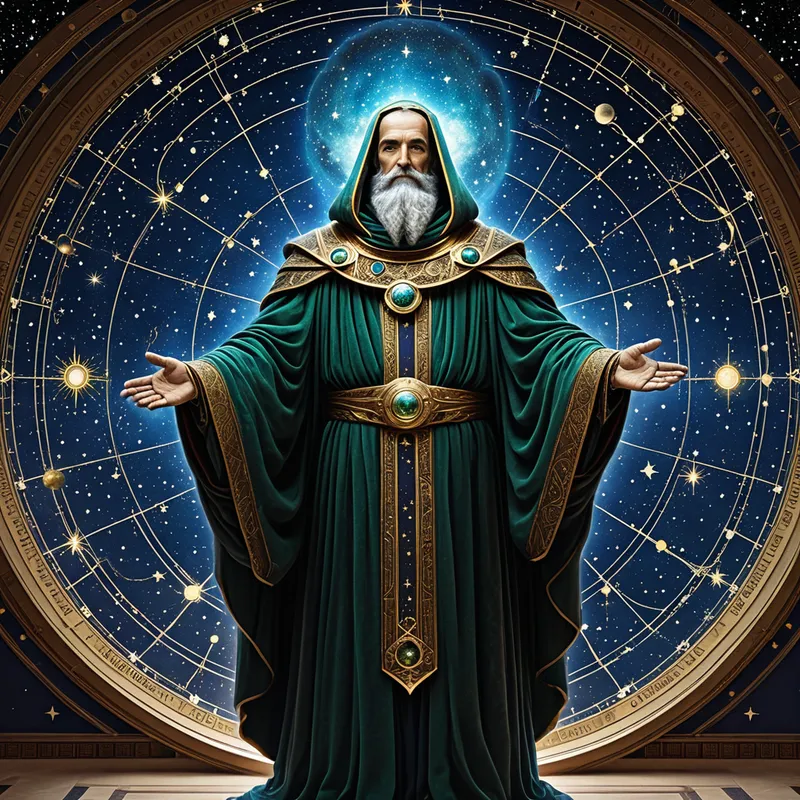
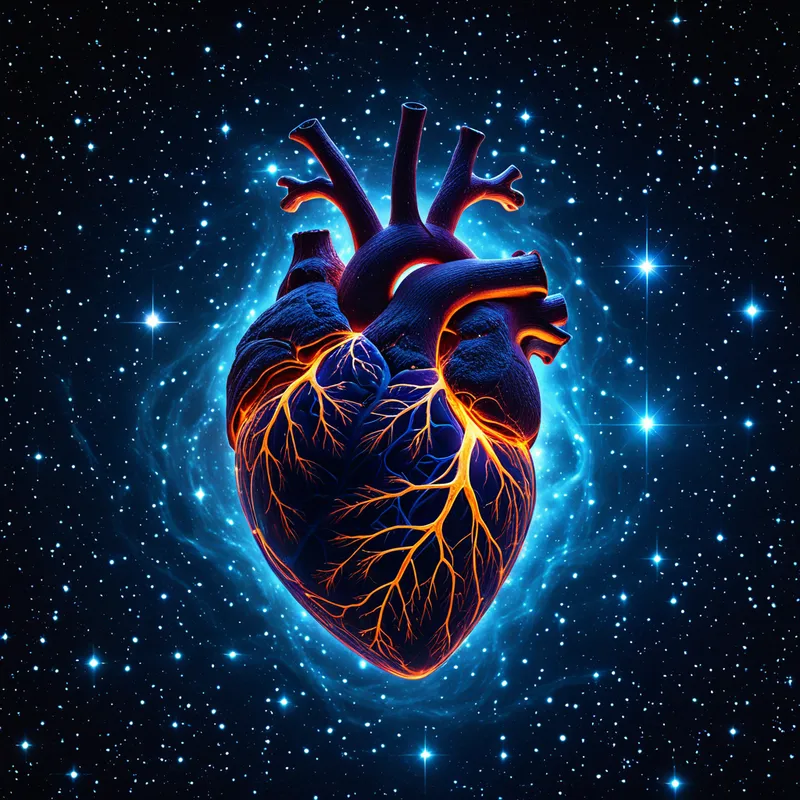
Listen, and hear the tale not written on parchment, but etched in the salt of your blood and the fire of your breath. In the beginning, before time was a spiral, there was only the One Breath, the Anima Mundi, exhaling the cosmos into being. From this breath, two mirrors were forged: one vast, cold, and glittering with distant suns—the Macrocosm. The other, small, warm, and pulsing with a secret fire—the Microcosm. They were perfect reflections. The dance of planets was the rhythm of the heart. The ocean’s tide was the ebb and flow of breath. The forge of stars was the belly’s digesting fire.
But a silence fell, a forgetting. The human, the Microcosm, grew enamored with its own reflection in still ponds and polished brass, seeing only its solitary form, not the constellations swirling within its own eyes. It turned its gaze outward, seeking the cosmos in the sky above, and in doing so, broke the sacred gaze. A crack, finer than a hair, splintered through the glass of reality. The harmony faltered. In the Macrocosm, a star sickened and died before its time. In the Microcosm, a new kind of chill entered the soul—a loneliness, a sense of being orphaned in a vast, indifferent vault.
The Spiritus wept, and its tears became the rain that no longer nourished. The Anima hid her face, and the moon grew cold. A whisper traveled the ley lines of the world: “As above, so below. The wound in one is the wound in all. The healer of one is the healer of all.”
And so the call came, not as a trumpet blast, but as a sinking feeling in the gut, a pull downward, not upward. It came to the Seeker, one who felt the discord as a constant, quiet ache behind the breastbone. Guided by dreams of descending staircases and roots seeking dark soil, the Seeker left the sunlit world. They entered the Vas Hermeticum of their own being—the cave of the psyche, the labyrinth of the viscera.
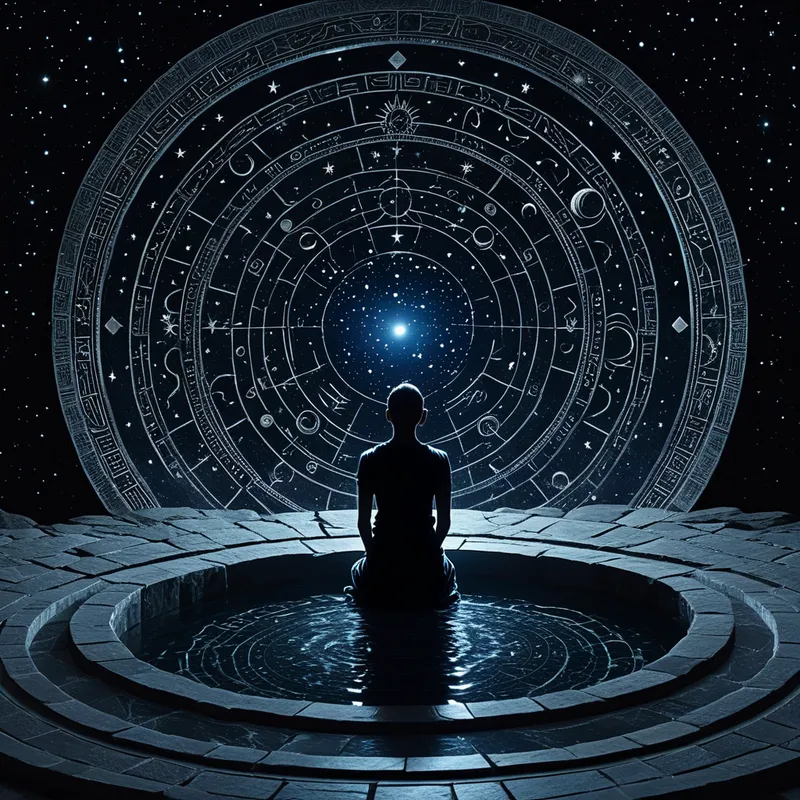
Here, in the profound blackness, there was no sky to look upon. There was only the inner firmament. The Seeker encountered the Prima Materia of their soul: shapeless fears, molten passions, the heavy lead of regret. They did not fight these shadows. Instead, with a courage born of despair, they knelt and gazed into the darkest pool they could find—the black, Nigredo-tinted waters of their own forgotten depths.
And in that black mirror, they did not see their own face. They saw the dying star. They saw the choked river. They saw the broken symmetry of the cosmos, and they knew, with a shock that was both terror and ecstasy, that it was their own fracture they witnessed. The chaos “out there” was the chaos in here. In that moment of horrific recognition, the first alchemical fire—the Calcination of the ego—was lit. The Seeker wept, and their tears, falling into the black pool, began to stir it. The act of seeing the connection, of bearing the truth, was the first medicine.
Cultural Origins & Context
This is not a myth of a single culture or epoch, but the bedrock of the Western alchemical tradition, spanning from Hellenistic Alexandria through the Islamic Golden Age to the Renaissance workshops of Europe. It was never a single story told around a fire, but a living, operative philosophy passed down in encrypted texts like the Tabula Smaragdina, in intricate woodcut illustrations, and through the master-apprentice chain of the art. Its tellers were not bards, but adepts and puffers laboring in smoky laboratories, who saw their retorts and alembics as models of the cosmic and human body.
Its societal function was dual. Exoterically, it provided a metaphysical framework for natural philosophy, linking human physiology to astronomy and chemistry. Esoterically, and more importantly, it was a map for inner transformation. In an age where the Church dictated the soul’s journey, alchemy offered a parallel, experiential path to redemption—one conducted not in a cathedral, but in the silent oratorium of the heart and the laboratory of the mind. It preserved a gnostic thread: salvation through self-knowledge, where knowing the self in its deepest, most chaotic state was knowing the divine architecture of the All.
Symbolic Architecture
The myth’s core symbol is the mirror. But this is no ordinary glass; it is a living, dynamic membrane of correspondence.
The Macrocosm is the soul writ large; the Microcosm is the cosmos drawn small. To look at one without seeing the other is the root of all alienation.
The Macrocosm represents the objective psyche, the collective unconscious, the totality of external reality and its laws. The Microcosm is the subjective, individual consciousness. The “crack” symbolizes the dawn of ego-consciousness—a necessary but painful separation from the unconscious unity, which creates the experience of a split between inner and outer, self and world, spirit and matter.
The Seeker’s descent is the critical movement. It inverts the heroic urge to ascend and conquer. The true quest is downward, into the shadow, the body, the forgotten and repressed. The black pool of Nigredo is the mirror of self-confrontation. To see the cosmic rift in one’s own soul is to achieve the unio mentalis, the mental union where projection ceases. The outer chaos is recognized as an aspect of the inner condition.
The Dreamer’s Resonance
When this myth stirs in the modern dreamer, it announces a profound process of psychic re-integration. You may dream of your body transforming into a landscape—your ribs a cave system, your bloodstream a map of rivers. You may look in a mirror and see a starfield or a rotting forest. You may have the somatic sensation of being unbearably heavy, as if made of lead (the alchemical Saturn), or of a crushing pressure, the vas sealing.
These are not mere fantasies. They are the psyche’s symbolic enactment of the Microcosm-Macrocosm realignment. The feeling of weight is the confrontation with embodied, material reality—the “lead” of your actual life circumstances and history. The mirror visions signal the breakdown of the persona, the constructed self, revealing the vast, often terrifying, archetypal realities operating beneath it. The dream is initiating a Lavatio, a psychic cleansing where the artificial boundary between “personal problems” and “the state of the world” begins to dissolve. You are being asked to carry the tension of the opposites—the personal and the transpersonal—without fleeing into spiritual bypassing or materialist nihilism.
Alchemical Translation
For the modern individual, this myth models the path of individuation not as a glorified self-improvement project, but as a cosmic duty. The laboratory is your own life. The prima materia is your raw experience—your trauma, your joy, your relationships, your work.
The first operation is not to change the world, but to see how the world’s suffering is embedded in the very structure of your own perceptions and reactions.
The “descent” is the commitment to shadow-work, to therapy, to honest introspection, to feeling the full weight of your emotions and history without anesthetic. The “crack” you seek to heal is the split within yourself—between mind and body, spirit and instinct, ideal self and actual self. As you work to integrate these fragments, you are, according to the alchemical conviction, performing an operation on the fabric of reality itself. Your increased inner order subtly alters your participation in the collective field.
The ultimate goal is the production of the Lapis Philosophorum, the Philosopher’s Stone. In psychological terms, this is the achieved Self, the central, unified archetype of wholeness. The individual who has undergone this process becomes a living stone—a grounded, embodied point of consciousness that consciously reflects the whole. They become a stabilized Microcosm, through which the Macrocosm can know and repair itself. Your personal healing is not separate from the healing of the world; it is the very locus where that healing becomes possible. You become the vessel where above and below finally remember they are one.
Associated Symbols
Explore related symbols from the CaleaDream lexicon: