The Market Myth Meaning & Symbolism
A mythic entity of ceaseless exchange where souls are weighed and transformed, embodying the alchemy of value, desire, and collective fate.
The Tale of The Market
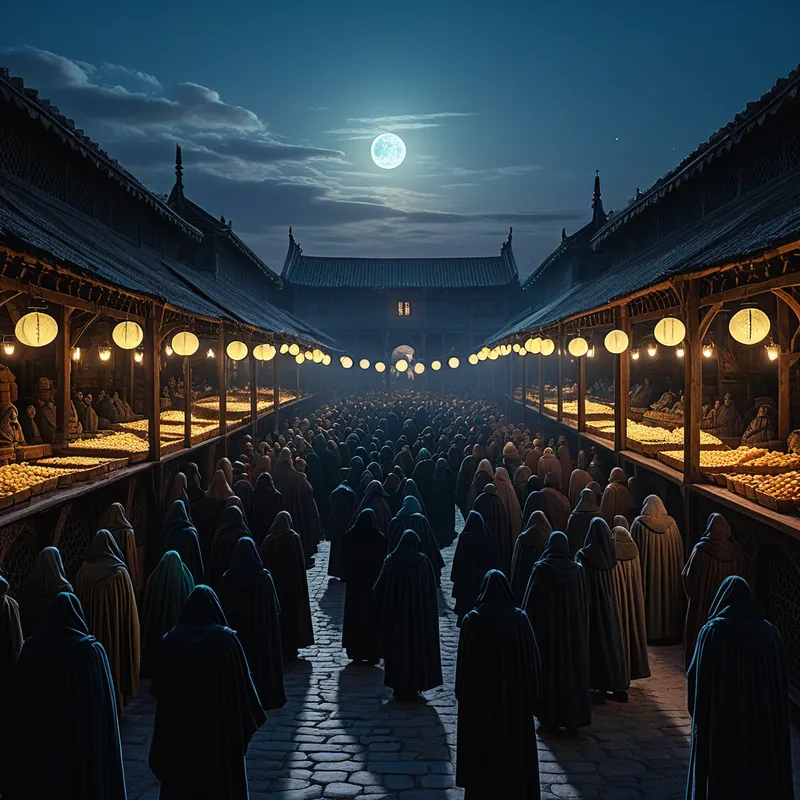
Listen. There is a place that is no place, a time that is all times. It exists in the breath between question and answer, in the hollow of a hand held out in hope. They call it The Market.
It is not built of stone or wood, but of longing and calculation. Its aisles are paved with whispered promises and the silent arithmetic of eyes. A great, formless roof stretches overhead, woven from the collective breath of every soul who has ever thought, “If I give this, what might I receive?” The air hums, thick with the scent of spices yet to be ground, of rain yet to fall on distant fields, of metal that dreams of becoming coin.
Here, the vendors are not mere men and women. They are The Assessors. Their faces shift like dunes in a desert wind—one moment a shrewd-eyed grandmother weighing grain, the next a sharp-suited trader watching numbers dance. They do not sell fruits or fabrics. They trade in potential. On their tables lie not objects, but the ghostly after-images of things: the shimmer where a vase once stood, the echo of a song’s first note, [the shadow](/myths/the-shadow “Myth from Jungian culture.”/) cast by a future harvest.
The people come, drawn from all corners of [the world](/myths/the-world “Myth from Tarot culture.”/)-dream. They arrive bearing their treasures: a memory of perfect love, a skill honed by ten thousand hours, an heirloom of bitter pride, a raw lump of untamed talent. They lay them before The Assessors. And the haggling begins—not with words, but with a profound, silent exchange of essence. A woman offers her courage; The Assessor holds it to the strange light of The Market, and it may glow like a sun or dull like lead. A man surrenders his time; it pools on the table like [mercury](/myths/mercury “Myth from Roman culture.”/), dividing and re-forming.
The great drama is the dance of value. Nothing has a fixed price. The worth of a [thing](/myths/thing “Myth from Norse culture.”/)—a vow, a discovery, a tear—swells and crashes like a tide governed by a hidden moon. One may trade a handful of seeds and receive a forest. Another may offer a kingdom and receive a single, perfect stone of no apparent worth. The only constant is the transaction itself, the sacred, terrifying moment of release and reception.
The climax is always a transformation. You cannot leave with what you brought. You enter with a possession and leave with a relationship—to the object gained, to [the self](/myths/the-self “Myth from Jungian culture.”/) that chose it, to the web of The Market itself. The final act is not a purchase, but a metamorphosis. The seeker walks out through the shimmering veils that serve as gates, and [the thing](/myths/the-thing “Myth from Norse culture.”/) they have gained—be it a jewel of wisdom or a burden of insight—fuses with their very breath. They are, and are not, the same person. The Market has digested their offering and given them a new piece of the world in return.
And so it hums, eternal. A living organism built on the twin pulses of desire and release, where every soul is both merchant and merchandise, forever participating in the great, silent bargain of being.
Cultural Origins & Context
The myth of The Market does not belong to a single scroll or tribe. It is a folkloric rhizome, emerging independently wherever human communities gathered to exchange more than just goods. Its earliest whispers are in the smoke of prehistoric campfires where shells and stories changed hands. It solidified in the ancient agora of Greece, the bustling fora of Rome, the [Silk Road](/myths/silk-road “Myth from Chinese culture.”/) caravanserais, and the medieval fairgrounds where money, news, and heresy were traded with equal fervor.
It was never a formal, priestly myth. It was carried by merchants, travelers, smugglers, and housewives. It was told not to explain the gods, but to explain them—the uncanny forces that seemed to govern daily survival. Why did the grain price soar when the harvest was good? Why did a family’s fortune vanish overnight? The myth provided a cosmology: there was a greater, invisible Market whose tides dictated the smaller ones. It was passed down in proverbs, bargaining rituals, and in the shared, superstitious glance between traders when a deal felt “blessed” or “cursed.”
Its societal function was one of meaning-making and social cohesion. It transformed the anxiety of random fortune into a narrative of participation in a vast, if inscrutable, system. To suffer a loss was not mere bad luck; it was a transaction with this greater entity, perhaps a debt paid for a past unseen gain. It taught that all value is relational and contextual, a crucial philosophy for any complex society built on trust and abstract promise.
Symbolic Architecture
At its core, The Market is the archetypal [symbol](/symbols/symbol “Symbol: A symbol can represent an idea, concept, or belief, serving as a powerful tool for communication and understanding.”/) of the psychic exchange principle. It represents the fundamental [human](/symbols/human “Symbol: The symbol of a human represents individuality, complexity of emotions, and social relationships.”/) [condition](/symbols/condition “Symbol: Condition reflects the state of being, often focusing on physical, emotional, or situational aspects of life.”/) of existing in a network of value-laden relationships, where nothing is intrinsic but everything is potential.
The Market is the stage where the soul meets its own shadow, priced in the currency of the world.
The Assessors symbolize the internal and external judges we all carry—the parental voices, societal expectations, and our own superego that appraise our worth. The shifting prices reflect the painful, liberating [truth](/symbols/truth “Symbol: Truth represents authenticity, honesty, and the quest for knowledge beyond mere appearances.”/) of psychological [reality](/symbols/reality “Symbol: Reality signifies the state of existence and perception, often reflecting one’s understanding of truth and life experiences.”/): our virtues in one context become vices in another; a wound can become a wellspring.
The central [ritual](/symbols/ritual “Symbol: Rituals signify structured, meaningful actions carried out regularly, reflecting cultural beliefs and emotional needs.”/) of trade—giving one thing to get another—is the symbol of sacrifice and [choice](/symbols/choice “Symbol: The concept of choice often embodies decision-making, freedom, and the multitude of paths available in life.”/), the engine of psychological development. You cannot keep your [innocence](/symbols/innocence “Symbol: A state of purity, naivety, and freedom from guilt or corruption, often associated with childhood and moral simplicity.”/) and gain experience. You cannot clutch your grievance and receive [peace](/symbols/peace “Symbol: Peace represents a state of tranquility and harmony, both internally and externally, often reflecting a desire for resolution and serenity in one’s life.”/). The Market demands a [payment](/symbols/payment “Symbol: Symbolizes exchange, obligation, and value. Represents what one gives to receive something in return, often tied to fairness, debt, or spiritual balance.”/) of psychic [energy](/symbols/energy “Symbol: Energy symbolizes vitality, motivation, and the drive that fuels actions and ambitions.”/), a letting go, for any new state of being to be acquired.

The Dreamer’s Resonance
When The Market appears in modern dreams, it often signals a profound process of somatic accounting. The dreamer is unconsciously weighing a life choice, a relationship, or a career path.
Dreaming of being lost in a vast, overwhelming market suggests anxiety about one’s value in the social or professional sphere, a fear of being a commodity. Haggling desperately over a price points to an inner conflict where the dreamer feels they are giving too much (time, energy, love) for too little in return. Finding a priceless item for a pittance can indicate the discovery of an undervalued talent or aspect of the self.
The somatic experience is key. The gut-churn of a bad deal, the elated lightness of a fair exchange—these are the body speaking the language of the myth. Such dreams ask the fundamental question: What transaction am I currently engaged in with my own life? Is the exchange equitable, or am I trading gold for dross?

Alchemical Translation
The myth of The Market is a precise map for the alchemical process of individuation. The seeker entering The Market is the [prima materia](/myths/prima-materia “Myth from Alchemical culture.”/)—the unrefined self with all its raw assets and burdens.
The first great work is to bring your hidden ore to the stall of assessment, to see it not as you wish it to be, but as it is valued by the cold, neutral light of consciousness.
The haggling with The Assessors represents the confrontation with the shadow and the collective voices. This is the [nigredo](/myths/nigredo “Myth from Alchemical culture.”/), the blackening, where one’s cherished self-image is challenged and devalued. The fluctuating prices mirror the painful dissolution of fixed identities.
The transformation upon leaving is the albedo and [rubedo](/myths/rubedo “Myth from Alchemical culture.”/)—the whitening and reddening. The acquired “object,” now integrated, is the philosopher’s stone. It might be the burden of consciousness (the perfect stone) or the liberation of a new perspective (the forest from seeds). The key is that the self has participated in a cosmic law of exchange and has been fundamentally altered by it. One has moved from being a passive object of fate to an active agent in a dynamic, meaningful system of psychic economy. The ultimate transaction is the trading of the illusion of static security for the authentic, perilous, and vibrant currency of a self-authored life.
Associated Symbols
Explore related symbols from the CaleaDream lexicon: