
The Mark of Cain Myth Meaning & Symbolism
A brother's murder, a god's mark of protection, and an eternal exile that transforms a curse into a sacred, wandering destiny.
The Tale of The Mark of Cain
Hear now a tale not of Olympus’s bright peaks, but of the dust from which we came and [the shadow](/myths/the-shadow “Myth from Jungian culture.”/) that walks beside every man. In the time when [the world](/myths/the-world “Myth from Tarot culture.”/) was young and raw, when the scent of turned earth was still a novelty to the gods, there lived two brothers, sons of the first exile. Cain, the elder, was a man of the soil. His hands were calloused from the plow, his soul attuned to the stubborn, silent language of seeds and seasons. Abel, the younger, was a keeper of flocks. His world was one of movement and breath, of guiding life under the wide, watchful sky.
Their offerings to the gods were acts of essence. Cain brought forth the fruits of his labor, grains and fruits, the solid yield of his toil. Abel selected the firstborn of his flock, the finest lambs, their lifeblood a sacred libation. And the smoke of their altars rose, carrying their prayers to the divine.
But the winds of favor are fickle. The smoke from Abel’s altar rose straight and true, a pleasing column to the heavens, welcomed by Zeus or perhaps the stern Demeter. The smoke from Cain’s offering scattered, dissipating into the indifferent air. A divine silence fell upon his gift. It was not a rejection thundered from the clouds, but a quieter, more devastating [thing](/myths/thing “Myth from Norse culture.”/): a divine absence. The soil, once his ally, now felt like a prison. The green shoots, a mockery.
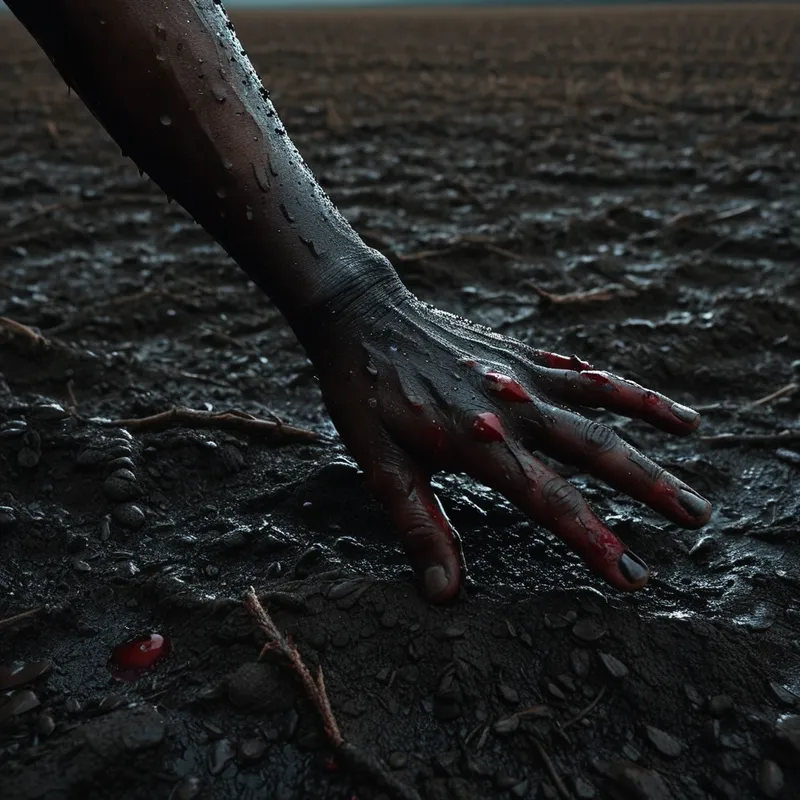
A poison took root in Cain’s heart, a weed of resentment watered by the perceived injustice of the silent sky. He watched his brother, innocent in his grace, and the shadow within him grew teeth. “Let us walk into the field,” Cain said, his voice flat as a stone. And in that field, far from [the hearth](/myths/the-hearth “Myth from Norse culture.”/), under the same sun that nurtured his crops, the unthinkable bloomed. It was not a battle of heroes, but a swift, brutal eruption of the shadow. [The earth](/myths/the-earth “Myth from Hindu culture.”/), Cain’s own domain, drank a new kind of offering.
Then came the voice. Not a roar, but a question that echoed in the hollow of his soul. “Where is Abel, your brother?” The god—perhaps Apollo the far-shooter, he who sees all—was present in the terrible clarity that followed. Cain’s defiance was the last wall of a crumbling city. “Am I my brother’s keeper?” But the earth itself bore witness. The very ground cried out, its voice the silent accusation of stained soil.
The curse was pronounced. Not death, but a life severed. The earth would no longer yield its strength to his touch. He was to be a wanderer, a fugitive, utterly alone. In his terror, Cain saw his fate: to be cast out not just from his family, but from humanity itself, a target for any who found him. “My punishment is greater than I can bear,” he wept. “Anyone who finds me will kill me.”
And here, the mystery unfolded. The god who judged also protected. “Not so,” came the decree. “If anyone kills Cain, vengeance shall be taken on him sevenfold.” Then, Apollo placed his mark upon Cain. It was no brand of shame, but a sigil of sacred exile. A glowing, intricate sign upon his forehead, a ward woven from divine law itself. It declared him both guilty and inviolable, cursed and chosen. And Cain went out from the presence of the god, into the land of Nod, east of all he had known, bearing the mark that was his doom and his shield, the first true citizen of a lonely, inward kingdom.
Cultural Origins & Context
This Hellenic rendition of the Cain narrative is not found in a single, canonical text like the Hebrew Bible, but is a powerful strand of thought woven through later philosophical and tragic traditions. While the core story is Near Eastern, Greek poets and thinkers, particularly in the Hellenistic period, adopted and adapted it, filtering it through their own worldview. It appears in fragments of lost epic cycles and in the works of philosophers like Philo of Alexandria, who sought to bridge Hebraic and Greek thought.
In the Greek context, the story was less about a single deity’s covenant and more about fundamental human conditions: hubris, moira, and the polluting nature of blood guilt (miasma). The tellers would have been rhapsodes and philosophers, using the myth to explore the origins of law, the birth of civilization (as Cain becomes a city-builder in some versions), and the existential state of alienation. Its societal function was to examine the paradox of the outcast who is necessary, the guilty one who carries a divine protection, thus probing the uncomfortable edges of [justice](/myths/justice “Myth from Tarot culture.”/), mercy, and the social contract.
Symbolic Architecture
The myth’s power lies in its profound paradoxes. Cain is the original [orphan](/symbols/orphan “Symbol: Represents spiritual abandonment, primal vulnerability, and the quest for belonging beyond biological ties. Often signifies a soul’s journey toward self-reliance.”/), cast out from the familial and divine garden. His [mark](/symbols/mark “Symbol: A ‘mark’ often symbolizes identity, achievement, or a defining characteristic in dreams.”/) is the central [symbol](/symbols/symbol “Symbol: A symbol can represent an idea, concept, or belief, serving as a powerful tool for communication and understanding.”/) of this ambiguous state.
The Mark is not a stigma of pure evil, but a seal of conscious suffering. It is the visible manifestation of the soul’s recognition of its own shadow—a recognition so total it becomes a protective talisman against further unconscious violence.
The fratricide represents the [psyche](/myths/psyche “Myth from Greek culture.”/)’s first civil war, where one [impulse](/symbols/impulse “Symbol: A sudden, powerful urge or drive that arises without conscious deliberation, often linked to primal instincts or emotional surges.”/) (the settled, egoic [identity](/symbols/identity “Symbol: Identity represents the sense of self, encompassing personal beliefs, cultural background, and social roles.”/) of the tiller) attempts to annihilate its perceived opposite (the free, instinctual, and favored [life](/symbols/life “Symbol: The symbol of ‘Life’ represents a journey of growth, interconnectedness, and existential meaning, encompassing both the joys and challenges that define human experience.”/) of the [shepherd](/symbols/shepherd “Symbol: A shepherd symbolizes guidance, protection, and the nurturing aspects of leadership, often reflecting the dreamer’s desire for direction or support.”/)). The “field” is the neutral territory of [consciousness](/symbols/consciousness “Symbol: Consciousness represents the state of awareness and perception, encompassing thoughts, feelings, and experiences.”/) where such inner conflicts are enacted. The god’s questioning voice symbolizes the awakening of conscience, the [emergence](/symbols/emergence “Symbol: A process of coming into being, rising from obscurity, or breaking through a barrier, often representing birth, transformation, or revelation.”/) of a witnessing [awareness](/symbols/awareness “Symbol: Conscious perception of self, surroundings, or internal states. Often signifies awakening, insight, or heightened sensitivity.”/) that shatters the illusion of isolated [action](/symbols/action “Symbol: Action in dreams represents the drive for agency, motivation, and the ability to take control of situations in waking life.”/).
The [curse](/symbols/curse “Symbol: A supernatural invocation of harm or misfortune, often representing deep-seated fears, guilt, or perceived external malevolence.”/) of sterile [soil](/symbols/soil “Symbol: Soil symbolizes fertility, nourishment, and the foundation of life, serving as a metaphor for growth and stability.”/) signifies the [bankruptcy](/symbols/bankruptcy “Symbol: A state of financial insolvency representing loss, failure, and the collapse of material security or personal foundations.”/) of the old [personality](/symbols/personality “Symbol: Personality in dreams often symbolizes the traits and characteristics of the dreamer, reflecting how they perceive themselves and how they believe they are perceived by others.”/). The strategies that once brought sustenance ([the ego](/myths/the-ego “Myth from Jungian culture.”/)’s labors) now fail utterly. The only [path](/symbols/path “Symbol: The ‘path’ symbolizes a journey, choices, and the direction one’s life is taking, often representing individual growth and exploration.”/) forward is [exile](/symbols/exile “Symbol: Forced separation from one’s homeland or community, representing loss of belonging, punishment, or profound isolation.”/)—a wandering into the unknown [interior](/symbols/interior “Symbol: The interior symbolizes one’s inner self, thoughts, and emotions, often reflecting personal growth, vulnerabilities, and secrets.”/), the land of Nod, which translates to “wandering.” This is not a [punishment](/symbols/punishment “Symbol: A dream symbol representing consequences for actions, often tied to guilt, societal rules, or internal moral conflicts.”/) in the simplistic sense, but the necessary [condition](/symbols/condition “Symbol: Condition reflects the state of being, often focusing on physical, emotional, or situational aspects of life.”/) for transformation. One must be lost to find a new, more authentic way of being.

The Dreamer’s Resonance
When this myth stirs in the modern unconscious, it often surfaces in dreams of profound alienation or carrying a hidden burden. To dream of bearing a visible mark on the forehead or hands that others either fear or ignore is to touch the Cain archetype. Somatic sensations might include a heaviness in the limbs, a sense of being watched yet unseen, or a chilling isolation even in a crowd.
Psychologically, this dream pattern signals a confrontation with a deep, perhaps long-buried, sense of guilt or self-betrayal. It is not necessarily about a literal crime, but about the soul’s accusation that one has “killed” some vital, innocent part of oneself—a creative impulse, a capacity for joy, an authentic connection—in order to survive or to gain a perceived advantage. The dreamer is in the “field” after the act, feeling the devastating consequences and the terrifying prospect of exile from their former sense of self or community. The process is one of moving from denial (“Am I my brother’s keeper?”) toward the awful, liberating acceptance of responsibility, which is the first step toward receiving the paradoxical “mark” of protection.

Alchemical Translation
The individuation journey modeled here is the transmutation of curse into vocation. Cain’s path is the ultimate shadow-work. The initial stage is the [nigredo](/myths/nigredo “Myth from Alchemical culture.”/): the blackening, the murderous act of shadow [projection](/myths/projection “Myth from Alchemical culture.”/) and the ensuing despair. The god’s confrontation is the beginning of the albedo: the whitening, the searing light of consciousness that illuminates the crime.
The alchemical fire is not the crime itself, but the unbearable, conscious endurance of its consequences. The Mark is the lapis, the philosopher’s stone, forged in that fire—a symbol of the unique, isolated identity born from accepting one’s own darkness.
The “land of Nod” is the stage of the citrinitas, the yellowing or wandering in [the desert](/myths/the-desert “Myth from Biblical culture.”/) of the soul, where the old laws no longer apply. Here, the mark protects the nascent, fragile consciousness from being destroyed by the outer world or by its own self-hatred. It allows the exile to wander without being annihilated, to build a new life (a city) not on innocence, but on hard-won, stained wisdom.
Finally, the [rubedo](/myths/rubedo “Myth from Alchemical culture.”/) or reddening is achieved when [the wanderer](/myths/the-wanderer “Myth from Taoist culture.”/) fully integrates the mark. It is no longer a brand he bears, but a sign he is. His exile becomes his sovereignty. His protection is recognized as the strength of one who has faced the absolute within and carries its law. He becomes the founder of a new inner order, built not on the forgotten innocence of Eden, but on the remembered, scarred, and sacred truth of the field. The myth tells us that our deepest guilt, when fully faced and carried consciously, does not destroy us but appoints us. It marks us as solitary travelers on a path that, precisely because it is ours alone, becomes sacred.
Associated Symbols
Explore related symbols from the CaleaDream lexicon: