The Many Faces of Proteus (Gre Myth Meaning & Symbolism
The tale of a shape-shifting sea god who holds all knowledge but must be physically held fast to reveal the truth.
The Tale of The Many Faces of Proteus
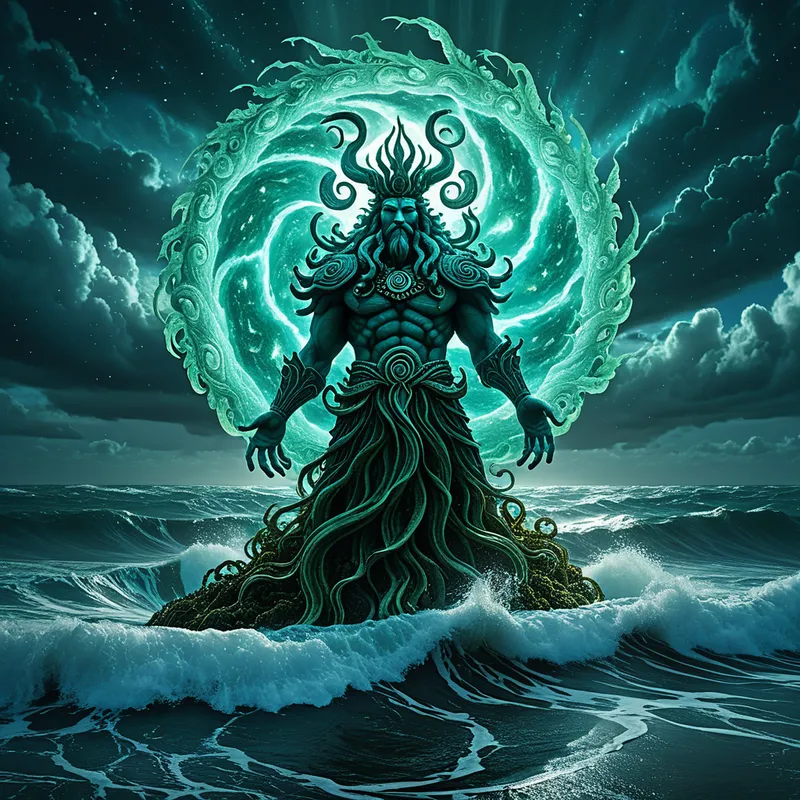
Hear now of the Old Man of the Sea, the herder of seals, the prophet who knows the turning of all tides. His name is Proteus, and he dwells not in a palace of coral but in the sun-baked, salt-rimed caves of a lonely island, surrounded by his bellowing, slick-skinned flock. He is a god of the deep, salt truth, the knowledge of what was, what is, and what is yet to coil into being from the womb of possibility.
At high noon, when the sun hangs like a hammer of brass and the world holds its breath, he emerges. He comes not in glory, but in the guise of an aged shepherd, leaning on a staff of driftwood, to lead his seals into the shallow, warm waters for their rest. This is the hour of his vulnerability, the still point in the turning world. This is the moment a seeker must strike.
For those who come—a lost king, a desperate hero, a soul parched for certainty—the approach is a trial of stealth and nerve. The air thrums with the smell of hot stone and decaying kelp. The seals sleep, great, glistening forms heaped upon the sand. And there he sits, the Old Man, perhaps humming a tune older than the mountains.
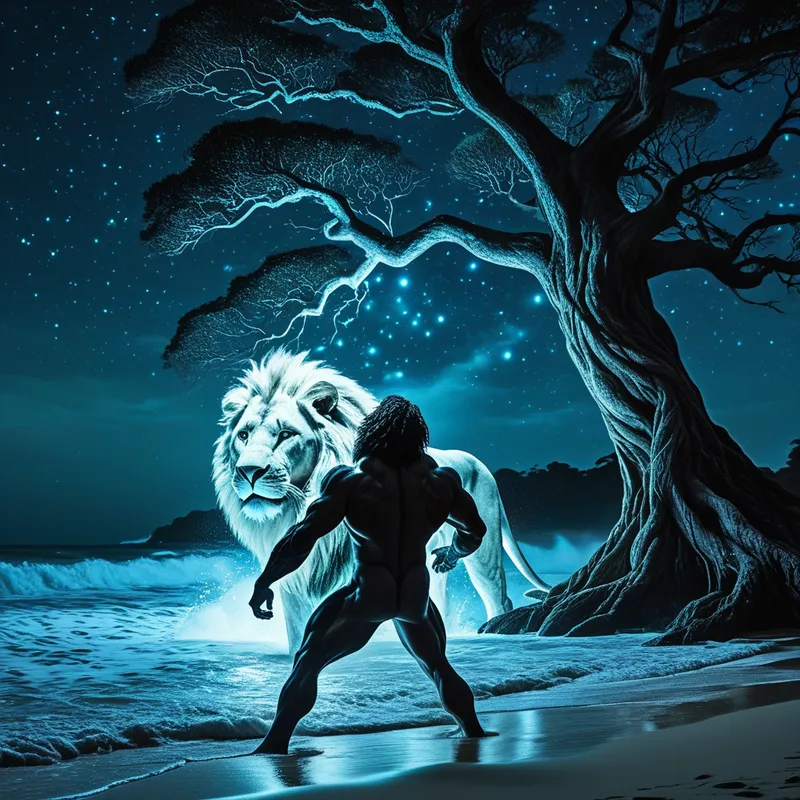
The seeker leaps. Fingers, desperate and strong, close upon a shoulder that is suddenly not there. For Proteus does not fight; he flows. The form beneath the grip erupts. The aged shepherd becomes a raging lion with a roar that shakes the sky. As the seeker holds fast, the lion’s mane melts into the slithering, impossible coils of a vast serpent. The serpent dissolves into a torrent of cold, fresh water that seeks to slip through grasping hands. The water hardens into the gnarled, unyielding bark of an ancient oak. Then fire. Then a panther. Then a flock of shrieking birds.
It is a storm of being. The seeker is battered by scale, claw, branch, and flame, blinded by the sheer, terrifying fertility of existence. The world loses its solidity. What is real? What is self? The only anchor is the grip, the relentless, physical insistence on this one point of contact amidst the chaos of transformation. To loosen the hold is to lose everything, to be left alone on the shore with nothing but the mocking crash of the waves.
And then, as if the universe itself grows weary of the game, the storm of shapes subsides. The seeker, trembling, breathless, finds himself holding fast to the old shepherd once more. The ancient eyes, now clear and deep as a calm sea, regard him. The price has been paid. The ordeal of fluidity has been endured. And so, the Old Man of the Sea speaks. He reveals the truth that was sought—the path home, the name of the betrayer, the cure for the blight. It is a truth earned not by cunning or force, but by endurance, by the willingness to hold on while reality itself dissolves and re-forms.
Cultural Origins & Context
The myth of Proteus is a strand of Greek mythology, most famously preserved in the epic poetry of Homer’s Odyssey (where Menelaus wrestles him to learn his fate) and later in the works of Virgil and Ovid. He is an example of a “prophetic daimon” or “Old Man of the Sea” figure, a archetype found in various maritime cultures. These beings are not Olympians who govern domains, but primal, chthonic powers associated with the raw, untamed, and profoundly ancient knowledge of the natural world.
The myth was not merely entertainment; it was a philosophical and psychological teaching story passed down by bards. In a culture navigating the treacherous, unknown seas of both geography and fate, Proteus embodied the fundamental nature of the cosmos as perceived by the ancients: fluid, deceptive on the surface, yet containing immutable truth at its core. The ritual of “wrestling” him models the proper relationship between humanity and this chaotic, knowing universe—one not of domination, but of steadfast engagement and earned revelation.
Symbolic Architecture
Proteus is the very principle of psychic liquidity. He symbolizes the unformed, potential-laden substance of the unconscious mind and of reality itself before it is pinned down by perception and language. His transformations are not lies, but expressions of latent possibilities.
To grasp Proteus is to accept that truth is not a static object to be found, but a dynamic process to be endured. The revelation comes not in spite of the transformations, but because of them.
The hero’s relentless grip is the critical symbol. It represents the conscious ego’s necessary, often exhausting, effort to maintain focus and integrity (ego-consciousness) in the face of the overwhelming, shape-shifting contents of the unconscious. The struggle is the process of containment. The truth Proteus finally speaks is the reward for this containment—the moment when the chaotic, creative energy of the unconscious is finally integrated and can deliver its insight to the conscious mind.
The Dreamer’s Resonance
When the Protean pattern stirs in modern dreams, it signals a profound encounter with the fluid, unintegrated aspects of the self. You may dream of a person whose face keeps changing, of a house whose rooms rearrange themselves, or of chasing a figure that melts into the landscape. The somatic experience is one of profound disorientation, groundlessness, and sometimes exhilarating freedom.
Psychologically, this is the psyche working through a state of liminality. The dreamer is in a process where old identities, beliefs, or emotional patterns are dissolving, but a new, solid form has not yet coalesced. The dream-ego’s task—whether it flees, observes, or, in potent dreams, grapples with the shifting forms—reveals one’s current relationship to this inner chaos. To successfully “hold fast” in the dream is a powerful indicator of the ego’s growing strength to contain a psychic transformation.

Alchemical Translation
The myth of Proteus is a perfect allegory for the alchemical and individuation process. The seeker’s journey to the isolated shore is the descent into the solitude of the self, the prima materia of one’s own unconscious. Proteus himself is the Mercurius, the elusive, trickster spirit that holds the secret of transformation.
The alchemical vessel is not the flask of the sage, but the unwavering grip of the conscious will. The “fixed” element that must master the “volatile” is one’s own enduring attention.
The violent, bewildering transformations—the nigredo—are the necessary dissolution of the outworn personality. To cling to the old, rigid form is to fail the operation. One must allow the self to become lion, serpent, and stream, to experience the full spectrum of one’s latent potentials and shadow aspects, all while maintaining the central, observing “I.” The moment Proteus resumes his original form and speaks the truth is the albedo, the dawn of lucid understanding that follows the dark night of the soul. The revealed truth is the newly integrated knowledge, the Self communicating directly to the ego, granting the wisdom needed to navigate the next phase of the life journey. One does not become Proteus; one learns the art of holding him, and in doing so, masters the fluid essence of one’s own being.
Associated Symbols
Explore related symbols from the CaleaDream lexicon: