The Manger Myth Meaning & Symbolism
A divine child is born into profound poverty, placed in an animal's feeding trough, heralding a world turned upside down by sacred vulnerability.
The Tale of The Manger
Listen. [The world](/myths/the-world “Myth from Tarot culture.”/) was heavy, groaning under the weight of its own iron laws and imperial dreams. [The sky](/myths/the-sky “Myth from Persian culture.”/) was a ledger, [the earth](/myths/the-earth “Myth from Hindu culture.”/) a tax district. Hope was a rumor whispered in the back alleys of forgotten temples.
Then, in the dead of a winter’s night, in the most overlooked province of a vast empire, the story turned. A man and a woman, dust on their sandals and weariness in their bones, were turned away from every door. The world had no room. The only shelter offered was a cave hewn into a hillside, a place for beasts, smelling of earth and animal breath. Here, in this humblest of hollows, surrounded by the warm, dumb presence of creatures, she gave birth.
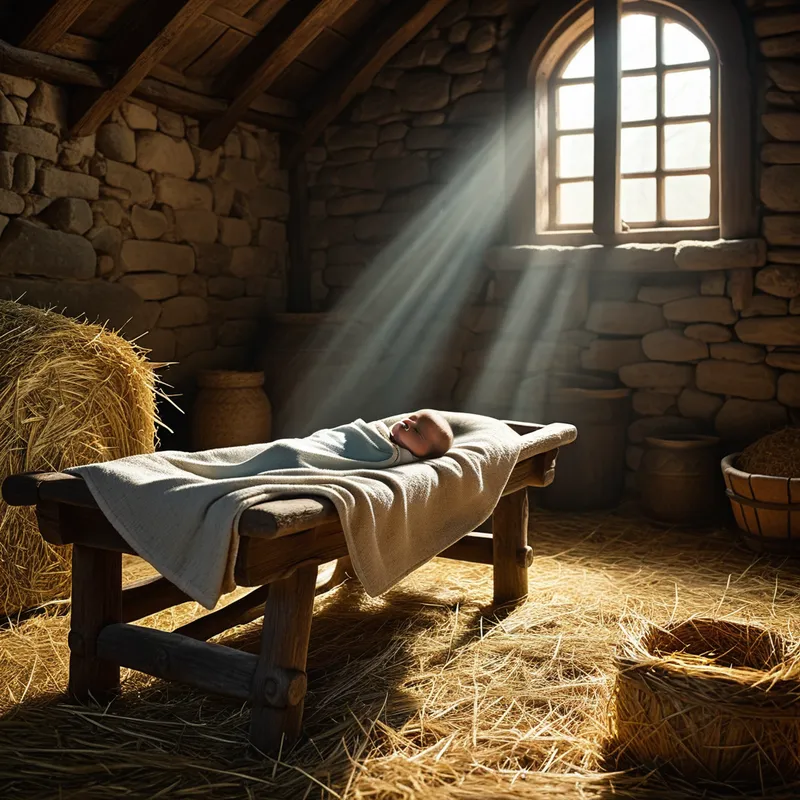
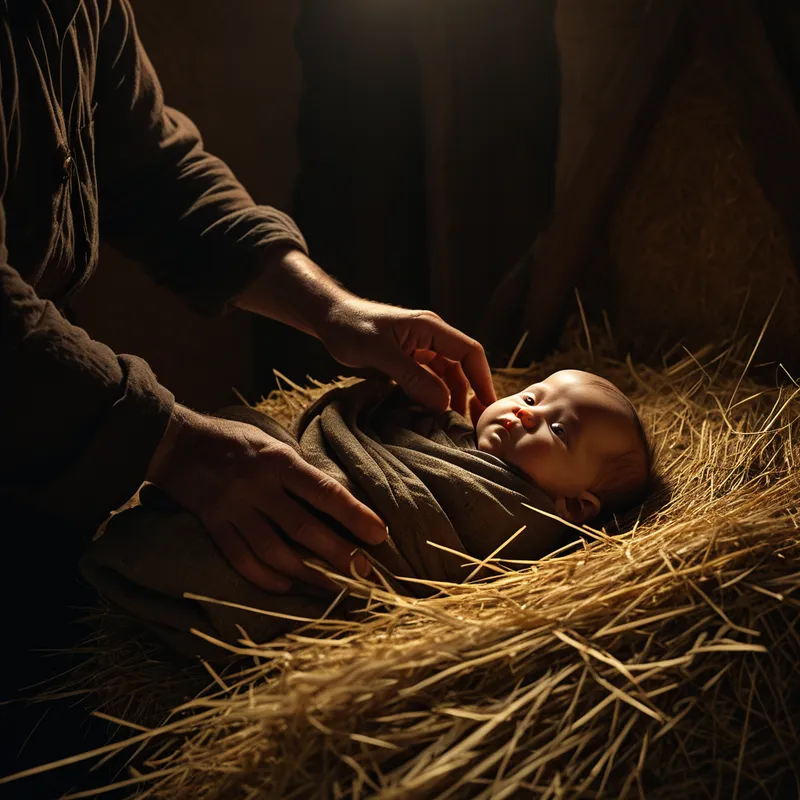
There was no silk, no royal proclamation. The first cradle was a [manger](/myths/manger “Myth from Biblical culture.”/), a feeding trough carved from rough stone or splintered wood, still scattered with the hay meant for oxen and sheep. Into this vessel of mundane necessity, they laid [the child](/myths/the-child “Myth from Alchemy culture.”/), wrapping him against the chill in simple strips of cloth.
But the heavens, which had seemed so silent, tore open. An angelic messenger, blazing with a light that had nothing to do with sun or moon, appeared not to kings in palaces, but to shepherds keeping watch in the fields—men who smelled of soil and flock, whose testimony was worthless in any court. “Do not be afraid,” the messenger said, and the words themselves were a new kind of law. “I bring you good news of great joy. For unto you is born this day, in the city of David, a Savior. And this will be a sign for you: you will find a baby wrapped in swaddling cloths and lying in a manger.”
And the sign was the contradiction itself: [the anointed](/myths/the-anointed “Myth from Biblical culture.”/) one, the Christos, identified not by a crown or a sword, but by his presence in a feed-box. The shepherds went, running through the night, and found the sign to be true. They saw the child in the trough, and in that seeing, the world’s axis shifted. The first to witness the event were the poor, the simple, and the beasts of the field. The throne was a plank of wood, the courtiers were animals, and the royal decree was the helpless cry of a newborn. The story began not with a conquest, but with a placement: a sacred vulnerability laid in the very place where the world takes its nourishment.
Cultural Origins & Context
This narrative, found in the Gospel of Luke, emerged from a Jewish-Christian community navigating life under the Pax Romana. It was a counter-story told among the subjugated and the hopeful. Its primary function was theological and sociological: to articulate a radical doctrine of incarnation—the divine entering the material world not in overpowering glory, but in utter defenselessness.
The manger detail is not a sentimental embellishment; it is a precise, shocking theological claim. In an honor-shame culture obsessed with status, patronage, and power, locating the birth of God’s son in a state of literal homelessness, attended by ritually impure shepherds, was a profound act of narrative resistance. It passed down not as a state history but as a “gospel”—good news specifically for those whom the world counted as nothing. The story served to invert societal values, creating a foundational identity for a community that saw sacredness in humility and power in weakness.
Symbolic Architecture
The manger is the central, transformative [symbol](/symbols/symbol “Symbol: A symbol can represent an idea, concept, or belief, serving as a powerful tool for communication and understanding.”/). It is an object of profound [paradox](/symbols/paradox “Symbol: A contradictory yet true concept that challenges logic and perception, often representing unresolved tensions or profound truths.”/), a [vessel](/symbols/vessel “Symbol: A container or structure that holds, transports, or protects something essential, representing the self, emotions, or life journey.”/) of meaning that shatters conventional hierarchies.
The container defines not the status of the contained, but transforms the meaning of containment itself. The divine is not diminished by the feed-trough; the feed-trough is sanctified by the divine.
Psychologically, the manger represents the vessel of the nascent Self. It is the humble, often overlooked, or even “animal” part of our [psyche](/myths/psyche “Myth from Greek culture.”/) that becomes the cradle for something entirely new and transformative. It is not the polished ego, the proud achievements, or the well-furnished [persona](/symbols/persona “Symbol: The social mask or outward identity one presents to the world, often concealing the true self.”/) that hosts the [birth](/symbols/birth “Symbol: Birth symbolizes new beginnings, transformation, and the potential for growth and development.”/) of wholeness. It is the crude, instinctual, and neglected inner [space](/symbols/space “Symbol: Dreaming of ‘Space’ often symbolizes the vastness of potential, personal freedom, or feelings of isolation and exploration in one’s life.”/)—our basic humanity with all its needs, vulnerabilities, and connections to the earthy and the mundane.
The Christ-[child](/symbols/child “Symbol: The child symbolizes innocence, vulnerability, and potential growth, often representing the dreamer’s inner child or unresolved issues from childhood.”/) symbolizes the emergent psychic novelty, the new potential for [consciousness](/symbols/consciousness “Symbol: Consciousness represents the state of awareness and perception, encompassing thoughts, feelings, and experiences.”/) that feels both utterly vulnerable and cosmically significant. The shepherds represent the attentive, instinctual functions of the psyche that first recognize this birth, while the “no [room](/symbols/room “Symbol: A room in a dream often symbolizes the self, representing personal space, mental state, or aspects of one’s identity.”/) at the inn” signifies [the ego](/myths/the-ego “Myth from Jungian culture.”/)’s initial [resistance](/symbols/resistance “Symbol: An object or tool representing opposition, struggle, or the act of pushing back against external forces or internal changes.”/) to hosting this disruptive, humble new [reality](/symbols/reality “Symbol: Reality signifies the state of existence and perception, often reflecting one’s understanding of truth and life experiences.”/).
The Dreamer’s Resonance
When this mythic pattern stirs in the modern dreamer, it often manifests not as a literal nativity scene, but as a profound sense of holy poverty. One might dream of discovering something precious—a jewel, a child, a luminous idea—in a dumpster, a garage, or a dusty attic. The dream ego feels a mixture of shame and awe: “How can this be here, in this place?”
Somatically, this can feel like a hollowing out in the chest or gut—a manger-space being prepared. It is a vulnerable, open feeling, often accompanied by anxiety (the “no room” of the ego) and then a deep, quiet warmth (the acceptance of the shepherds). The psychological process is the ego’s confrontation with its own insufficiency and its gradual, often reluctant, agreement to make space for a guiding principle that does not originate from its own willpower or intellect, but from a deeper, more foundational layer of being. The dream signals a call to honor what is emerging from the lowly, forgotten, or instinctual quarters of the soul.
Alchemical Translation
The alchemy of the manger is the transmutation of base reality into [the vessel](/myths/the-vessel “Myth from Alchemical culture.”/) of the sacred. It models the individuation process where the goal is not to escape one’s humanity but to fully incarnate through it.
[The first stage](/myths/the-first-stage “Myth from Alchemical culture.”/) is the [nigredo](/myths/nigredo “Myth from Alchemical culture.”/), the blackening: the “no vacancy” of the world, the journey’s fatigue, the rejection. This is the necessary dissolution of the ego’s pretensions to self-sufficiency. One must be brought to the stable-cave, the humble acknowledgment of one’s crude, animal nature and needs.
The birth occurs only when the conscious mind has exhausted its own accommodations.
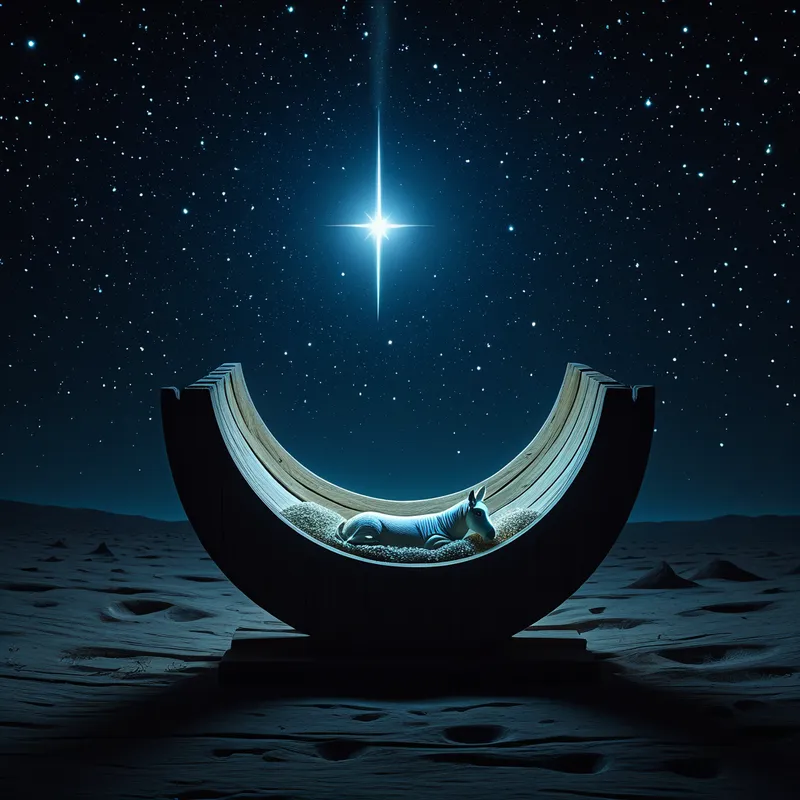
The manger itself is the vas, [the crucible](/myths/the-crucible “Myth from Alchemical culture.”/). It is the humble, earthly container of the body, the instincts, the personal history—all that is “base” material. The alchemical work is to recognize this very container as the only possible birthplace for the lumen de lumine, the light born of light. The new consciousness does not descend upon us from on high to obliterate our nature; it emerges from within our nature.
The arrival of the shepherds symbolizes the integration of [the shadow](/myths/the-shadow “Myth from Jungian culture.”/). These are the parts of ourselves we consider lowly, simple, or unspiritual—our raw instincts, our forgotten joys, our unpolished truths. They are the first witnesses, indicating that the new psychic birth is authenticated not by the approval of the inner critic or the [persona](/myths/persona “Myth from Greek culture.”/) (the “innkeepers”), but by the acceptance of the whole self. The final transmutation is the realization that the gold was in the straw all along; the divine is inherent in the humble act of feeding, of nurturing, of being present in the simple, animal fact of existence. To find the savior in the manger is to discover that salvation is not a rescue from life, but a profound, transformative embrace of it, in all its vulnerable, earthy, and glorious particularity.
Associated Symbols
Explore related symbols from the CaleaDream lexicon: