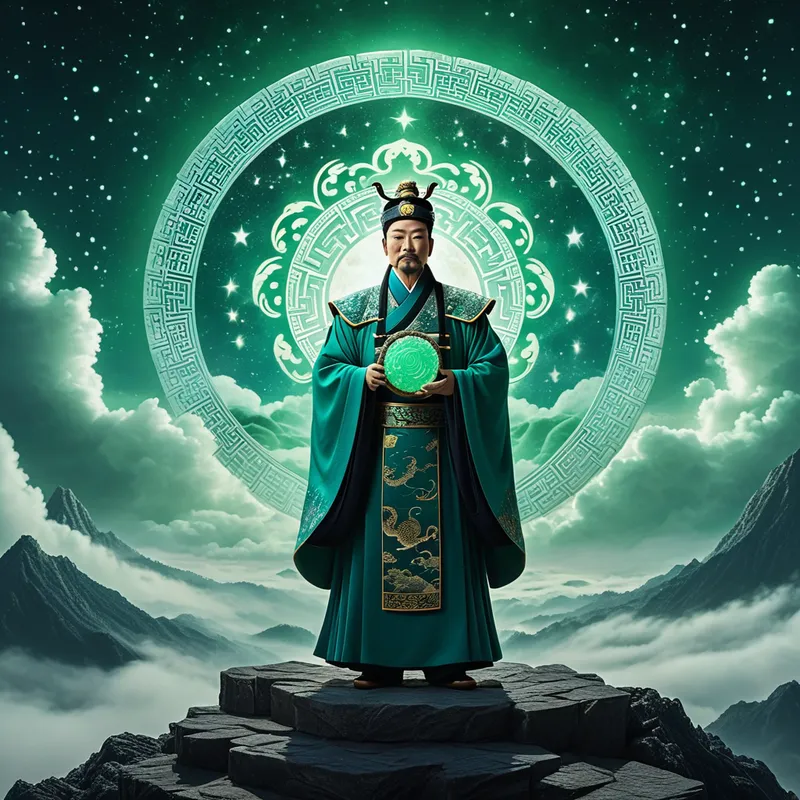
The Mandate of Heaven Myth Meaning & Symbolism
A cosmic principle where divine right to rule is granted and revoked based on a dynasty's virtue, signaling the cyclical rise and fall of empires.
The Tale of The Mandate of Heaven
Listen, and hear the whisper of the cosmos through the bamboo groves. In the time before time was measured, when the earth was raw and the rivers sang older songs, there was no king, only chaos. The people suffered under the harsh rule of Jie of Xia, a man whose heart had turned to black jade. He drained lakes to build towers of wine, and his cruelties were as numerous as the stars. The heavens watched, and the Jade Emperor grew heavy with displeasure. The seasons faltered; the Yellow River ran thick with sorrow.
Then, from the west, a virtue began to glow. It was Tang of Shang, a lord whose compassion was as deep as the well from which he drew water for the thirsty. He did not seek the throne; he sought only to mend the broken world. The omens spoke. A phoenix, its feathers the color of dawn, alighted in his courtyard. A sacred tortoise emerged from the Luo River, its shell inscribed with a celestial map pointing to his destiny. The people turned their faces to him like sunflowers.
The final conflict was not merely of armies, but of essences. On the day of the great battle at Mingtiao, the sky darkened not with storm clouds, but with the gathered will of heaven itself. Jie’s forces, though vast, moved as if through mud, their weapons dull. Tang’s modest army was lit from within by a righteous fire. When he raised his sword, it was not steel that flashed, but a reflection of the Milky Way. Jie was defeated, his tyranny washed away like a sandcastle before the tide.
And then, in the silence after the clamor, the Mandate descended. No hand passed a scepter; no voice boomed from the clouds. It was a knowing, a profound and unshakeable resonance that settled over the land and into the heart of every living thing. The rivers ran clear again. The harvests grew abundant. Tang knelt not in conquest, but in solemn stewardship, feeling the weight of the cosmos upon his shoulders. He had been tested, found worthy, and the heavens had shifted their gaze. The Mandate was his—a sacred trust written not on parchment, but in the harmony between earth and sky.

Cultural Origins & Context
The concept of the Mandate of Heaven (Tiānmìng) is not a single myth from a singular text, but the bedrock of Chinese political theology for millennia. It crystallized during the Zhou Dynasty to justify their overthrow of the preceding Shang. It was propagated by scholars, historians, and court officials, woven into the official histories like the Shujing (Book of Documents).
Its primary societal function was profound: it provided a cosmic framework for political legitimacy and revolution. It answered the most dangerous question—“By what right does one rule, and by what right is he overthrown?”—with an answer that transcended mere bloodline or power. The Mandate made the ruler accountable not just to the people, but to the very order of the universe. It was a narrative tool that explained dynastic cycles, natural disasters as divine displeasure, and the necessity of virtuous governance. It was history, philosophy, and state religion fused into one powerful story.
Symbolic Architecture
At its core, the Mandate is a grand symbol of legitimacy earned, not inherited. It represents the psychic truth that true authority—whether over a nation or one’s own life—must be aligned with a higher moral order. The ruler is not a god, but a conduit.
The throne is not a seat of power, but an altar where the human will is sacrificed to the greater needs of the Cosmos.
The key symbols are alchemical. The virtuous ruler (De) symbolizes the integrated Self, where personal desire submits to transpersonal responsibility. The tyrant represents the unbridled, inflating ego, the Persona that has consumed the soul. The omens—the phoenix, the tortoise, the aberrant stars—are eruptions of the unconscious, messages from the deep Self that the conscious order has become pathological and must be re-aligned. The transfer of the Mandate itself is the ultimate symbol of psychic renewal, the death of an old, rigid complex and the birth of a new, more authentic ordering principle.
The Dreamer’s Resonance
When this myth stirs in the modern psyche, it rarely appears as emperors and dragons. It manifests in dreams of fraudulence and legitimacy. You dream of being thrust into a leadership role you feel unqualified for, yet everyone insists you are the chosen one. Or conversely, you dream of exposing a corrupt authority figure, of being the whistleblower who reveals the “celestial omens” of their failure.
Somatically, this can feel like a pressure in the chest—the weight of the Mandate—or a vertiginous sense of a foundation crumbling. Psychologically, you are in the liminal space between an old, outworn identity (a job, a relationship, a self-concept) and a new, more authentic one that is demanding recognition. The dream is the psyche’s Mingtiao, the battleground where your inner tyrant (complacency, fear, corruption) clashes with your inner virtuous claimant (potential, integrity, calling). The outcome of the dream signals whether you are granting yourself the mandate to change.

Alchemical Translation
For the individual, the myth models the arduous process of inner sovereignty. Our personal psychology is a kingdom with many claimants: the tyrant of old habits, the rebel of unresolved trauma, the sage of wisdom. The “Mandate” is the right of the central, conscious ego to govern this inner realm, a right that must be continually earned through virtue—here meaning alignment with the Self.
The first alchemical stage is The Fall of the Tyrant. This is the necessary disillusionment, the painful recognition that an old way of being (an addiction, a toxic relationship pattern, a career built on others’ expectations) is morally bankrupt and causing inner famine. The “natural disasters” are the symptoms: anxiety, depression, a sense of meaninglessness.
The revolution is never external until it is first internal. One must depose the petty dictator within before one can rule a single moment in peace.
The second stage is The Ascension of Virtue. This is the conscious cultivation of the qualities of De: integrity, compassion, responsibility toward one’s own soul. It is doing the inner work not for glory, but because it is right. This is Tang drawing water for the thirsty—attending to the neglected, parched parts of your own psyche.
The final, ongoing stage is Holding the Mandate. This is the understanding that legitimacy is a dynamic state, not a permanent trophy. It requires constant attention to the “omens”—your emotions, intuitions, and bodily signals—to ensure your rule remains in harmony with your deepest truth. To lose this connection is to risk inner chaos and the eventual, inevitable fall, making way for the next cycle of growth. The goal is not to reign forever, but to reign well while the mandate is yours, contributing your virtuous chapter to the eternal, cyclical story of the Self.
Associated Symbols
Explore related symbols from the CaleaDream lexicon: