The Magi's Gifts Myth Meaning & Symbolism
Three wise kings journey through desert and dream, guided by a star, to offer gifts that honor a divine mystery in a humble manger.
The Tale of The Magi’s Gifts
Let the story be told of the seekers from the sunrise lands. Not in palaces did their quest begin, but in the silent watch of the heavens. In the courts of the East, where the dust of ancient scrolls smells of cedar and longing, they saw it—a new star, a herald written in fire upon the velvet scroll of night. It was a word they had spent lifetimes learning to read.
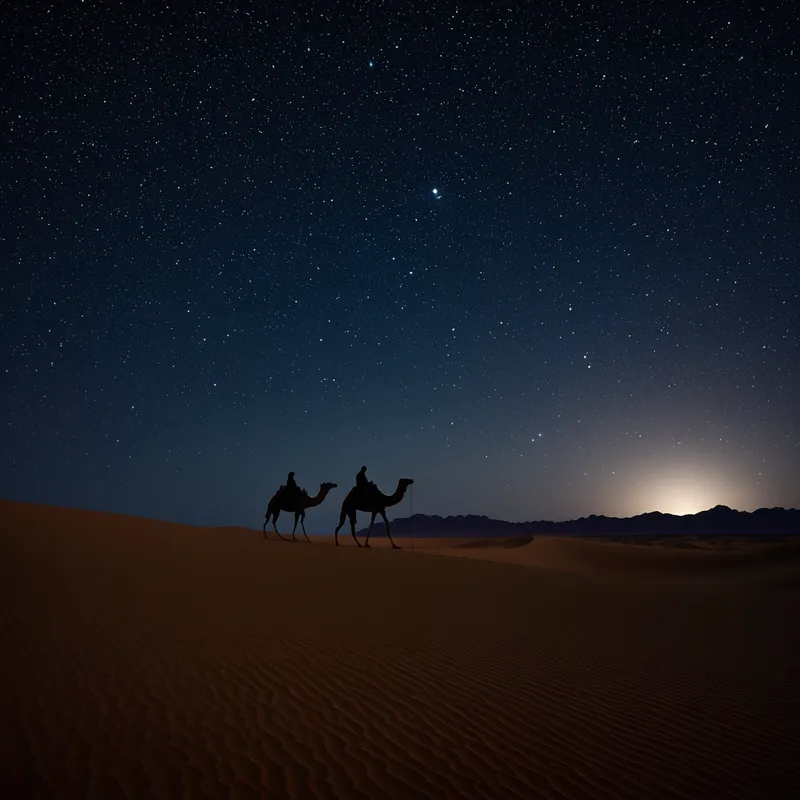
So they departed. Kings of thought, princes of observation, their crowns were the knowledge of cycles and the whispers of prophets. They left their thrones of certainty and mounted the ships of the desert, their camels groaning under the weight of provisions and the heavier weight of hope. The world narrowed to the rhythm of hooves on sand, the creak of leather, the day’s blistering sun and the night’s bone-chilling cold. The star moved, a silent guide, pulling them through wastelands and past sleeping kingdoms. It was a pilgrimage of the mind following a sign for the heart.
They came, at last, not to a citadel but to the petty fortress of a jealous king, Herod, whose fear was a cold stench in his marble halls. Undeterred, they followed the star’s final descent. It stopped—not over a palace, but over a humble dwelling in the little town of Bethlehem. The contrast was the universe’s great joke and its profoundest truth.
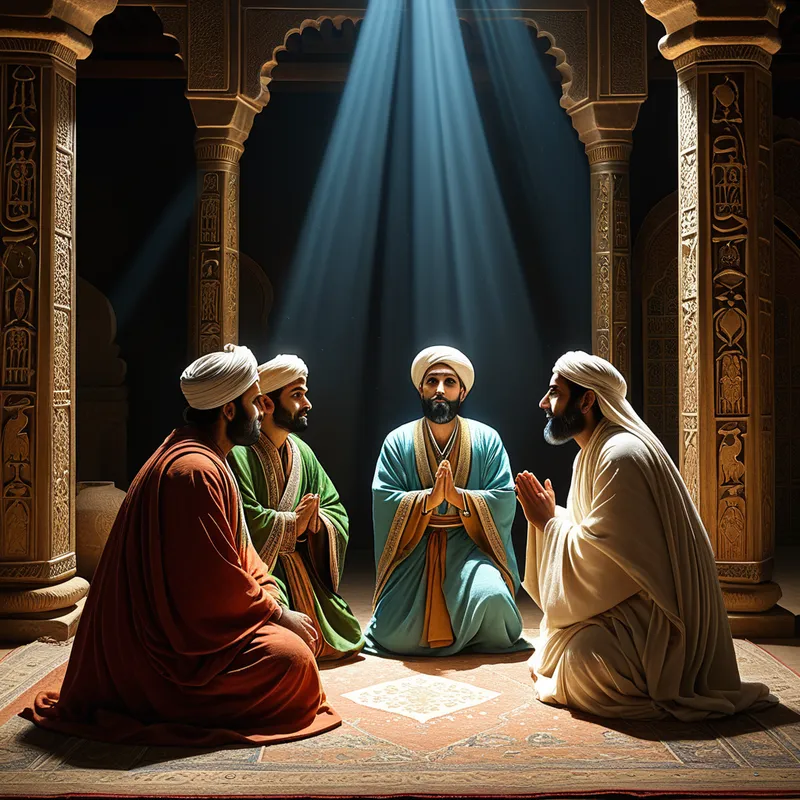
Pushing aside the rough curtain, the light of their lamps mingled with the animal warmth of the place. There, in the arms of a young woman whose face held the weariness and wonder of all creation, was the child. No fanfare met them but the soft breath of cattle. In that moment, the long journey, the scholarly debates, the desert trials, crystallized into a single, overwhelming act of knowing. They fell to their knees, these mighty men, their foreheads touching the earthen floor.
Then, from their treasure chests, they brought forth their offerings. First, gold, ringing softly as it was laid down—a tribute fit for the King of Kings. Next, frankincense, its complex, holy scent rising in a visible plume to honor the High Priest of Heaven. Finally, myrrh, bitter and profound, an ointment for one destined for a sacred tomb. Having poured out their meaning at the feet of the Mystery, they received a warning in a dream and returned home by another way, their old maps forever obsolete.
Cultural Origins & Context
The story is found only in the Gospel of Matthew, a text deeply concerned with framing the life of Jesus as the fulfillment of Jewish prophecy. Matthew’s audience likely included Jewish converts, for whom the arrival of Gentile sages bearing homage would have been a powerful symbol: the light of the Messiah drawing all nations.
The figures are not named, nor numbered, in the original account. They are magoi from the East—a term denoting a Persian priestly caste of astrologers and interpreters of signs. Over centuries, tradition crystallized them into three kings, named Caspar, Melchior, and Balthazar, and assigned them ages and ethnicities representing the known continents. This evolution shows the myth’s function: to universalize the event. It was a story told to signify that the divine revelation transcended ethnic and religious boundaries, arriving through the language of nature (the star) and speaking to the wisdom traditions of the world.
Symbolic Architecture
The myth’s power lies not in historical detail but in its perfect symbolic architecture. It is a map of the soul’s journey toward recognition of the sacred.
The Star is the inner compass, the call from the Self that disrupts comfortable consciousness. It is the intuition, the synchronicity, the “numinous” pull that insists there is something more to seek, even if the destination is unknown.
The Journey is the necessary ordeal. One cannot comprehend the sacred by thinking alone; one must move, must endure the “desert” of doubt, hardship, and the death of old assumptions. The encounter with Herod is crucial—it is the confrontation with the worldly psyche that would co-opt or destroy the nascent spiritual truth for its own ends.
The gifts are not merely presents; they are acts of diagnosis and recognition. They name the mystery before them.
Gold acknowledges sovereign value, the ultimate worth of this center of being. It is the recognition of the Self as the true ruler of the inner kingdom. Frankincense acknowledges connection to the transcendent, the spiritual essence that permeates and uplifts material life. It is the soul’s dialogue with the divine. Myrrh is the most profound and challenging gift: it acknowledges mortality, suffering, and the necessity of death for transformation. It honors the incarnated, vulnerable, and sacrificial dimension of existence.
The “other way” home signifies the irreversible transformation of consciousness. The seeker cannot return to their old mindset; the path of the ego is closed. A new, often more solitary and integrated, route must be found.

The Dreamer’s Resonance
When this myth stirs in modern dreams, it speaks to a process of seeking and recognition at a critical juncture. To dream of following a strange, beautiful light suggests the psyche is orienting toward a new, emerging value or aspect of the Self, often following a period of spiritual aridity (the desert).
Dreams of preparing or carrying significant gifts indicate the dreamer is consolidating what they have learned or earned in life, preparing to “offer it up” to something greater than the ego—a relationship, a creative project, a deeper commitment to one’s own truth. The somatic feeling is often one of solemn purpose or anxious reverence.
Conversely, dreaming of losing the gifts, or of the star vanishing, points to a crisis of meaning, a fear that one’s journey is futile or that one has nothing of value to contribute. The dream of meeting a deceptive or threatening “Herod” figure warns of external pressures or internal voices that would divert the authentic quest for personal truth toward collective approval, material gain, or cynical manipulation.
Alchemical Translation
Psychologically, the myth of the Magi is a master narrative of individuation. The star is the call from the Self, the integrated totality of the psyche, which feels alien and “other” to the conscious ego.
The alchemical work is in the journey—the opus of enduring the conflict between the ego’s plans (going to Herod’s palace) and the Self’s destination (the humble manger).
The desert represents the nigredo, the necessary darkening and purification, where all that is non-essential is burned away by the sun of scrutiny and the cold of isolation. The gifts represent the culmination of the alchemical process. Gold is the citrinitas, the dawning of the solar, conscious realization of the Self’s value. Frankincense is the connection to the spiritus, the transcendent function that unites opposites. Myrrh is the acceptance of the mortificatio, the death of the infantile ego, which allows for the rebirth of a consciousness capable of holding paradox: the king in the stable, the divine in the mortal, the end in the beginning.
For the modern individual, this translates to the courage to follow one’s unique “star”—an intuition, a calling, a deep interest that society may deem impractical. It requires journeying through the desert of self-doubt and external criticism. The ultimate goal is to arrive at a humble inner space where one can recognize and honor the full spectrum of one’s being: its innate value (gold), its spiritual longing (frankincense), and its vulnerable, mortal, suffering aspect (myrrh). Only by offering this whole self can one integrate it and return “by another way,” transformed, no longer a subject of the inner Herod, but a wise traveler guided by a light now carried within.
Associated Symbols
Explore related symbols from the CaleaDream lexicon: