The Magician Myth Meaning & Symbolism
The myth of the adept who stands at the crossroads of worlds, wielding the elemental tools to shape reality through focused will and conscious connection.
The Tale of The Magician
Before the world was fixed in its habits, when the veil between what is and what could be was as thin as morning mist, there walked a figure at the crossroads. He was not a king in a castle, nor a hermit in a cave. He was the one who stood in the in-between, in the garden where the wild roses grew over ancient stone.
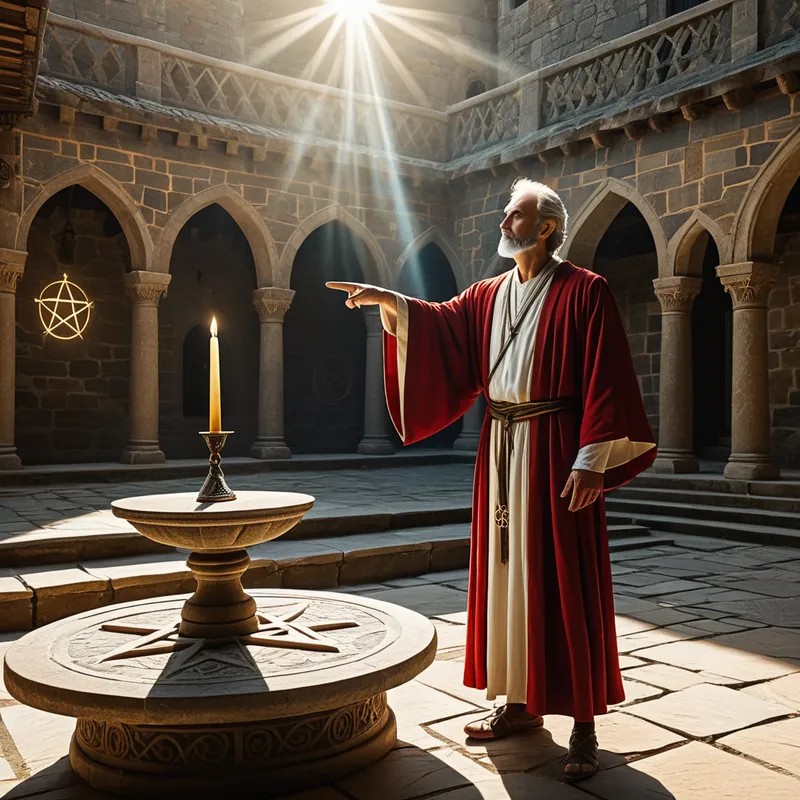
His name was a whisper on the wind, but we may call him the Adept. He wore the white of pure potential and the red of manifest life. Above his brow, where thought becomes thing, hung the Lemniscate, turning slowly like a serpent of light. He stood in a courtyard open to the sky, a place neither fully inside nor out, a threshold. Before him was a table of simple, sun-warmed stone.
Upon it lay his tools. Not weapons of war, but instruments of covenant. From the south, a Wand of living wood, its tip alive with a spark waiting to be fanned. From the west, a Cup of deep silver, holding the still waters of emotion and intuition. From the east, a Sword of sharpest air, its blade honed on the whetstone of intellect. From the north, a Pentacle of engraved earth, heavy with the promise of form.
The Adept did not move with haste. He breathed in, and the scent of rosemary and damp earth filled him. He listened, and heard the hum of the world’s unseen currents. He raised his right hand, fingers stretching toward the vault of heaven, where clouds drifted like thoughts. He lowered his left hand, palm open toward the good, dark soil beneath his feet. In that moment of perfect tension, he was the bridge. The spark from the Wand yearned upward; the stability of the Pentacle pulled downward. The clarity of the Sword sought to divide; the depth of the Cup sought to unite.
His will was not a shout, but a focused note. He did not command the tools; he recognized them. He saw the fire in the seed, the ocean in the tear, the wind in the sigh, the mountain in the bone. He brought his awareness, like a lens focusing sunlight, to the point where all four met—in the center of the table, in the center of himself.
And there, in that silent, potent convergence, possibility stirred. Not with thunder, but with the quiet certainty of a seed cracking open. The potential that swirled in the ether above began to channel down the pathway of his raised arm, through the conduit of his heart, and out through his grounded hand into the world of substance. He was not making something from nothing. He was the conscious midpoint in a great circuit, the one who remembers that to point to the sky is also to touch the earth, and in that remembrance, the garden itself seemed to hold its breath, blooming in recognition.
Cultural Origins & Context
The figure of The Magician, known in earlier decks as The Juggler or The Mountebank, finds its roots in the rich visual and philosophical culture of the European Renaissance. The Tarot, emerging in 15th-century Italy as a card game (tarocchi), was a product of an era intoxicated with rediscovered knowledge. It was a time when Hermetic philosophy, smuggled from the ancient world, taught “as above, so below,” and when the boundaries between science, art, and magic were beautifully blurred.
The Magician was not initially a myth from an oral tradition but a myth encoded in an image, passed from hand to hand across gaming tables and later, within esoteric circles. His story was told not by bards, but by the arrangement of symbols on a card, studied by philosophers and seekers. In the societal function of the early decks, he likely represented skill, cunning, and resourcefulness—the street performer’s adeptness. However, by the late 18th century, with the advent of occult Tarot systems like that of the Hermetic Order of the Golden Dawn, his narrative was profoundly deepened. He was reinterpreted as the conscious operator of cosmic forces, the embodiment of the human will aligned with divine purpose. His myth became a core instruction in the Western esoteric tradition: a visual guide to the first step of manifestation, positioned as Card I, the beginning of the Fool’s journey into conscious existence.
Symbolic Architecture
Psychologically, The Magician represents the fully activated conscious ego that has discovered its role as a co-creator with the unconscious. He is the archetype of directed consciousness, the “I” that can focus the disparate energies of the psyche into a single, potent point of action. The tools are not external but internal: Will (Wand), Emotion (Cup), Intellect (Sword), and Sensation (Pentacle). The table is the field of everyday reality, and the Adept is the psyche that has learned to work with all its parts.
The Magician’s power lies not in possessing the elements, but in recognizing he is made of them. His will is the circuit that completes the connection between inspiration and form.
The Lemniscate above his head symbolizes the infinite potential of the mind and the eternal flow of psychic energy. His gesture—as above, so below—is the quintessential act of meaning-making, the process by which abstract insight (from the unconscious, the “above”) is translated into concrete reality (the conscious world, the “below”). He represents the moment of agency, where one moves from being a passive experiencer of life to an active participant in shaping it.
The Dreamer's Resonance
When the pattern of The Magician stirs in modern dreams, it often manifests as a dream of startling capability or focused intent. You may dream of holding a tool that works perfectly, of giving a speech with flawless eloquence, or of solving a complex problem with effortless insight. Conversely, its shadow may appear as dreams of forgotten tools, broken instruments, or a frustrating inability to communicate or make an impact—the blocked circuit.
Somatically, this archetypal energy can feel like a surge of directed vitality, a “click” of alignment in the mind or chest. The psychological process underway is one of resource recognition. The dreaming culture.") psyche is assembling its internal tools, connecting personal skills (the intellect of the Sword) with deep feeling (the intuition of the Cup), passionate will (the drive of the Wand), and practical grounding (the stability of the Pentacle). It is a dream of integration, signaling a readiness to act from a place of wholeness rather than fragmentation. The anxiety in such dreams often points to the dreamer’s waking-life hesitation to step into this role of conscious creator.

Alchemical Translation
In the alchemical journey of individuation, The Magician models the crucial first stage of the Opus: the recognition and organization of the prima materia, the raw stuff of the soul. Before transformation can occur, one must first take inventory of what is already present. The modern individual, often feeling scattered and reactive, is called to perform the Magician’s act: to stand at the center of their own life, to consciously gather their inner resources—their passions, their empathy, their critical mind, their physical presence—and to see them as sacred tools.
Individuation begins not with a grand quest outward, but with the quiet, potent act of pointing within and saying, “This too is part of me, and it is usable.”
The core struggle in this myth is the illusion of powerlessness. The triumph is the realization of agency through connection. The alchemical translation is the transmutation of “I can’t” into “I will, because I am connected to the means.” It is the process of moving from identifying with a single element (“I am only my emotions,” “I am only my logic”) to presiding over the complete set. By consciously directing attention and will (the raised hand) while remaining firmly grounded in reality (the lowered hand), the individual becomes the crucible where spirit takes form. The Magician’s lesson is that we are all the meeting point of heaven and earth, and our focused consciousness is the wand that orchestrates the symphony of our becoming.
Associated Symbols
Explore related symbols from the CaleaDream lexicon: