The Magi Myth Meaning & Symbolism
Wise men from the East follow a celestial sign, offering sacred gifts to a divine child, embodying the soul's pilgrimage toward revelation.
The Tale of The Magi
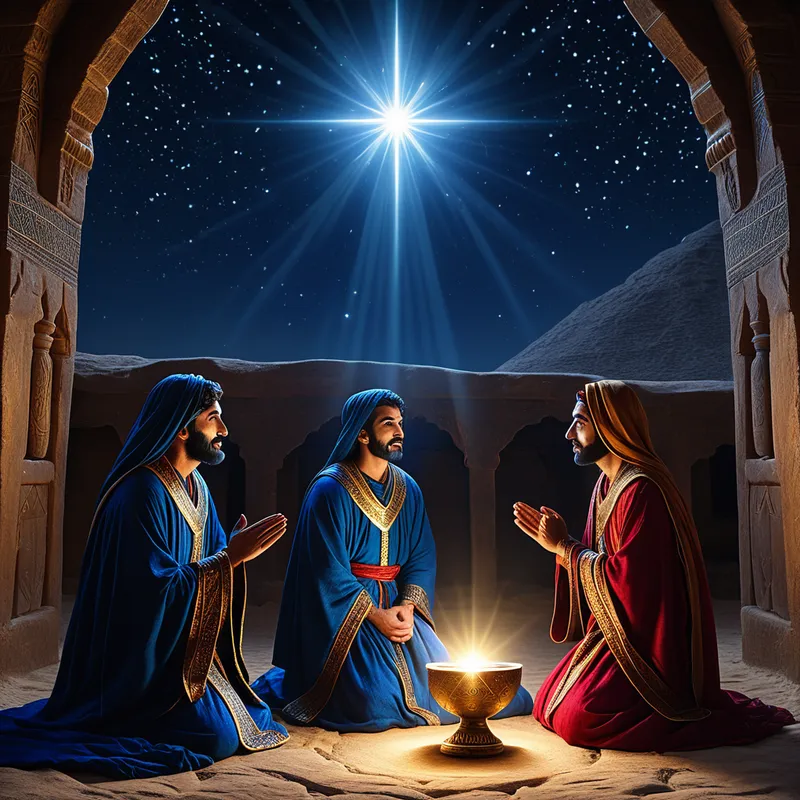
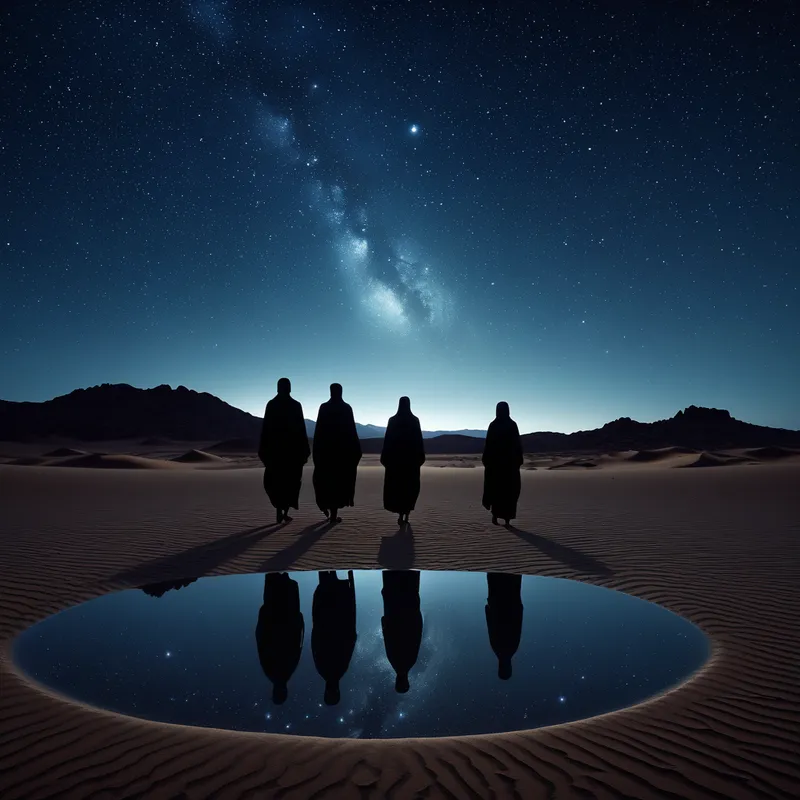
Listen. In the time when empires slept and the sky was a deeper black, a new star was born. It burned not with the cold indifference of its brethren, but with a fierce, singular purpose. In the distant East, where the earth meets the wisdom of the old gods and the calculations of the celestial spheres, men of ancient knowledge watched. These were the Magi, readers of the scroll of heaven. They saw the star’s impossible journey and felt a tremor in the marrow of their souls—a call written in light.
They did not hesitate. Leaving behind warm libraries and positions of honor, they turned their faces toward the unknown West. Their caravan became a moving island of purpose in a sea of sand and rumor. For weeks, then months, the star was their only compass. It led them not to palaces, but to the petty court of a jealous king, Herod, in the land of Judea. His smile was thin as a blade, his questions laced with a fear that smelled of blood and stone. He sent them onward, to a town of little consequence: Bethlehem.
The night they arrived was cold, the air sharp. The star, their relentless guide, ceased its motion. It hung, pulsing, over a place of utter simplicity—a dwelling for beasts. The scent of animals and earth filled their nostrils. Pushing aside the rough curtain, the light of their lamps fell upon a scene that un-made all their learning: a young woman, weary and radiant; a protective man; and in a feeding trough, a child.
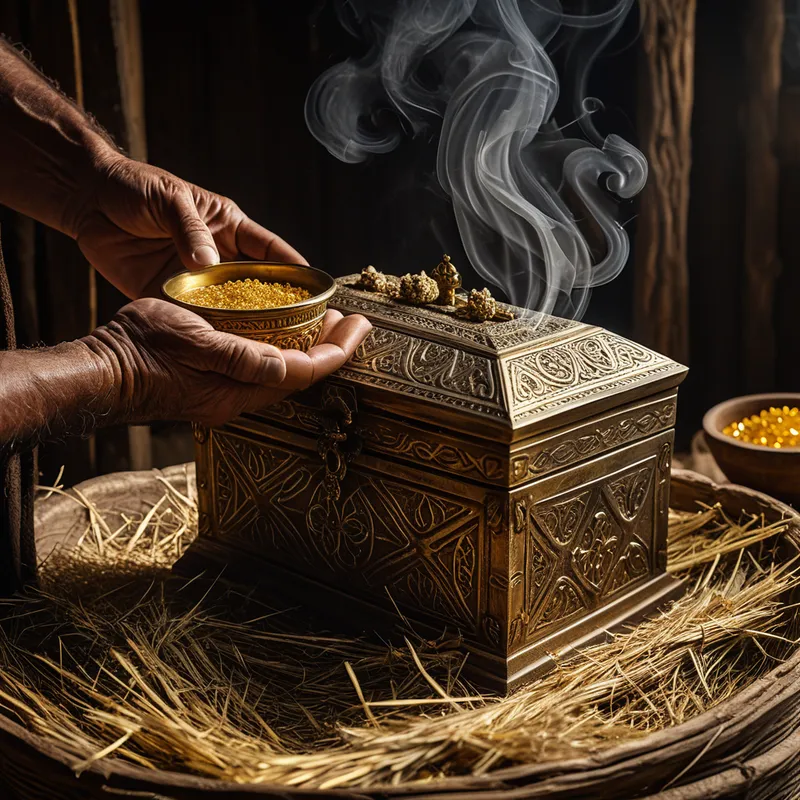
The universe contracted to this point. All their long roads, their sophisticated charts, their debates on the nature of the Asha, culminated not in a throne room but here, in the scent of hay and humility. Without a word, they fell to their knees. These lords of knowledge prostrated themselves before helpless infancy. Then, from the treasures borne across continents, they offered their gifts: Gold, for a king without a crown. Frankincense, for a divinity veiled in flesh. Myrrh, for a body destined for the grave.
Their offering complete, a warning echoed in a dream—a divine whisper against Herod’s treachery. They obeyed, vanishing into the night by another road, becoming ghosts in their own story, guardians of a secret too terrible and wonderful for the world of power. They returned home, but they were not the men who had left. They carried a silent, burning knowledge in their chests, and the world, though unchanged, was forever different.
Cultural Origins & Context
The story of the Magi appears only in the Gospel of Matthew, a text aimed at a Jewish audience seeking to position Jesus within a grand prophetic lineage. Their inclusion is profoundly strategic and symbolic. The Magi are not Jews; they are Gentile sages from “the East,” likely evoking the Persian and Babylonian traditions where the Magoi were renowned as astrologers, interpreters of dreams, and custodians of religious wisdom.
By having these prestigious foreign experts recognize and bow to the Jewish messiah, Matthew’s narrative makes a cosmic claim: the significance of this birth transcends ethnic and religious boundaries, fulfilling prophecies that “nations shall come to your light.” The story was passed down orally and textually within early Christian communities, functioning as a foundational myth of epiphany (theophany)—the manifestation of God to the world. It served to assert the universal kingship of Christ, contrast true wisdom (which seeks and bows) with worldly power (which fears and destroys), and validate the idea of divine guidance through signs both celestial and intuitive.
Symbolic Architecture
The myth is a perfect symbolic map of the psyche’s orientation toward the Self. The Magi represent the conscious intellect and worldly wisdom—the ego-complex in its mature, accomplished form. Yet this ego realizes its own incompletion. The star is the symbol of the Self, the central, organizing principle of the psyche, which appears as a compelling, numinous, and guiding image when the ego is ready for a deeper alignment.
The journey begins when the soul’s own knowledge confesses its ignorance, and sets out toward the unknown source of its light.
Their trek to Herod’s court is the necessary, often misguided, attempt to find the new center through old structures of power and collective consciousness—a false lead. The true destination is profoundly humble, even “lowly,” representing the nascent, vulnerable, and often overlooked core of new potential within (the divine child). The gifts are the surrender of the ego’s treasures to this new center: its wealth (Gold), its spiritual aspiration (Frankincense), and its conscious acknowledgment of its own mortality and necessary suffering (Myrrh). The “return by another way” signifies the irreversible transformation of the personality; once you have encountered the Self, you cannot navigate the world using your old maps.
The Dreamer’s Resonance
When this myth stirs in modern dreams, it often signals a profound reorientation of life’s purpose. Dreaming of following a strange, compelling light suggests the dreamer is being guided by an inner imperative toward a new stage of development, often one that feels irrational to the waking mind. The appearance of wise, foreign figures indicates the involvement of the archetype of the Wise Old Man/Woman, an aspect of the unconscious offering counsel.
Dreams of bearing significant gifts to an unexpected or humble recipient point to the dreamer preparing to offer their hard-won skills, love, or creativity to a nascent part of themselves or a new life venture. Conversely, dreams featuring a treacherous king (a Herod-figure) blocking the path represent the cynical, controlling, or fear-based complexes within the psyche that seek to destroy new growth. The somatic feeling is often one of determined pilgrimage—a sense of being compelled forward despite fatigue, coupled with moments of awe and kneeling, a literal somatic metaphor for the ego’s submission to a greater reality.
Alchemical Translation
The alchemical process mirrored here is the nigredo giving way to the albedo. The Magi’s initial state is one of latent potential—knowledge exists, but it is static. The call of the star is the vocatio, shattering this equilibrium and initiating the perilous journey (iter) of dissolution. The confrontation with Herod is the encounter with the shadow of worldly power, the devouring mother/father who would co-opt the process for egoic ends.
The gold offered is not spent, but transmuted; it is the ego’s substance surrendered to become the foundation of a new, more authentic kingdom within.
The stable is the vas hermeticum—the sealed, humble vessel where the great work occurs, unseen by the world. The act of kneeling and offering is the crucial coniunctio—the marriage of the conscious mind (Magi) with the emerging Self (the child). The gifts represent the final transmutation: base awareness becomes spiritual sovereignty (Gold), intellectual curiosity becomes devotional connection (Frankincense), and the fear of death becomes conscious acceptance of life’s cycles (Myrrh). The “return by another way” is the creation of the corpus incorruptibile—a personality now aligned with its inner center, capable of navigating life through inner authority rather than external convention. The myth, therefore, is a master blueprint for the individuation journey: the wise ego must undertake a perilous pilgrimage to offer all it has and all it is to the mysterious, nascent totality of the Self.
Associated Symbols
Explore related symbols from the CaleaDream lexicon: