The Luminous Darkness Myth Meaning & Symbolism
A seeker journeys into the heart of absolute darkness to discover the source of all light, finding the divine in the annihilation of the self.
The Tale of The Luminous Darkness
Listen, and let the silence between the words speak. There was a seeker, a traveler of the path, whose heart was a furnace of questions. He had scaled the mountain of knowledge and drunk from [the river](/myths/the-river “Myth from Buddhist culture.”/) of devotion, yet a thirst remained—a longing for the source of the spring itself. The wise ones spoke in whispers of a place beyond places, a condition beyond conditions. They called it Anwar al-Zulma, the Luminous Darkness.
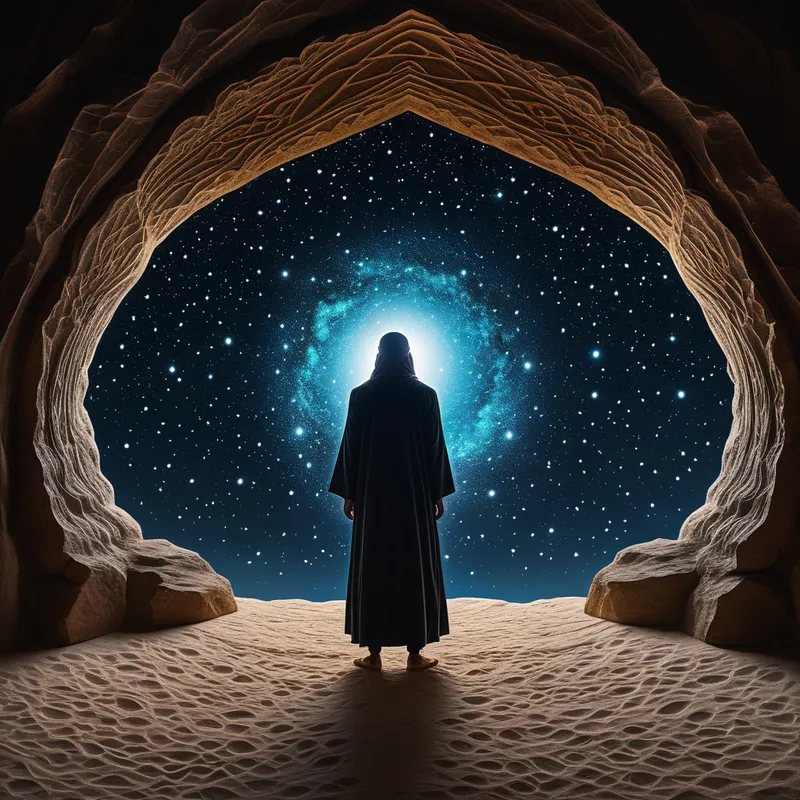
Driven by a love that burned away caution, the seeker left the gardens of certainty and walked into [the desert](/myths/the-desert “Myth from Biblical culture.”/) of unknowing. For forty days and forty nights, he followed the fading star of his own understanding until it, too, winked out. He arrived not at a temple, but at the mouth of a cave. Not a cave of stone, but of absence. It was a doorway into the Ghayb, the Unseen. From it breathed not wind, but a profound, welcoming silence that felt older than time.
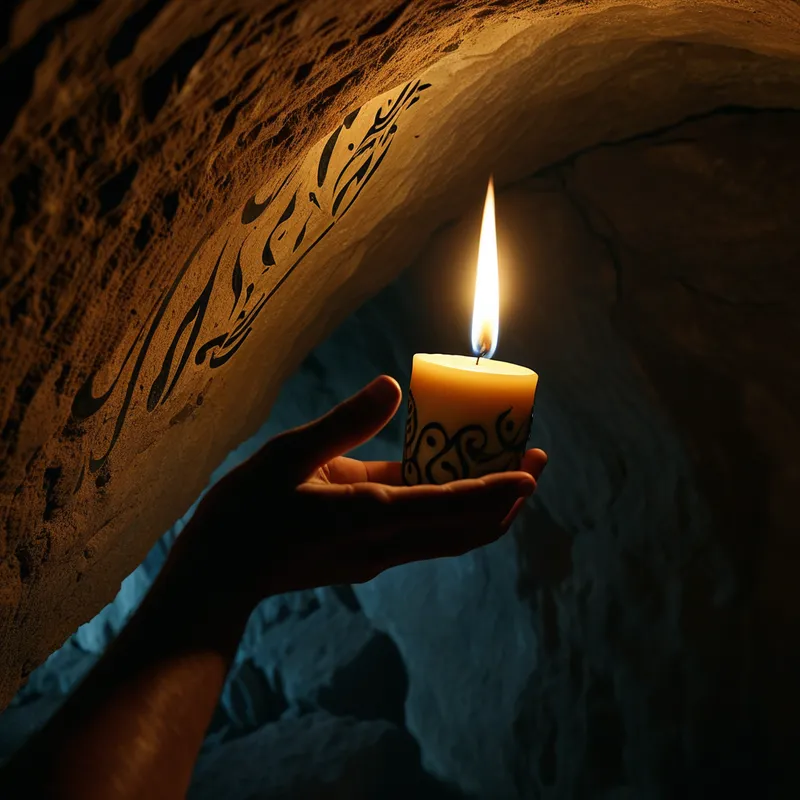
He lit a candle, a final spark of his will. Stepping inside, the light did not push back the dark; it was swallowed whole. The flame guttered, its light stretching thin and desperate before being absorbed into a blackness so complete it felt tangible—a velvet presence. The walls, the floor, the ceiling, his very sense of self began to dissolve into this boundless night. Panic, that last guardian of [the ego](/myths/the-ego “Myth from Jungian culture.”/), arose. He clutched his chest, feeling his identity, his memories, his name unravel like threads in a cosmic loom.
He fell to his knees. The candle died. In that final moment of surrender, when the last “I” was extinguished, something shifted. The darkness, which had felt like an end, began to feel like a womb. It was not empty. It was full—terrifyingly, magnificently full. And within it, he began to perceive. Not with his eyes, but with his essence. The blackness was not the absence of light, but its source. It was a luminous, living void. From its depths, all forms, all colors, all stars and souls emerged like breaths. He saw the cosmos spun from its stillness, every atom singing a note of its silent song. He was not looking at it. He was within it. He was it. The seeker, the search, and the sought had become one in the radiant, dark heart of the Real.
Cultural Origins & Context
This narrative is not a single, codified myth but a core metaphor woven through the tapestry of Sufism, from the poetic visions of Jalaluddin Rumi to the philosophical treatises of Ibn Arabi. It finds its roots in the Hadith about God’s primordial concealment: “I was a Hidden Treasure and I loved to be known, so I created creation.” The “Hidden Treasure” is imagined as a divine darkness, a plenitude of potential before manifestation.
It was passed down not as a children’s fable, but as an advanced teaching (dars) in khanqahs and through silsilas. Masters (Murshids) would impart it orally to disciples (murid) who had progressed beyond formal rituals. Its function was societal in a deeply introverted way: to model the ultimate goal of the mystic path—fana—and to provide a symbolic map for the soul’s journey beyond form, dogma, and the individual self, towards union (tawhid).
Symbolic Architecture
The myth is a masterclass in the [symbolism](/symbols/symbolism “Symbol: The use of symbols to represent ideas or qualities, often conveying deeper meanings beyond literal interpretation. In dreams, it’s the language of the unconscious.”/) of [paradox](/symbols/paradox “Symbol: A contradictory yet true concept that challenges logic and perception, often representing unresolved tensions or profound truths.”/), the central engine of mystical thought.
- [The Cave](/myths/the-cave “Myth from Platonic culture.”/): Represents the [heart](/symbols/heart “Symbol: The heart symbolizes love, emotion, and the core of one’s existence, representing deep connections with others and self.”/) (qalb), the [interior](/symbols/interior “Symbol: The interior symbolizes one’s inner self, thoughts, and emotions, often reflecting personal growth, vulnerabilities, and secrets.”/) castle of the [soul](/symbols/soul “Symbol: The soul represents the essence of a person, encompassing their spirit, identity, and connection to the universe.”/). It is not a [prison](/symbols/prison “Symbol: Prison in dreams typically represents feelings of restriction, confinement, or a lack of freedom in one’s life or mind.”/) but a sanctuary for the deepest encounter.
- The Extinguished [Candle](/symbols/candle “Symbol: Candles symbolize illumination, hope, and spiritual guidance, often representing the light within amidst darkness.”/): Symbolizes the intellect, the sensory mind, and the individual will. Its light is necessary for the [journey](/symbols/journey “Symbol: A journey in dreams typically signifies adventure, growth, or a significant life transition.”/) but insufficient for the [destination](/symbols/destination “Symbol: Signifies goals, aspirations, and the journey one is on in life.”/). Its [death](/symbols/death “Symbol: Symbolizes transformation, endings, and new beginnings; often associated with fear of the unknown.”/) is not a defeat but a prerequisite.
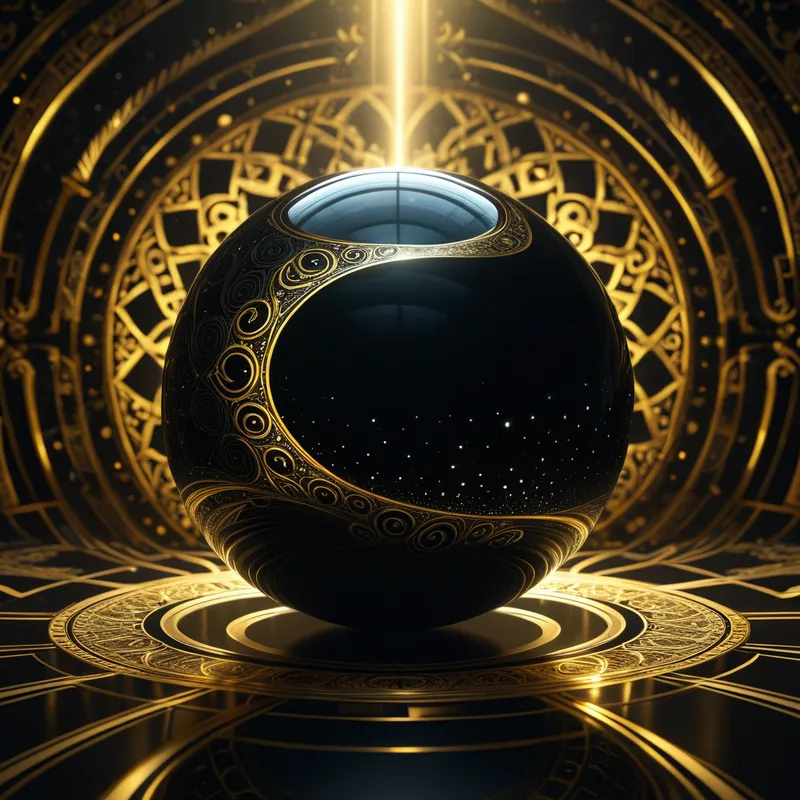
- The Luminous Darkness (Anwar al-Zulma): This is the core [symbol](/symbols/symbol “Symbol: A symbol can represent an idea, concept, or belief, serving as a powerful tool for communication and understanding.”/). It represents the Dhat of the Divine, the unconditioned [reality](/symbols/reality “Symbol: Reality signifies the state of existence and perception, often reflecting one’s understanding of truth and life experiences.”/) that precedes and encompasses all duality (light/dark, existence/nonexistence). Psychologically, it is the Unconscious—not as a repository of repressed [trauma](/symbols/trauma “Symbol: A deeply distressing or disturbing experience that overwhelms the psyche, often manifesting in dreams as unresolved emotional wounds or psychological injury.”/), but as the fecund, creative ground of the [psyche](/myths/psyche “Myth from Greek culture.”/) from which [consciousness](/symbols/consciousness “Symbol: Consciousness represents the state of awareness and perception, encompassing thoughts, feelings, and experiences.”/) itself dawns.
The light you seek to find by your own effort is the very veil that hides the greater Light which is its source.
The [seeker](/symbols/seeker “Symbol: A person actively searching for meaning, truth, or a higher purpose, often representing the dreamer’s own quest for identity or fulfillment.”/)‘s journey is the ego’s journey into its own fundament. The [terror](/symbols/terror “Symbol: An overwhelming, primal fear that paralyzes and signals extreme threat, often linked to survival instincts or deep psychological trauma.”/) of [dissolution](/symbols/dissolution “Symbol: The process of breaking down, dispersing, or losing form, often representing transformation, release, or the end of a state of being.”/) is the fear of the psyche confronting its own boundless, unknown [depths](/symbols/depths “Symbol: Represents the subconscious, hidden emotions, or foundational aspects of the self, often linked to primal fears or profound truths.”/). The final [revelation](/symbols/revelation “Symbol: A sudden, profound disclosure of truth or insight, often through artistic or musical means, that transforms understanding.”/)—that the darkness is the light—signals a transcendence of oppositional thinking, a realization that [the Self](/myths/the-self “Myth from Jungian culture.”/) (al-Haqq) is both the [source](/symbols/source “Symbol: The origin point of something, often representing beginnings, nourishment, or the fundamental cause behind phenomena.”/) of individual [identity](/symbols/identity “Symbol: Identity represents the sense of self, encompassing personal beliefs, cultural background, and social roles.”/) and the vastness in which it is annihilated and reborn.
The Dreamer’s Resonance
When this myth stirs in the modern dreamer, it often manifests not as a clear narrative, but as a profound somatic atmosphere. One may dream of:
- Floating in a dark, starless space that feels deeply peaceful yet awe-inspiring.
- Entering a familiar room that has become impossibly vast and dark, yet feels “full.”
- Losing a vital object (a light, a key, a name) and, in the panic, discovering a new sense of perception.
- Witnessing a black sun or a dark flame that radiates cool, magnetic energy.
These dreams signal a psychological process of de-integration. The conscious personality is being called, often by the Self, to release its rigid structures. The somatic feeling is key: a chilling fear giving way to a profound, warm stillness. This is the psyche’s innate intelligence guiding the ego through its own necessary “dark night,” where old identifications (career, roles, self-image) must dissolve to make way for a more authentic, less ego-centric mode of being. It is the dreamwork of fana.
Alchemical Translation
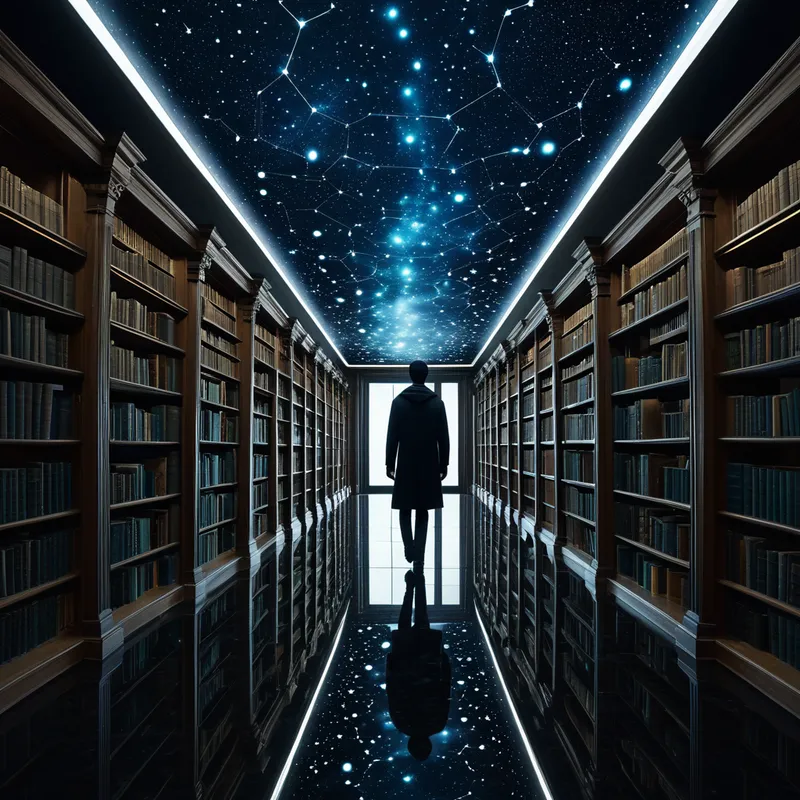
For the modern individual, this myth models the alchemical stage of [nigredo](/myths/nigredo “Myth from Alchemical culture.”/)—the blackening, the descent into the [prima materia](/myths/prima-materia “Myth from Alchemical culture.”/)—but with a crucial Sufi insight: the blackening is not a morbid end, but the beginning of true perception.
The “cave” is any life event that forces introspection: loss, failure, illness, or simply the existential void behind daily routines. The “candle” is our coping mechanisms, our stories of who we are, our frantic search for external answers. The alchemical work is to have the courage to stop, to let the candle go out, and to sit in the disorienting darkness without immediately seeking another light.
The treasure is not found by illuminating the darkness, but by realizing you are made of the same substance as the dark.
This is the transmutation. By enduring the annihilation of the ego’s certainties, one does not find a new, better “self” to identify with. Instead, one gains a perspective from the Darkness itself—from the ground of being. From here, life’s forms, relationships, and endeavors are no longer grasped for security but are perceived as beautiful, ephemeral manifestations of that one, luminous reality. The individual is not erased but is recontextualized. The struggle to “become someone” transforms into the grace of participating in a boundless, creative mystery. [The hero’s journey](/myths/the-heros-journey “Myth from Global culture.”/) concludes where it began, but the seeker now sees with the eyes of the Darkness-Light, at home in [the world](/myths/the-world “Myth from Tarot culture.”/) yet utterly free from it.
Associated Symbols
Explore related symbols from the CaleaDream lexicon: