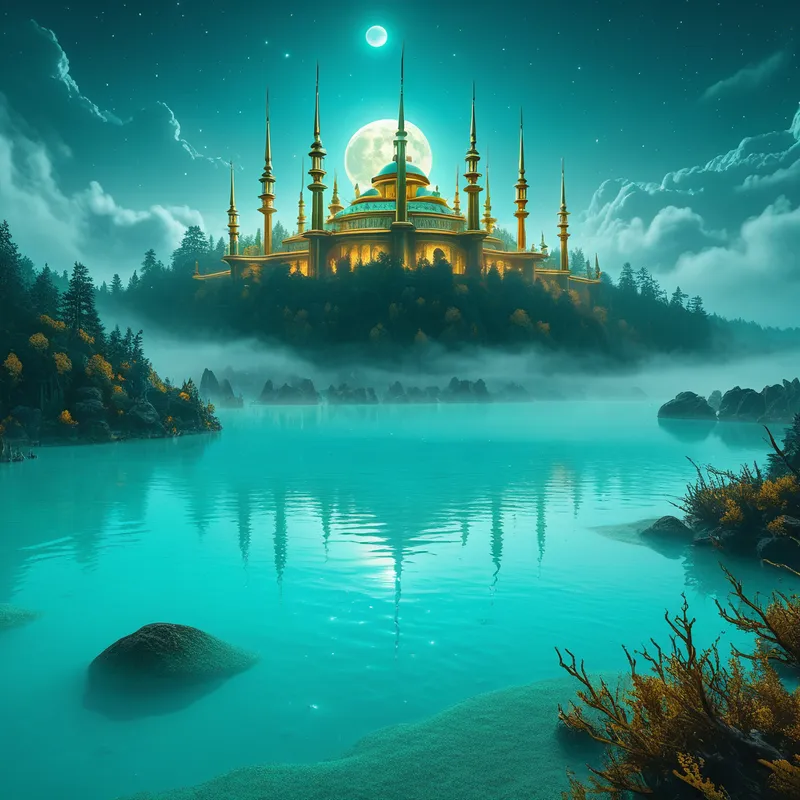
The Lost City/Civilization Myth Meaning & Symbolism
A golden city, swallowed by sea or jungle, whispers of a forgotten age, a lost part of ourselves we are compelled to seek.
The Tale of The Lost City/Civilization
Listen. Before the maps were drawn, before the names of our nations were spoken, there was a whisper on the wind. It spoke of a place where the sun never truly set, where the streets were paved with a light that came from within the stones themselves. They called it by many names: Atlantis, El Dorado, Shambhala, the Kumari Kandam. Its towers scraped the bellies of the clouds, and its scholars conversed with the stars.
In this age, it is said, humanity walked in harmony with forces we have since forgotten. The city was not built with hammer and nail, but with song and thought. Water flowed upward to nourish hanging gardens. Light was woven into tapestries that told living stories. There was no hunger, no strife, for the people understood the deep language of the world, the Logos that binds stone to star.
But listen closer. The whisper carries a tremor. For in their zenith, a flaw was born. It began not with a crash, but with a quiet turning inward. The songs became rote. The living light was captured and put to petty use. The dialogue with the cosmos faded to a monologue of self-congratulation. They believed their mastery was over nature, not of it. They built a great crystal, a lens to focus all the world’s energy, not to commune, but to command.
The sky, once a friend, darkened. The earth, once a partner, grew restless. The wise ones, voices now drowned out by the din of progress, spoke of a balance broken. They were ignored. Then came the night of the double moon. The seas, which had gently lapped at the city’s marbled docks, drew back a breath—a terrible, silent inhalation. For a moment, there was only the exposed seabed, glistening under the alien light.
Then the wave came. It was not water, but the world itself, roaring in rectification. It did not crash against the walls; it embraced the entire island, the entire continent, pulling it down into a loving, suffocating abyss. The great crystal shattered with a sound that was not heard, but felt in the bones of every creature for a thousand leagues. The light of the city was extinguished, not by darkness, but by the deep, patient blue of the ocean. In a single, graceful cataclysm, the peak of human endeavor was swallowed by the primal womb from which it had arrogantly declared its independence.
All that remained was the whisper. A memory of spires against the sunset. A dream of knowledge just beyond reach. The city was gone. But it was not forgotten. It became a longing etched into the spirit of every generation that followed.
Cultural Origins & Context
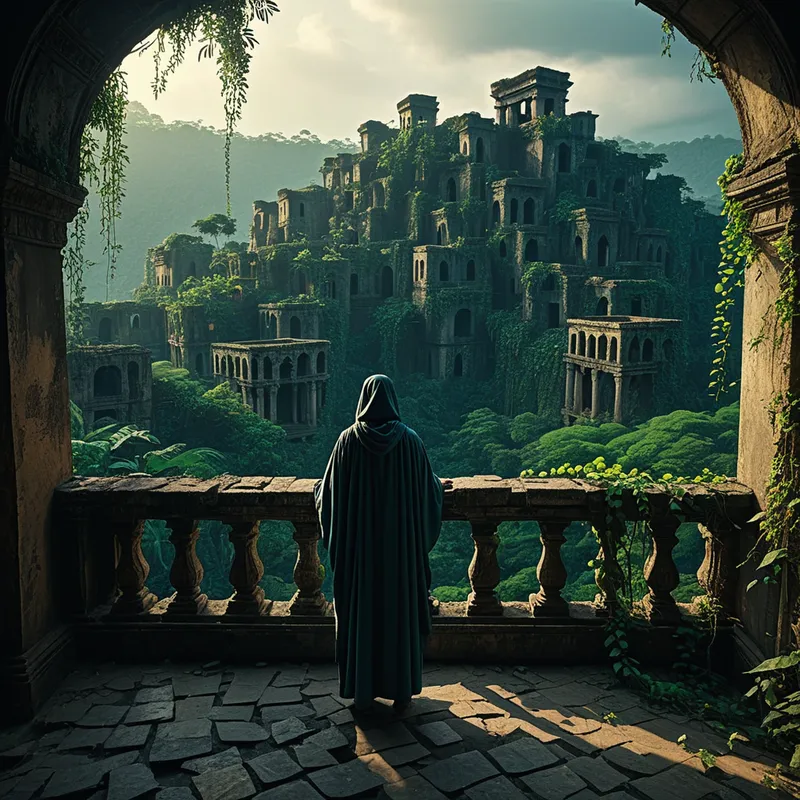
The myth of the lost civilization is perhaps the most ubiquitous and persistent story humanity tells itself. It is not the property of any one culture, but a psychic artifact of the species. We find it in Plato’s dialogues, written as a philosophical allegory for a decadent state. We hear it in the oral histories of the Amazonian tribes, speaking of a city of gold that shone through the trees. It echoes in Hindu texts about lands lost to the sea, and in Celtic legends of sunken kingdoms like Ys.
This story was never meant to be a history lesson. It was a tool used by elders, shamans, and philosophers. Its primary function was memento mori for civilizations—a warning against hubris, spiritual decay, and the loss of connection to the natural order. For the individual listener, it served a different purpose: it validated a deep, inexplicable sense of nostalgia for a time and place they had never known. It gave a shape to the feeling that something essential has been misplaced, that our current state is a fragmented echo of a more complete past. The story was passed down not to be believed literally, but to be felt as a truth of the soul.
Symbolic Architecture
Psychologically, the Lost City is not a place on any map. It is a symbol of the Self in its integrated, potential state—the totality of who we are meant to be, before life, trauma, and adaptation force us to compartmentalize and forget.
The city is the psyche in its wholeness; the cataclysm is the necessary trauma of incarnation that shatters that wholeness into manageable fragments.
The golden age represents the original, unconscious unity of the infant, where need and fulfillment are one. The advanced, yet flawed, technology symbolizes the burgeoning ego—powerful, inventive, but dangerously prone to inflation and separation from its instinctual roots (the natural world). The cataclysm—be it flood, earthquake, or jungle—is the symbolic representation of the shadow and the unconscious reasserting themselves. It is not merely punishment, but a violent, necessary correction. The city is not destroyed out of malice; it is reclaimed. It is submerged into the unconscious, where it becomes the hidden treasure, the core of our being that we spend a lifetime seeking to recover.

The Dreamer’s Resonance
When this myth activates in the modern dreamscape, it signals a profound process of recollection. To dream of wandering through vast, empty halls of an ancient, overgrown, or submerged city is to walk the corridors of one’s own forgotten potential. The somatic feeling is often one of awe mixed with melancholy—a poignant recognition.
The dreamer is not a tourist, but an archaeologist of the self. The specific ruin holds the clue: a flooded archive points to drowned memories or intuitions; a crumbling temple suggests a neglected spiritual center; a pristine, inaccessible tower glowing in the distance represents an idealized but unintegrated aspect of the personality. The journey through the dream-city is the psyche’s attempt to re-map itself, to find the central plaza where all these disparate ruins connect. The feeling upon waking is crucial: not of fear, but of a haunting, urgent nostalgia. It is the Self, buried under the daily debris of life, sending up a signal flare.

Alchemical Translation
The individuation journey—the process of becoming who we truly are—is precisely the quest for the Lost City. We begin in the state of diaspora, living in the outposts of our own personality, unaware of the magnificent ruin at our core.
The quest is not to rebuild the city as it was, but to dive into the waters that cover it, to retrieve not the gold, but the blueprint.
The first step is Nigredo, the blackening. This is the recognition of the loss—the depression, the feeling of meaninglessness, the sense that something vital is missing. This is the dream of the city in utter darkness. Next is Albedo, the whitening. This is the gathering of clues—the memories, the synchronicities, the fragments of dreams and passions that point toward the submerged whole. We follow the “whisper on the wind.”
The crucial phase is Citrinitas, the yellowing, often symbolized by the dive into the abyss. This is the confrontation with the shadow, the painful acknowledgment of the pride and fear that caused our personal “cataclysm.” We must swim through the murk of our own unconscious to even glimpse the sunken spires. Finally, Rubedo, the reddening, is the integration. It is not the physical raising of the city, but the internal realization of its pattern. We understand that the city was never outside us. We become the living vessel of its architecture. The civilization is not restored to the world; its wisdom is born anew, in a humbler, more conscious form, within the individual. The lost is found not where it fell, but in the heart of the seeker.
Associated Symbols
Explore related symbols from the CaleaDream lexicon: