The Lost City of Atlantis Myth Meaning & Symbolism
A magnificent island civilization, blessed by the gods, succumbs to pride and corruption before being swallowed by the sea in a single day and night.
The Tale of The Lost City of Atlantis
Hear now a tale not of heroes, but of a kingdom. A story whispered by the salt-wind and murmured in the deep places of [the earth](/myths/the-earth “Myth from Hindu culture.”/), told by the one who would not, could not, forget.
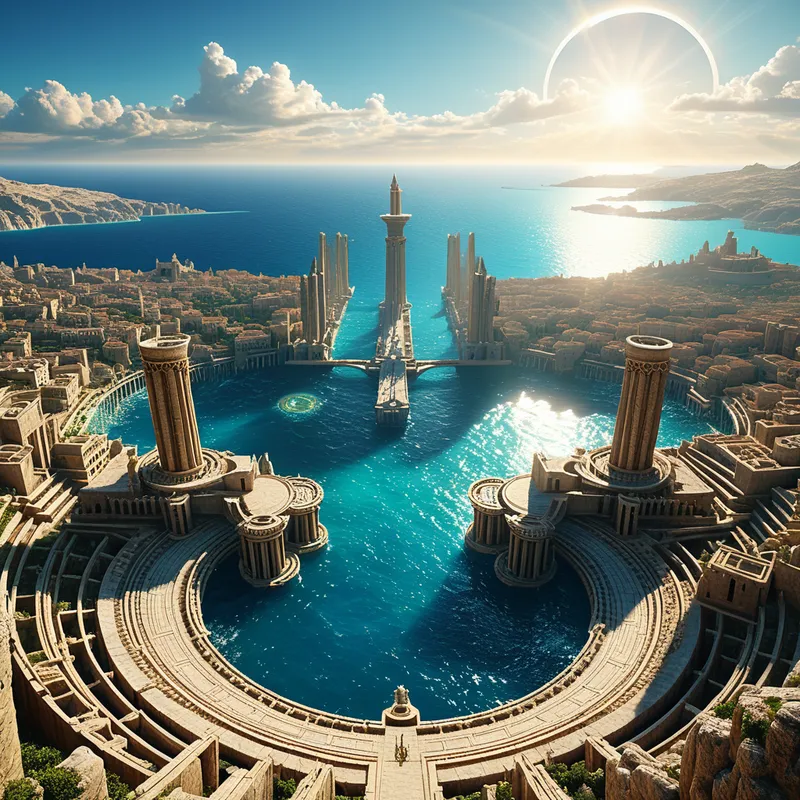
In the age when the gods walked closer to [the world](/myths/the-world “Myth from Tarot culture.”/), in the great ocean beyond the Pillars of [Heracles](/myths/heracles “Myth from Greek culture.”/), there rose an island greater than Libya and Asia Minor combined. This was Atlantis, a gift from the earth-shaker himself, [Poseidon](/myths/poseidon “Myth from Greek culture.”/). He cleaved the mountain at the island’s heart into concentric rings—two of earth, three of [water](/myths/water “Myth from Chinese culture.”/)—so that no ship might approach unbidden. At the center, he raised a temple of silver, gold, and ivory, dedicated to him and his mortal love, Cleito. From their union sprang ten kings, and the eldest, Atlas, ruled over all.
For generations, Atlantis was a marvel. The earth yielded fragrant woods and fruits twice a year. Herds of elephants roamed. The very stones of the city were red, white, and black, quarried from the rings themselves. A metal more precious than gold, orichalcum, gleamed on the walls of the citadel. The kings, descendants of the god, met in the central temple every fifth and sixth year. There, surrounded by the inscribed laws of Poseidon, they passed judgment, binding a bull with staves and noose, sacrificing it upon a sacred pillar of orichalcum, and swearing to govern justly.
Their bounty was immense. Their navies commanded the seas. Their architecture hummed with a perfect, divine geometry. They wanted for nothing the earth or ingenuity could provide. But the divine blood in their veins grew thin, diluted by mortal ambition. The noble character bestowed by Poseidon began to fade. Where there was [justice](/myths/justice “Myth from Tarot culture.”/), a craving for more grew. Where there was piety, arrogance took root. They looked upon their perfect rings and towering walls and saw not a divine gift, but a testament to their own unmatched power. The eye of their soul, once fixed on [the law](/myths/the-law “Myth from Biblical culture.”/) of the god, turned inward, admiring its own reflection.
And the god who had given them everything watched. He felt the shift in the tectonic plates of their spirit. The prayers became demands. The sacrifices, empty ritual. The sacred bond of king to god and king to people frayed, then snapped. The Atlanteans, in their hubris, marshaled their great force and set their sight on conquering all the lands within the Mediterranean, believing nothing could oppose their will.
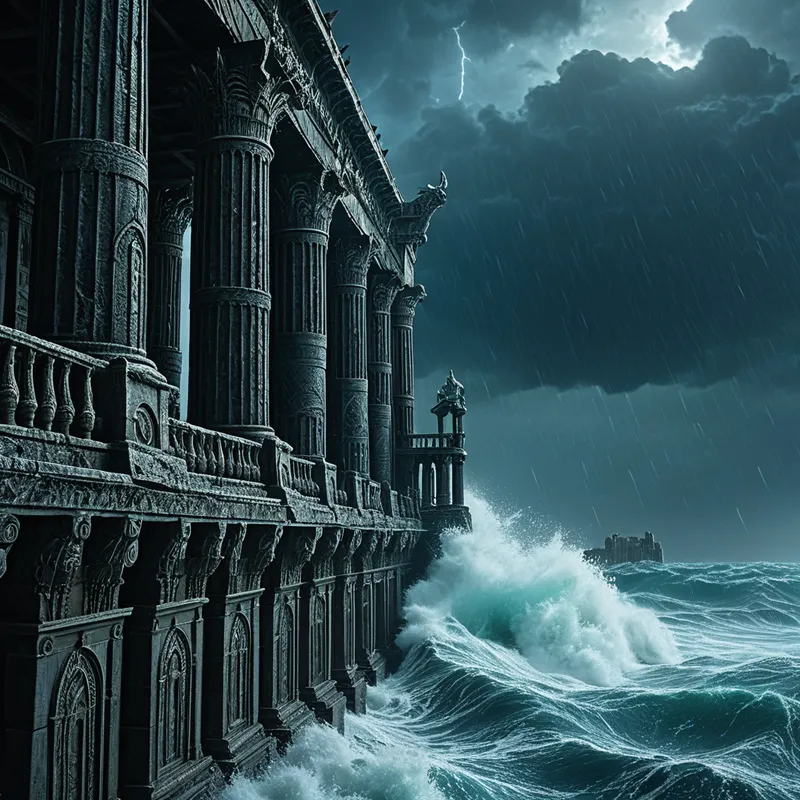
They did not see the gathering clouds. They did not feel the deep tremor in the world’s bones, the stirring of a wrath as deep and cold as [the abyss](/myths/the-abyss “Myth from Kabbalistic culture.”/). It came not with a declaration of war, but with a sigh from the ocean floor. The earth shook with a violence that shattered the perfect rings. [The sea](/myths/the-sea “Myth from Greek culture.”/), which had been their moat and their bounty, rose up in a single, mountainous wave. It did not crash upon the shores; it consumed them. The gleaming temples, the bustling harbors, the palaces of the god-born kings—all were swallowed in a single, terrible day and night of fire and quake and flood. The ocean poured into the great rift, and the island of wonders sank beneath the waves, leaving only a legend, a warning, and a sea of mud so thick no sailor could ever find its grave.
Cultural Origins & Context
The myth of Atlantis comes to us from a singular, profound source: the philosopher Plato. In his dialogues Timaeus and the unfinished Critias, written around 360 BCE, he presents the story not as popular folklore, but as a “true account” passed down through generations. The tale is recounted by Critias, who heard it from his grandfather, who heard it from the great Athenian lawgiver Solon, who learned it from Egyptian priests at Sais. These priests claimed the story was recorded in their ancient temples, preserved when other histories were lost to great cataclysms.
Its societal function in Plato’s work is didactic and political. Atlantis serves as the magnificent, arrogant foil to his ideal city-state, ancient Athens. In the story, it is the virtuous, proto-Athenians who defeat the imperialist Atlanteans before the cataclysm. The myth is a vehicle for exploring themes of ideal governance, the corruption of power, and the cyclical nature of civilization. It is a philosophical parable about the soul of a state: when its spiritual order (dikaiosyne) collapses into material greed and hubris, divine necessity (ananke) will bring about its catastrophic end. Unlike other Greek myths centered on individual heroes, Atlantis is a myth of collective destiny, a cautionary tale for the polis itself.
Symbolic Architecture
Atlantis is not merely a lost place; it is a lost state of being. It represents the [zenith](/symbols/zenith “Symbol: The highest point in the sky or life’s peak moment, representing spiritual culmination, achievement, and divine connection.”/) of [human](/symbols/human “Symbol: The symbol of a human represents individuality, complexity of emotions, and social relationships.”/) potential when aligned with divine order—a perfect society born from the [marriage](/symbols/marriage “Symbol: Marriage symbolizes commitment, partnership, and the merging of two identities, often reflecting one’s feelings about relationships and social obligations.”/) of the elemental (Poseidon) and the [human](/symbols/human “Symbol: The symbol of a human represents individuality, complexity of emotions, and social relationships.”/). Its concentric rings are a [mandala](/symbols/mandala “Symbol: A sacred geometric circle representing wholeness, the cosmos, and the journey toward spiritual integration.”/) of cosmic and psychic order, a map of a harmonious [soul](/symbols/soul “Symbol: The soul represents the essence of a person, encompassing their spirit, identity, and connection to the universe.”/) where instinct, [emotion](/symbols/emotion “Symbol: Emotion symbolizes our inner feelings and responses to experiences, often guiding our actions and choices.”/), and intellect are perfectly balanced and protected.
The fall of Atlantis is the psyche’s own warning: any structure, no matter how grand, built upon a forgotten foundation will inevitably collapse into the sea of the unconscious.
The corruption of the kings symbolizes [the ego](/myths/the-ego “Myth from Jungian culture.”/)’s fatal turn. The divine law within (Poseidon’s [covenant](/symbols/covenant “Symbol: A binding agreement or sacred promise between parties, often carrying deep moral, spiritual, or social obligations and consequences.”/)) is ignored in [favor](/symbols/favor “Symbol: ‘Favor’ represents the themes of acceptance, goodwill, and the desire for approval from others.”/) of external [expansion](/symbols/expansion “Symbol: A symbol of growth, increase, or extension beyond current boundaries, often representing personal development, opportunity, or overwhelming change.”/) and domination. The [orichalcum](/symbols/orichalcum “Symbol: A mythical metal from ancient legends, often associated with divine power, lost civilizations, and spiritual perfection.”/) shifts from being a sacred [material](/symbols/material “Symbol: Material signifies the tangible aspects of life, often representing physical resources, desires, and the physical world’s influence on our existence.”/) to a [symbol](/symbols/symbol “Symbol: A symbol can represent an idea, concept, or belief, serving as a powerful tool for communication and understanding.”/) of mere [wealth](/symbols/wealth “Symbol: Wealth in dreams often represents abundance, security, or inner resources, but can also symbolize burdens, anxieties, or moral/spiritual values.”/). The myth maps the archetypal [journey](/symbols/journey “Symbol: A journey in dreams typically signifies adventure, growth, or a significant life transition.”/) from the Ruler in its benevolent [aspect](/symbols/aspect “Symbol: A distinct feature, quality, or perspective of something, often representing a partial view of a larger whole.”/) to the Tyrant. The catastrophic sinking is not a random [punishment](/symbols/punishment “Symbol: A dream symbol representing consequences for actions, often tied to guilt, societal rules, or internal moral conflicts.”/), but the necessary [dissolution](/symbols/dissolution “Symbol: The process of breaking down, dispersing, or losing form, often representing transformation, release, or the end of a state of being.”/) of a form that has become antithetical to its own soul-[purpose](/symbols/purpose “Symbol: Purpose signifies direction, meaning, and intention in life, often reflecting personal ambitions and core values.”/). The sea does not destroy Atlantis; it reclaims it, reabsorbing the corrupted [projection](/symbols/projection “Symbol: The unconscious act of attributing one’s own internal qualities, emotions, or shadow aspects onto external entities, people, or situations.”/) back into the primordial, undifferentiated [depths](/symbols/depths “Symbol: Represents the subconscious, hidden emotions, or foundational aspects of the self, often linked to primal fears or profound truths.”/) from which all form emerges.
The Dreamer’s Resonance
To dream of Atlantis is to encounter a profound complex within the personal and collective unconscious. It often appears in periods of life when one has achieved a hard-won structure—a career, a relationship, a personal identity—that has begun to feel rigid, arrogant, or spiritually empty. The sunken city in the dreamscape is the dreamer’s own submerged potential and forgotten ideals.
Somatically, such dreams may be accompanied by sensations of pressure, drowning, or tectonic shifting. Psychologically, the dreamer is undergoing a process of humiliation in the ancient sense—being returned to the humus, the earth and sea. It is the ego’s constructed “island” of self-importance being inundated by forces it cannot control. The dream is not necessarily negative; it can be a call to remember one’s original “divine covenant,” the core values and authentic self that preceded the current, perhaps corrupt, structure. The haunting beauty of the sunken spires speaks to the enduring allure of that lost ideal, now waiting to be rediscovered in a more conscious, integrated form.
Alchemical Translation
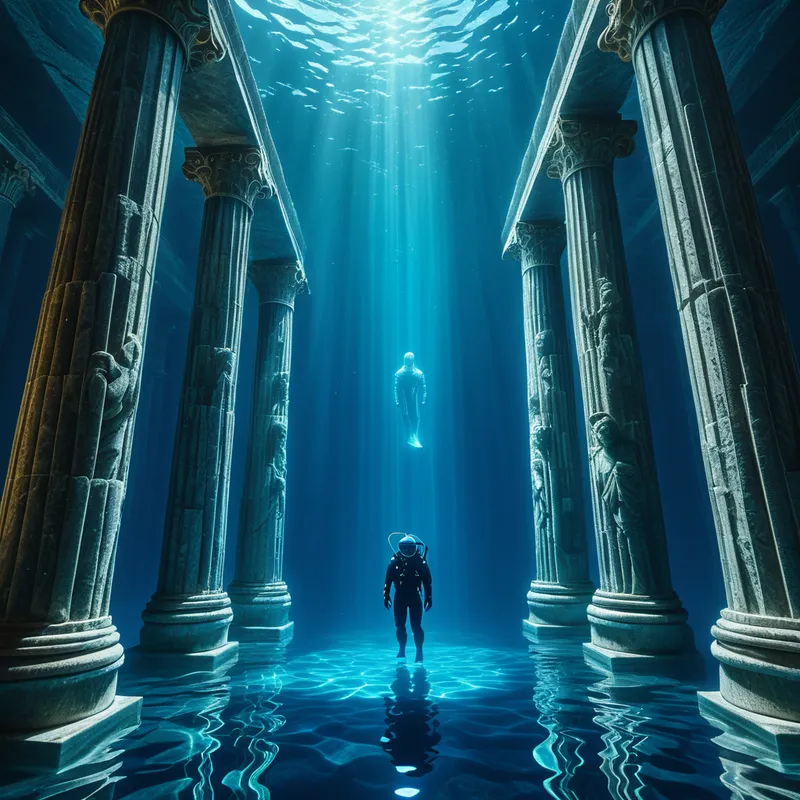
The myth of Atlantis models the alchemical process of [solutio](/myths/solutio “Myth from Alchemical culture.”/)—dissolution—a necessary and terrifying stage in the work of individuation. The proud, crystalline, isolated consciousness (the island kingdom) must be dissolved back into the massa confusa of the unconscious (the sea) so that a new, more authentic synthesis can emerge.
Individuation requires not just the building of a conscious ego, but the courageous drowning of the ego that has mistaken itself for the entire self.
For the modern individual, the “Atlantis complex” manifests as an attachment to a past achievement, a rigid self-image, or a worldview that has outlived its usefulness but is defended with imperial pride. The alchemical translation invites one to consciously participate in the dissolution. This means allowing old identities, burned-out ambitions, and corrupt patterns to be “swallowed by the sea”—released into the unconscious for transformation. It is a surrender of control. The goal is not to rebuild the same city on the same faulty foundation, but to salvage the true orichalcum—the core, uncorrupted value—from the wreck. From this, a new inner state can be founded, not on isolation and domination, but on a humble awareness of one’s place within the vast, unpredictable, and creative depths of the whole [psyche](/myths/psyche “Myth from Greek culture.”/). The lost city is never truly lost; it becomes the sunken treasure of the soul, a memory of wholeness that guides the next phase of becoming.
Associated Symbols
Explore related symbols from the CaleaDream lexicon: