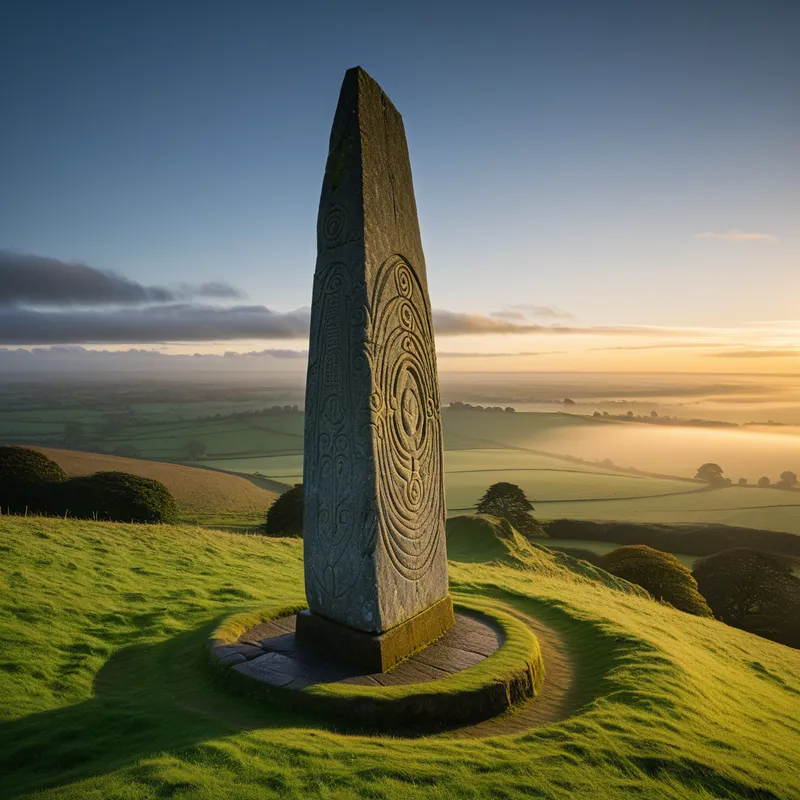
The Lia Fáil Myth Meaning & Symbolism
The sacred stone that cries out under the true king, a myth of sovereignty, destiny, and the deep resonance between land, ruler, and soul.
The Tale of The Lia Fáil
Listen, and hear the tale of the Stone that Knows.
In the time of mists, when [the world](/myths/the-world “Myth from Tarot culture.”/) was woven from song and shadow, a people of power came to the green shores of Éire. They were the Tuatha Dé Danann, and they brought with them four great treasures from the four mythic cities of the north. From Falias they brought a stone. Not a jewel, nor a weapon, but a pillar of grey destiny: the [Lia Fáil](/myths/lia-fil “Myth from Celtic culture.”/).
They set it upon the sacred hill of Teamhair, the navel of the land. [The earth](/myths/the-earth “Myth from Hindu culture.”/) itself seemed to sigh as the stone settled into the soil. The Dagda laid his hands upon its cold, rough surface and spoke a binding. “Here it shall stand,” his voice rumbled like distant thunder, “until the ending of the world. It shall be the heart of this land. And it shall know the heart of the one who would be king.”
The years turned like pages. Men of ambition and bloodline came to the hill. They came with armies at their backs and gold in their hands, seeking the high seat. Each in turn would stand before the silent stone, place a hand upon it, and declare their right. And for many, the stone remained just that—a cold, dumb rock. Their words echoed hollowly, and the land did not stir. These men ruled, if they ruled at all, by force and fear, and their reigns were brief, plagued by blight and battle.
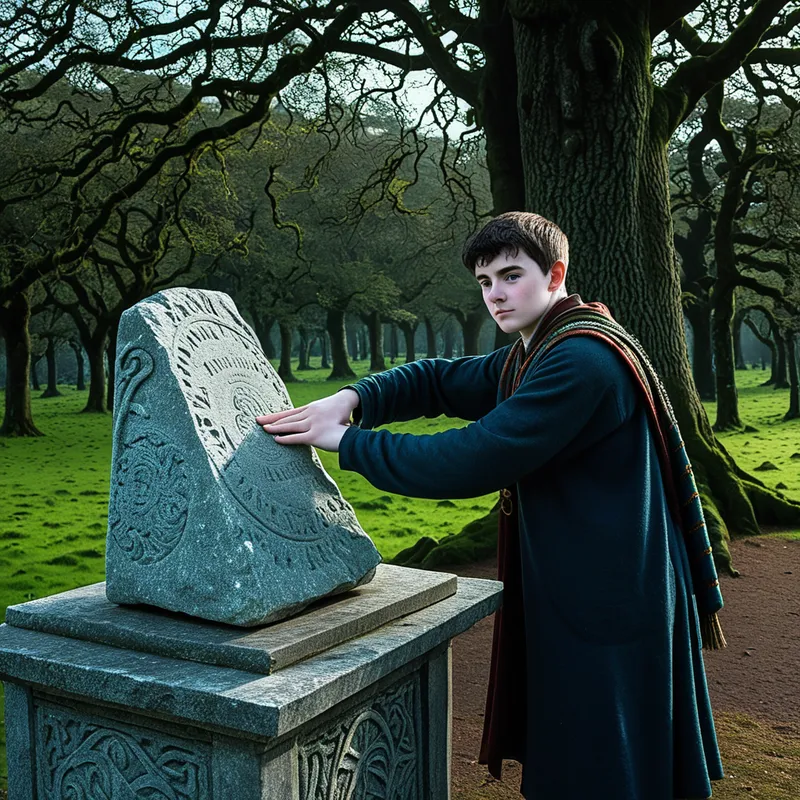
Then came a youth, not the eldest, not the most heralded. He came not with an army, but with a quiet step. He had been fostered in the wild places, taught by the banfheis and the fáith. He stood before the Lia Fáil as the first light of dawn touched its crest. He did not speak of his lineage or his might. He simply placed his bare palm upon the stone and breathed.
A silence deeper than any before fell upon Teamhair. The birds ceased their song. [The wind](/myths/the-wind “Myth from Various culture.”/) held its breath. Then, from the very core of the earth, through the roots of the hill and into the stone, a vibration began. It was a low hum that tuned the marrow of the bones. The stone, the grey and silent judge, began to sing. It was not a sound for the ears, but for the soul—a clear, resonant chord of perfect truth. And then, audible to all, the Lia Fáil cried out. A great roar of recognition, a shout of joy that shattered the morning dew on the grass.
In that cry, the land spoke. The rivers ran clearer, the cattle grew fat, and the people felt a peace settle in their chests they had not known. The stone had chosen. It had found the true king, not by blood or blade, but by an invisible, essential quality—the right resonance between the sovereign’s soul and the soul of the land itself. The stone had spoken, and a kingdom was born from its sound.
Cultural Origins & Context
The myth of the Lia Fáil is anchored in the complex tapestry of early Irish tradition, primarily preserved within the medieval manuscript cycle known as the Lebor Gabála Érenn (The Book of Invasions) and in the lore surrounding the Hill of Tara. It is crucial to understand that “Celtic” is a broad linguistic and cultural umbrella; this myth is specifically Irish, a product of the island’s unique synthesis of indigenous belief and incoming Goidelic tradition.
This was not a story for children, but a foundational political and sacred narrative. It was the domain of the filid, the poet-seers who acted as custodians of history, law, and cosmic order. By reciting the myth of the Lia Fáil at a rí’s inauguration, they were not merely telling a tale; they were performing a ritual of legitimation. The story served as the divine template for kingship: sovereignty was not a human right to be claimed, but a sacred condition to be recognized and confirmed by a power greater than any mortal assembly. The stone was the impartial arbiter, connecting the ruler directly to the Sovereignty Goddess and the land’s wellbeing.
Symbolic Architecture
At its core, the Lia Fáil is a [symbol](/symbols/symbol “Symbol: A symbol can represent an idea, concept, or belief, serving as a powerful tool for communication and understanding.”/) of objective [truth](/symbols/truth “Symbol: Truth represents authenticity, honesty, and the quest for knowledge beyond mere appearances.”/) in a subjective world. It represents the innate, unyielding law of authenticity. It cannot be bribed, flattered, or intimidated. It responds only to the genuine [article](/symbols/article “Symbol: An article in dreams symbolizes communication, insight, and the need for understanding, often reflecting one’s intellectual pursuits and social exchanges.”/).
The stone does not judge the resume of the life, but the resonance of the soul. Its cry is the sound of a destiny clicking into place.
Psychologically, the [stone](/symbols/stone “Symbol: In dreams, a stone often symbolizes strength, stability, and permanence, but it may also represent emotional burdens or obstacles that need to be acknowledged and processed.”/) embodies the Self—the deepest, most complete core of an individual. The many false kings who approach it represent the [persona](/symbols/persona “Symbol: The social mask or outward identity one presents to the world, often concealing the true self.”/) and [the ego](/myths/the-ego “Myth from Jungian culture.”/)’s ambitions—the titles, the achievements, the crafted [image](/symbols/image “Symbol: An image represents perception, memories, and the visual narratives we create in our minds.”/) we believe should grant us [authority](/symbols/authority “Symbol: A symbol representing power structures, rules, and control, often reflecting one’s relationship with societal or personal governance.”/) over our own lives. They place their hand on their [idea](/symbols/idea “Symbol: An ‘Idea’ represents a spark of creativity, innovation, or realization, often emerging as a solution to a problem or a new outlook on life.”/) of kingship, and are met with silence. The true [king](/symbols/king “Symbol: A symbol of ultimate authority, leadership, and societal order, often representing the dreamer’s inner power or external control figures.”/) represents the individual who, often through a [period](/symbols/period “Symbol: Periods in dreams can symbolize cyclical patterns, renewal, and the associated emotions of loss or change throughout life.”/) of [exile](/symbols/exile “Symbol: Forced separation from one’s homeland or community, representing loss of belonging, punishment, or profound isolation.”/) or fostering in the [wilderness](/symbols/wilderness “Symbol: Wilderness often symbolizes the untamed aspects of the self and the unconscious mind, representing a space for personal exploration and discovery.”/) of the unconscious (the wild places), has made contact with something more essential. He approaches not with a claim, but with a bare, vulnerable touch. The resulting cry is the [moment](/symbols/moment “Symbol: The symbol of a ‘moment’ embodies the significance of transient experiences that encapsulate emotional depth or pivotal transformations in life.”/) of coniunctio—[the ego](/myths/the-ego “Myth from Jungian culture.”/)’s alignment with [the Self](/myths/the-self “Myth from Jungian culture.”/). It is the [psyche](/myths/psyche “Myth from Greek culture.”/) recognizing its own rightful ruler.
The Dreamer’s Resonance
When this myth stirs in the modern dreamscape, it rarely appears as a literal stone on a hill. Its pattern manifests in dreams of testing, verification, and profound recognition. You may dream of standing before a silent panel of judges who only nod if you speak a specific, unknown word. You might dream of playing an instrument, and only when you stop reading the sheet music and play from pure feeling does the room fill with a glorious, unexpected harmony. You may dream of touching a mundane object—a doorknob, a tree in your backyard—and feeling a seismic vibration of “rightness” course through you.
Somatically, this is the process of the body sensing alignment. The dreamer is in a life phase where an external role (a job, a relationship, a social identity) has been assumed, but it lacks the vitalizing “cry.” There is a silent, draining friction. The dream signals that the psyche is conducting its own inauguration ritual, testing the current “sovereign” of your life—your dominant attitudes and identifications—against the deeper template of the Self. The anxiety or awe in the dream is the somatic marker of that test in progress.

Alchemical Translation
The alchemical journey modeled by the Lia Fáil is the transmutation of borrowed authority into innate sovereignty. The initial state is the [prima materia](/myths/prima-materia “Myth from Alchemical culture.”/) of the false kings: the leaden weight of living by external validation, societal scripts, and inherited mandates. This is the “silent stone” phase of life, where effort yields no deep resonance, only exhaustion.
The fostering in the wild—the hero’s unglamorous preparation—is the [nigredo](/myths/nigredo “Myth from Alchemical culture.”/). It is the necessary dissolution of the old, false [persona](/myths/persona “Myth from Greek culture.”/). This is the period of depression, confusion, or “wilderness” where one’s familiar identity breaks down. It feels like a loss of kingship, but it is the essential clearing of the throne.
The approach to the stone is the albedo—a moment of stark, clear simplicity. No armies, no speeches. Just the bare self, presented without adornment. The act of touching the stone is the ultimate risk: the willingness to be judged by an inner, absolute standard.
The cry of the stone is the rubedo—the eruption of life, color, and authentic power. It is not an explosion of ego, but the resonant hum of the entire system coming online.
For the modern individual, this is the process of individuation. It is moving from being a subject of external forces (parents, culture, the inner critic) to becoming the legitimate ruler of your own inner kingdom. The “land” that prospers is your own life—your relationships, your work, your creative expression—which begins to flourish not from strained effort, but from the natural, resonant authority of a Self-aligned existence. You stop trying to make the stone cry out for you, and you become the person for whom it cannot stay silent.
Associated Symbols
Explore related symbols from the CaleaDream lexicon: