The Leprechaun's Hat Myth Meaning & Symbolism
A tale of a mortal who captures a leprechaun, seizes his hat of power, and discovers that true sovereignty cannot be stolen, only earned from within.
The Tale of The Leprechaun’s Hat
Listen now, and hear the whisper in [the hawthorn hedge](/myths/the-hawthorn-hedge “Myth from Celtic culture.”/). Feel the damp of the evening moss. In the time when [the world](/myths/the-world “Myth from Tarot culture.”/) was thinner, and the [Sídhe](/myths/sdhe “Myth from Celtic / Irish culture.”/) walked closer to [the world](/myths/the-world “Myth from Tarot culture.”/) of men, there lived a man named Dáire. Dáire was a farmer of sour disposition, whose eyes saw only the hardness of soil and the weight of coins, never the green fire of the foxglove or the laughter hidden in [the wind](/myths/the-wind “Myth from Various culture.”/).
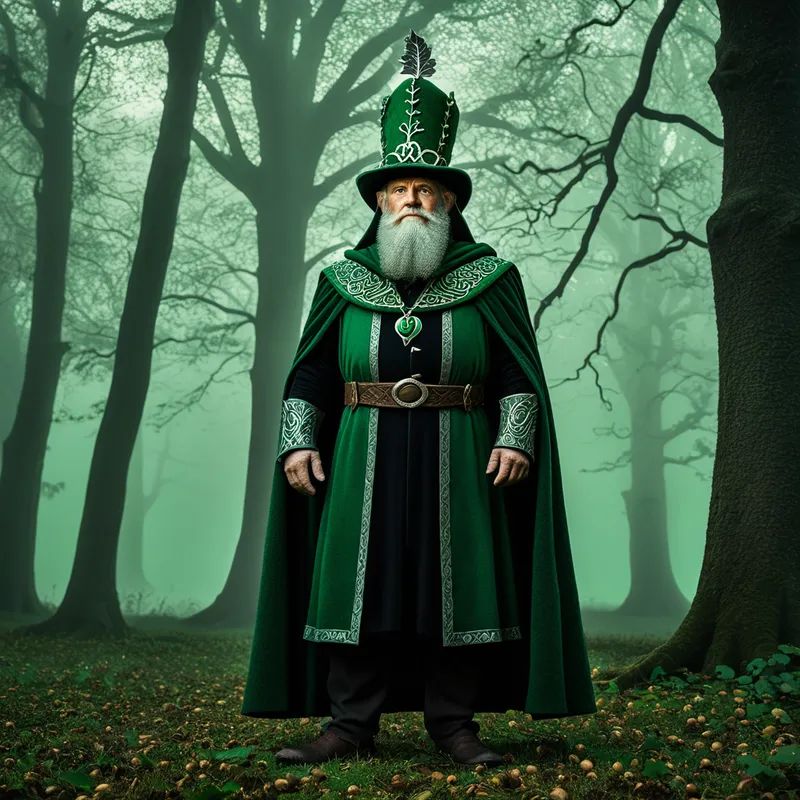
One twilight, as a mist, grey as a ghost, curled up from the bog, Dáire heard a rhythmic tap-tap-tapping. Peering through a veil of [ferns](/myths/ferns “Myth from Celtic culture.”/), he beheld a sight that stilled his breath. There, under the gnarled root of an ancient oak, sat a [leprechaun](/myths/leprechaun “Myth from Celtic culture.”/). He was old, older than the stone in the stream, dressed in a coat of weathered green. Upon his head sat a hat, a simple, battered [thing](/myths/thing “Myth from Norse culture.”/) of brown felt, and he was mending a tiny boot with fierce concentration, his hammer a flash of silver in the gloom.
Dáire’s heart, a cramped and dusty chamber, flooded with a single, burning thought: the gold. Every child knows the lore: capture a leprechaun, and he must grant you his hidden treasure to buy his freedom. With the stealth of a stalking cat, Dáire lunged, his heavy hand closing around the tiny being. The leprechaun did not startle. He simply ceased his tapping and looked up, his eyes like chips of wet bog-oak, holding depths Dáire could not fathom.
“Release me,” the little man said, his voice the sound of dry leaves skittering over stone. “Your gold first,” Dáire rasped, his grip tightening. “Show me your crock, or I’ll not let go till the sun burns this mist away.” The leprechaun sighed, a sound like a distant hill collapsing. “Very well. It lies buried at the foot of the rainbow that touches the far hill yonder.”
Dáire scoffed. “A fool’s errand! You’ll slip away the moment I look to the hill. No. I’ll have a pledge. Your hat. Give me your hat as surety, and I will carry you to the spot. Without it, you cannot vanish, for all your kind need their hats to work their glamours.”
A silence fell, thicker than [the mist](/myths/the-mist “Myth from Celtic culture.”/). The leprechaun’s ancient face was unreadable. Slowly, with a deliberate grace, he removed his hat. As it left his head, something in the air changed. The leprechaun seemed to dim, to become less present, like a memory fading. Dáire felt a chill that had nothing to do with the evening. He snatched the hat, a plain, rough thing, yet it felt strangely heavy, dense with silence.
He carried the leprechaun to the hill, but of course, there was no rainbow, only the creeping dark. The leprechaun offered other places—under the white thorn, in the heart of the round fort—but each time Dáire refused, clutching the hat like a [talisman](/myths/talisman “Myth from Global culture.”/). Finally, as the first star pricked the violet sky, the leprechaun spoke again, his voice now faint.
“You have the hat. You have the power of binding. But what is bound, binds in turn. The hat is not a tool for men. It is a seal. Keep it, and keep what comes with it.”
With a sound like a sigh of [the earth](/myths/the-earth “Myth from Hindu culture.”/) itself, the leprechaun was simply… gone. Not by magic, but by a profound absence, as if he had been recalled from the world. Dáire stood alone on the lonely hill, the little brown hat in his hand, the vast, star-filled sky above him, and a hollow, echoing coldness in the place where his greed had been.

Cultural Origins & Context
The figure of the leprechaun, and tales of capturing him, are staples of later Irish folk tradition, passed down through the seanchaí (storytellers) by hearthsides and at crossroads. While the specific motif of the hat as the source of his power is less common than the pursuit of his gold, it is a potent folkloric elaboration that speaks to a deep, pre-Christian understanding. These stories were not mere children’s fables; they were societal cautionary tales, often told to illustrate the peril of engaging with the [Otherworld](/myths/otherworld “Myth from Celtic culture.”/) on purely transactional, human terms.
The leprechaun himself is a complex figure. He is a solitary faerie, a craftsman (a cobbler), and a guardian of treasure. His hat is a fascinating later accretion. In a culture where headgear often denoted status, profession, or sovereignty (think of a king’s crown or a druid’s hood), the leprechaun’s hat can be seen as the symbol of his specific office and power within the unseen ecology of the land. To take it is not just to capture him, but to attempt to usurp a role, to steal an identity that is intrinsically tied to a realm and a logic alien to human ambition.
Symbolic Architecture
The myth operates on a profound symbolic level. The leprechaun represents the autonomous, [trickster](/symbols/trickster “Symbol: A boundary-crossing archetype representing chaos, transformation, and the subversion of norms through cunning and humor.”/) [spirit](/symbols/spirit “Symbol: Spirit symbolizes the essence of life, vitality, and the spiritual journey of the individual.”/) of the unconscious—the innate, crafty genius of the [psyche](/myths/psyche “Myth from Greek culture.”/) that works in the shadows, mending the “shoes” that connect us to the [earth](/symbols/earth “Symbol: The symbol of Earth often represents grounding, stability, and the physical realm, embodying a connection to nature and the innate support it provides.”/) of our instincts. His gold is the potential for psychic [wealth](/symbols/wealth “Symbol: Wealth in dreams often represents abundance, security, or inner resources, but can also symbolize burdens, anxieties, or moral/spiritual values.”/): creativity, [insight](/symbols/insight “Symbol: A sudden, deep understanding of a complex situation or truth, often arriving unexpectedly and illuminating hidden connections.”/), and transformation. Dáire represents the conscious ego, driven by a literal, acquisitive mindset that seeks to possess this [wealth](/symbols/wealth “Symbol: Wealth in dreams often represents abundance, security, or inner resources, but can also symbolize burdens, anxieties, or moral/spiritual values.”/) without understanding its [nature](/symbols/nature “Symbol: Nature symbolizes growth, connectivity, and the primal forces of existence.”/).
The hat is the crown of the inner sovereign, the symbol of integrated identity. To possess it without right is to wear a crown of lead.
The hat, therefore, is the key [symbol](/symbols/symbol “Symbol: A symbol can represent an idea, concept, or belief, serving as a powerful tool for communication and understanding.”/). It is not merely a tool of invisibility or escape; it is the container of [identity](/symbols/identity “Symbol: Identity represents the sense of self, encompassing personal beliefs, cultural background, and social roles.”/) for the leprechaun. It is his [connection](/symbols/connection “Symbol: Connection symbolizes relationships, communication, and bonds among individuals.”/) to his own sovereign power within [the Otherworld](/myths/the-otherworld “Myth from Celtic culture.”/). When Dáire demands the hat, he is not asking for a tool; he is demanding the very essence of the other’s being as collateral. His victory is the ultimate pyrrhic victory. He gains the [symbol](/symbols/symbol “Symbol: A symbol can represent an idea, concept, or belief, serving as a powerful tool for communication and understanding.”/) of power but loses the living [relationship](/symbols/relationship “Symbol: A representation of connections we have with others in our lives, often reflecting our emotional state.”/) to the magic itself. The leprechaun [doesn](/symbols/doesn “Symbol: The word ‘doesn’ typically points to a lack or feeling of uncertainty regarding action or inactivity in one’s life.”/)‘t escape; he withdraws, because the [condition](/symbols/condition “Symbol: Condition reflects the state of being, often focusing on physical, emotional, or situational aspects of life.”/) for his [presence](/symbols/presence “Symbol: Presence in dreams often signifies awareness or acknowledgment of something significant in one’s life.”/)—his integral, self-possessed [identity](/symbols/identity “Symbol: Identity represents the sense of self, encompassing personal beliefs, cultural background, and social roles.”/)—has been violated and taken.
The haunting [resolution](/symbols/resolution “Symbol: In arts and music, resolution refers to the movement from dissonance to consonance, creating a sense of completion, release, or finality in a composition.”/), where Dáire is left with the object but not the spirit, perfectly encapsulates the psychological [truth](/symbols/truth “Symbol: Truth represents authenticity, honesty, and the quest for knowledge beyond mere appearances.”/): you cannot steal wholeness. You can only cultivate it from within.
The Dreamer’s Resonance
When this myth pattern appears in modern dreams, it often signals a critical encounter with the “trickster” aspect of the psyche. Dreaming of chasing or capturing a leprechaun-like figure may reflect a conscious desire to quickly “capture” an insight, a solution, or a creative spark (the gold) through force of will or cleverness.
Dreaming specifically of taking the hat, however, points to a deeper, more troubling process. It suggests [the ego](/myths/the-ego “Myth from Jungian culture.”/) is attempting to appropriate an inner authority or identity that it has not earned. This can manifest somatically as a feeling of hollowness, a “crown of pressure” on the head, or a sense of being an imposter. The dreamer may be in a situation where they have achieved a position or adopted a role (the hat) but feel disconnected from the authentic power and responsibility it should confer. The leprechaun’s disappearance in the dream mirrors a feeling of the soul’s genius, the inner craftsman, going dormant or inaccessible, leaving the dreamer with the empty shell of a status they cannot animate.

Alchemical Translation
The alchemical journey modeled here is the transition from literal appropriation to symbolic integration—a core process in Jungian individuation. Dáire begins in the [nigredo](/myths/nigredo “Myth from Alchemical culture.”/), the blackening, ruled by the base lead of greedy literalism. He seeks the gold outwardly, in a physical crock. His “capture” of the hat represents a flawed, inflationary attempt at the albedo (whitening), a premature grabbing of a symbol of enlightenment without the requisite dissolution of the ego.
The true transmutation begins not with seizing the hat, but with feeling the profound chill of its emptiness in your hands.
The leprechaun’s final lesson is the catalyst for the real work. The hollow victory is the necessary disillusionment. The modern individual must undergo the same: to recognize that the sought-after power, creativity, or sovereignty cannot be taken from an external source—be it another person, a title, or a purchased spirituality. One must first feel the absence, the “hollow on the hill.”
The next stage is to stop clutching the stolen hat and to begin, like the leprechaun, to become a craftsman. To mend what is worn, to attend to the small, practical boots of daily life and integrity. In doing so, slowly, through genuine engagement with the psyche’s depths (the mending work under the oak root), one earns the right to a hat of one’s own making. This earned hat is not a tool for binding others or for escape, but the symbol of a self-created, authentic identity—a sovereignty that does not vanish when challenged, because it was never stolen, but forged in the humble, tapping rhythm of soul-work.
Associated Symbols
Explore related symbols from the CaleaDream lexicon: