The Lemnian Women Myth Meaning & Symbolism
A myth of women who murder their husbands, are exiled, and find redemption through the hero Jason, embodying the shadow, exile, and the return of the masculine.
The Tale of The Lemnian Women
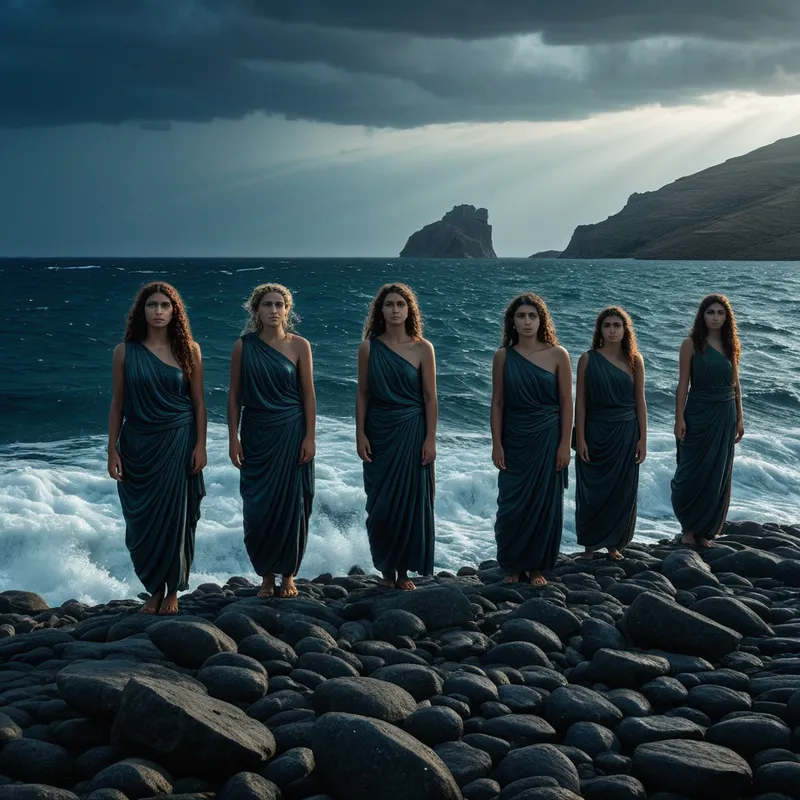
Hear now of the isle of Lemnos, a land born of fire and ash, where the air itself smelled of the forge. Its women were famed for their beauty, but a deeper scent clung to them—the bitter perfume of neglect. For the men of Lemnos, their husbands, had turned their hearts and bodies away, captivated by the sleek-limbed captives they brought from the shores of Thrace. The hearths grew cold, the laughter of children faded, and a silent, seething poison took root in the women’s souls.
It was the goddess Aphrodite herself who planted the final seed of wrath. Offended by the lack of worship, she cursed the women with a foul, unbearable odor. This was the final betrayal, not by the gods, but by their own flesh. The stench was [the mirror](/myths/the-mirror “Myth from Various culture.”/) of their husbands’ disgust, made manifest. In that shared humiliation, a terrible council was held. Not in the agora, but in the secret dark, led by Queen Hypsipyle. The verdict was unanimous and absolute. In one night of blood and iron, the women rose. They did not meet their men in battle; they met them in sleep, in trust, in the very beds they had abandoned. Fathers, husbands, sons—all who wore the male form were cut down. The island’s streams ran red, and the only cries that echoed from the houses were not of pain, but of grim [triumph](/myths/triumph “Myth from Roman culture.”/). Lemnos became a kingdom of women, a silent, efficient, and utterly lonely gynocracy.
Years passed. The blood soaked into [the earth](/myths/the-earth “Myth from Hindu culture.”/), but the isolation grew heavier than any chain. They tended the fields, built the walls, and in the stillness, the ghost of their deed became their only companion. Then, a shadow appeared on [the horizon](/myths/the-horizon “Myth from Various culture.”/)—the Argo, mighty ship of the Argonauts, blown off course by a raging storm. From the cliffs, the Lemnian women saw not men, but demons of the deep sent to punish them, or perhaps saviors sent to break their cursed solitude. Hypsipyle, to protect her people, devised a ruse. She would welcome them, but as traders, as temporary guests. The plan dissolved at the first touch. The long famine of connection was too great. [The Argonauts](/myths/the-argonauts “Myth from Greek culture.”/), weary from [the sea](/myths/the-sea “Myth from Greek culture.”/), found not monsters, but skilled, fierce, and achingly lonely women. For a season, Lemnos bloomed again. Love was rekindled, and from these unions, a new generation quickened in [the womb](/myths/the-womb “Myth from Various culture.”/).
But the Argo’s quest called. The Fleece was not on Lemnos. When [the wind](/myths/the-wind “Myth from Various culture.”/) turned fair, [Jason](/myths/jason “Myth from Greek culture.”/) and his men prepared to depart. The air, once filled with the scent of reconciliation, grew thick with a second, more profound grief. Hypsipyle, who had borne Jason twin sons, stood on the shore. She did not beg. She, who had orchestrated a massacre, now presided over a sacrifice of a different kind—the sacrifice of her newfound love to destiny. The ship sailed. The women of Lemnos were left once more on their shore, but they were no longer just murderers. They were mothers. The island was no longer just a prison of their crime, but a homeland awaiting its children.
Cultural Origins & Context
The myth of the Lemnian women is a foundational layer in the epic cycle of [Jason and the Argonauts](/myths/jason-and-the-argonauts “Myth from Greek culture.”/), most comprehensively recorded in Apollonius of Rhodes’s Hellenistic epic, the Argonautica. Its roots, however, dig far deeper into the pre-Greek substrate of the Aegean. Lemnos was historically associated with [Hephaestus](/myths/hephaestus “Myth from Global/Universal culture.”/), the limping god cast out from Olympus, and its indigenous population, the Tyrsenoi, were considered “barbaric” by the later Greeks.
This myth functioned as a terrifying “what if” scenario for the patriarchal Greek polis. It explored the ultimate societal inversion: a world without men. It was a cautionary tale about the dangers of neglecting sacred duties (to Aphrodite, to [the hearth](/myths/the-hearth “Myth from Norse culture.”/)) and the monstrous potential of the repressed feminine. Yet, it was not simply a horror story. By integrating it into the Jason saga, the myth-tellers also presented a narrative of painful reintegration. The Argonauts, a band of heroic masculinity, do not conquer the island; they heal its rupture, however temporarily, and plant the seed for its future. The story thus served to reinforce social norms while simultaneously acknowledging the powerful, chaotic forces that lurk if those norms are broken.
Symbolic Architecture
At its core, this myth is a profound [drama](/symbols/drama “Symbol: Drama signifies narratives, emotional expression, and the exploration of human experiences.”/) of the [Shadow](/symbols/shadow “Symbol: The ‘shadow’ embodies the unconscious, repressed aspects of the self and often represents fears or hidden emotions.”/). The Lemnian women embody the collective [shadow](/symbols/shadow “Symbol: The ‘shadow’ embodies the unconscious, repressed aspects of the self and often represents fears or hidden emotions.”/) of the feminine, driven to monstrous [action](/symbols/action “Symbol: Action in dreams represents the drive for agency, motivation, and the ability to take control of situations in waking life.”/) by profound neglect. Their murder is not mere violence; it is the [eruption](/symbols/eruption “Symbol: A sudden, violent release of pent-up energy or emotion from beneath the surface, often representing transformation or crisis.”/) of everything a culture has denied, devalued, and cast aside.
The shadow, when utterly abandoned, does not whisper; it takes up the knife. The Lemnian crime is the psyche’s autocatalytic reaction to total emotional exile.
The [island](/symbols/island “Symbol: An island represents isolation, self-reflection, and the need for separation from the external world.”/) itself is a perfect [symbol](/symbols/symbol “Symbol: A symbol can represent an idea, concept, or belief, serving as a powerful tool for communication and understanding.”/) of the psychic state of [exile](/symbols/exile “Symbol: Forced separation from one’s homeland or community, representing loss of belonging, punishment, or profound isolation.”/)—a isolated [consciousness](/symbols/consciousness “Symbol: Consciousness represents the state of awareness and perception, encompassing thoughts, feelings, and experiences.”/), defined entirely by its traumatic act, cut off from the reconciling “other.” The [arrival](/symbols/arrival “Symbol: The act of reaching a destination, marking the end of a journey and the beginning of a new phase or state.”/) of the Argonauts represents the necessary, often disruptive, return of the masculine principle—not as a dominator, but as a [partner](/symbols/partner “Symbol: In dreams, the symbol of a ‘partner’ often represents intimacy, connection, and the dynamics of personal relationships, reflecting one’s desires and fears surrounding companionship.”/). Jason’s [crew](/symbols/crew “Symbol: A crew often symbolizes collaboration, teamwork, and collective purpose, suggesting a need for shared goals and support from others in one’s journey.”/) are wanderers themselves, unrooted, on a [quest](/symbols/quest “Symbol: A quest symbolizes a journey or search for purpose, fulfillment, or knowledge, often representing life’s challenges and adventures.”/). Their union with the women is a symbolic coniunctio, a sacred [marriage](/symbols/marriage “Symbol: Marriage symbolizes commitment, partnership, and the merging of two identities, often reflecting one’s feelings about relationships and social obligations.”/) of the severed parts of [the self](/myths/the-self “Myth from Jungian culture.”/). It is fleeting, as all such integrative moments can be, but it is fertile. The true “[golden fleece](/myths/golden-fleece “Myth from Greek culture.”/)” won on Lemnos is not [treasure](/symbols/treasure “Symbol: A hidden or valuable object representing spiritual wealth, inner potential, or divine reward.”/), but the potential for new [life](/symbols/life “Symbol: The symbol of ‘Life’ represents a journey of growth, interconnectedness, and existential meaning, encompassing both the joys and challenges that define human experience.”/)—the nascent Self conceived from the reconciliation of conscious [identity](/symbols/identity “Symbol: Identity represents the sense of self, encompassing personal beliefs, cultural background, and social roles.”/) (the heroes) and the unconscious shadow (the women).

The Dreamer’s Resonance
To dream of the Lemnian pattern is to be in the throes of a profound somatic and psychological reckoning with one’s own exiled parts. You may dream of a familiar place—a home, an office—suddenly emptied of a specific gender or type of person, leaving you alone with a heavy, guilty secret. There is often a tangible sense of odor in the dream—something rotting, or a cloying, suffocating perfume.
This is the [psyche](/myths/psyche “Myth from Greek culture.”/) signaling that a long-held resentment, a festering wound from neglect or betrayal, has reached its catalytic point. The “murder” in the dream is not a call to action, but a metaphor for the drastic, internal severing you have already performed. You have “killed off” your capacity for trust, for vulnerability, or for a certain kind of relationship. The dream presents the island you now inhabit: a psyche-landscape defined by that defensive, isolating act. The somatic experience upon waking is often one of deep fatigue, a metallic taste in the mouth, or a feeling of being “stained.” The dream asks: What have you exiled to maintain your lonely sovereignty? And what storm-tossed part of your own spirit is now approaching the shore, seeking not to conquer, but to reconnect?

Alchemical Translation
The alchemical journey mirrored in this myth is the [Nigredo](/myths/nigredo “Myth from Alchemical culture.”/), the blackening. The initial crime is the putrefaction—the rotting of relational bonds, the descent into the blackest despair and violent action. Lemnos is the alchemical crucible, sealed and burning with its own toxic contents.
The first step of transmutation is not purification, but the full, horrific acknowledgment of the base matter. One must become the murderer on the island before one can become the queen who welcomes the stranger.
The arrival of the Argonauts signifies the beginning of the Albedo. The “white” is not purity in a moral sense, but the washing of the shores by the sea (the unconscious), the introduction of the opposite principle. The loving unions represent the coniunctio oppositorum, the union of opposites, which creates the [Rebis](/myths/rebis “Myth from Alchemical culture.”/), symbolized by the children conceived. For the modern individual, this translates to the agonizing process of shadow integration. You must first confront the “Lemnian” within—the part of you capable of ruthless, isolating self-preservation. Then, you must allow the “Argonaut”—the adventurous, questing, complementary energy you have rejected—to land. The resulting “child” is a more complete personality, capable of both fierce autonomy and deep connection. The myth does not promise a happy ending, only fertile ground. The work continues, but you are no longer defined solely by the crime. You are defined by the potential born from its aftermath.
Associated Symbols
Explore related symbols from the CaleaDream lexicon: