The Law of Moses Myth Meaning & Symbolism
A prophet ascends a fiery mountain to receive divine law, forging a covenant between a wandering people and the sacred, shaping identity from chaos.
The Tale of The Law of Moses
Hear now the tale of the mountain that touched heaven, and the man who walked between worlds.
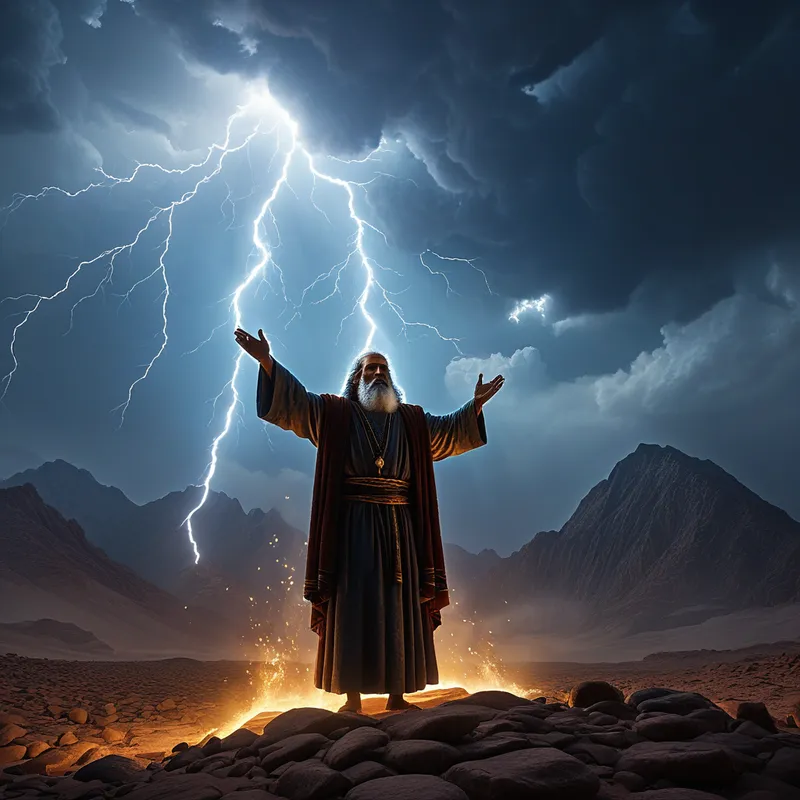
The air in the desert of Sin was a furnace breath, tasting of dust and desperation. A people, numberless as the sands, camped at the foot of a terrible majesty—Mount Sinai. It was no mere rock. It was a throne. Smoke cloaked its peak, thick and seething, for YHWH had descended upon it in fire. The ground itself trembled, a low, constant groan. The sound of a shofar—a ram’s horn trumpet—ripped through the camp, not blown by human lips, but swelling from the mountain’s heart, a blast so immense it struck terror into bone and spirit. The people trembled and stood far off.
But one man approached the thick darkness where God was.
Moses, his face lined with the trials of wilderness and the weight of a nation’s murmuring, ascended. The heat was not of the sun, but of a forge. The path was not of stone, but of will. For forty days and forty nights, he entered the cloud, the terrifying Kabod, the heavy glory. There, in the heart of the thunder, a covenant was forged not of gold, but of word.
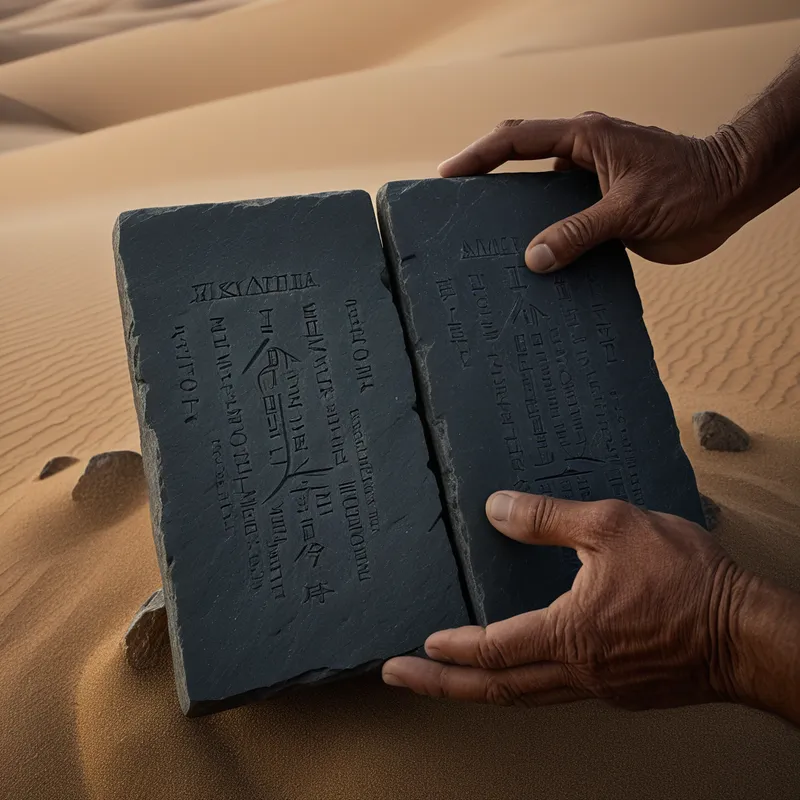
The voice spoke. It carved principles of being into the fabric of reality: You shall have no other gods. You shall not make an idol. You shall not murder. You shall not steal. The words were not suggestions; they were the architecture of a sacred society, the bones of a holy people. And this living law was given substance. With His own finger, YHWH inscribed these ten words onto two tablets of stone—not smooth, polished alabaster, but rough-hewn, enduring rock from the mountain itself. They were heavy with meaning, cold and permanent to the touch.
Moses carried this divine burden down the mountain, the weight of order in his arms, descending back into the realm of chaos. But the chaos had taken form. Below, in the shadow of the very mountain where God spoke, the people had grown impatient. From their gold, they had fashioned a molten calf, a god they could see and control. They danced around it in revelry, the shofar’s holy blast forgotten, replaced by the noise of idolatry.
Seeing this, the covenant shattered in Moses’s hands before it could be delivered. In a fury of holy grief, he cast the tablets upon the ground, and they broke at the foot of the mountain. The law was given, and in the same breath, it was broken by the very tension it sought to resolve—the tension between the perfect divine order and the flawed human heart.
Cultural Origins & Context
This myth is the foundational legal and theological narrative of ancient Israel, crystallized in the books of Exodus and Deuteronomy. It emerged from a tribal confederation seeking identity and cohesion after a perceived liberation from Egyptian hegemony. The story was not a single author’s creation but a core tradition recited at festivals, taught to children, and embedded in covenant renewal ceremonies. It functioned as a national constitution and a sacred history, answering the profound questions: Who are we? What makes us distinct? By what rules do we live before God and each other?
The tellers were priests, prophets, and elders—the guardians of memory. Its societal function was multifaceted: it established a theocratic legal system, created a powerful group identity separate from surrounding Canaanite cultures, and provided an ethical framework that bound morality to divine mandate. The myth asserted that their law was not of human invention, but received from the ultimate source of reality itself, granting it absolute authority and sanctifying the community’s social order.
Symbolic Architecture
Psychologically, the myth maps the tumultuous birth of consciousness from the unconscious. The wandering Israelites in the chaotic desert represent the undifferentiated, instinctual psyche—liberated from the “slavery” of unconscious identification (Egypt) but not yet structured, prone to anxiety and regression (the Golden Calf).
The mountain is the axis mundi, the point where the human psyche strives to connect with the transpersonal, the realm of archetypal order.
Moses is the archetype of the mediating ego-consciousness, the part of the self that can endure the terrifying encounter with the numinous (the fire, cloud, and thunder of Sinai) and return with a formative principle. The Tablets of the Law symbolize the hard, enduring structures necessary for a coherent psyche and a viable society: boundaries, ethics, and the differentiation between sacred and profane. They are the “bones” of the self.
The shocking act of breaking the tablets is not merely an expression of anger. It is a profound symbolic truth: the perfect, absolute law of the Self (the divine blueprint) is inevitably shattered by the realities of the imperfect, living personality. The covenant is always broken and must be continually re-forged—this is the ongoing work of individuation.

The Dreamer’s Resonance
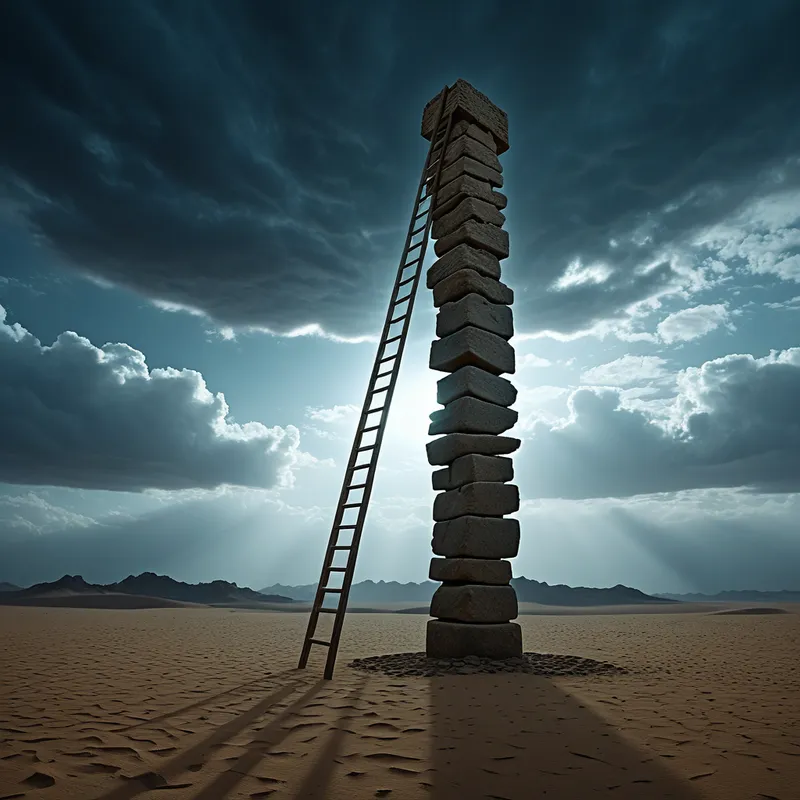
When this myth stirs in modern dreams, it often manifests as a profound confrontation with the need for internal order. A dreamer may find themselves at the base of an immense, intimidating structure (a mountain, a skyscraper, a ladder), tasked with carrying a heavy, precious, or fragile object of great importance. There is often a somatic sense of immense weight, trembling, or awe.
This dream pattern signals a critical phase of psychological restructuring. The dreamer is being called to “ascend”—to consciously engage with a higher order of values or a demanding moral/ethical choice within their life. The “tablets” they carry might represent a new responsibility, a commitment, a creative project, or a hard truth they must bear. The fear of “breaking” them reflects anxiety about failing to live up to an internalized ideal or external standard. The dream is the psyche’s ritual enactment of receiving a law for one’s own life, a difficult integration of principle that will shape identity and demand sacrifice.
Alchemical Translation
The alchemical process modeled here is the coagulatio—the transformation of spirit into substance, of divine wind into solid stone. The chaotic prima materia of the liberated but unformed psyche (the Israelites) must be solidified through encounter with the transcendent.
The first stage is the ascensus: the ego (Moses) must turn away from the collective clamor and dare the solitary journey into the terrifying/fascinating realm of the Self. This is the withdrawal for meditation, the deep introspection where one encounters the non-negotiable truths of one’s own being—the “commandments” of the soul.
The law received is not a prison, but the vessel that makes the spirit incarnate. Without it, the spirit remains smoke; with it, the spirit gains a shape in the world.
The return is the descensus: bringing this hard-won structure back into the messy reality of daily life, relationships, and one’s own frail humanity (the camp). The inevitable “breaking” of the ideal is not failure, but the next stage of the work. After the breaking comes the re-inscribing. Moses later hews new tablets himself, and God writes the words again. This is the alchemical secret: the law must be internalized. It is no longer just externally given stone; it becomes a covenant written on the “tablets of the heart.” The modern individual’s triumph is not in perfect adherence to an external code, but in the continual, conscious, and often painful labor of forging their own living ethic from the encounter between divine aspiration and human limitation, creating a personal covenant that grants both structure and meaning to their existence.
Associated Symbols
Explore related symbols from the CaleaDream lexicon: