The Last Supper in Christian t Myth Meaning & Symbolism
A final shared meal becomes the stage for a cosmic drama of betrayal, sacrifice, and the promise of eternal communion.
The Tale of The Last Supper in Christian t
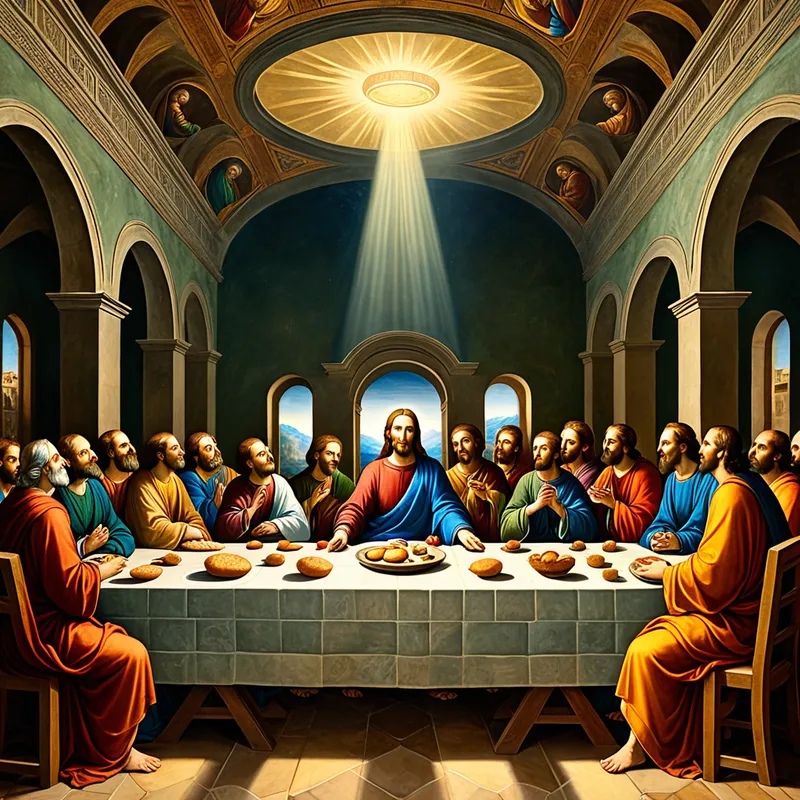
The air in the [upper room](/myths/upper-room “Myth from Biblical culture.”/) was thick with the scent of roasted lamb, unleavened bread, and old wine. Lamplight danced on worried faces, casting long, trembling shadows on the stone walls. They had gathered for the Passover, to remember an ancient deliverance, but a new and terrifying deliverance was being prepared in their very midst.
At the head of the table sat the Teacher. His eyes held a deep, unsettling peace, like the calm at the eye of a storm. He took the bread, and his hands, which had healed the sick and lifted the fallen, now broke it with a deliberate finality. The crack echoed in the silent room. “Take and eat,” he said, his voice a low river of sorrow and promise. “This is my body, broken for you.” The words hung in the air, a mystery too vast to grasp. The disciples passed the pieces, their fingers brushing, a communion of confusion and dawning dread.
Then he took the chalice, raised it, gave thanks, and gave it to them. “Drink from it, all of you,” he instructed. “This is my blood of the covenant, which is poured out for many for the forgiveness of sins.” The wine was bitter and sweet on their tongues, a taste of a pact written not on stone, but in flesh and spirit.
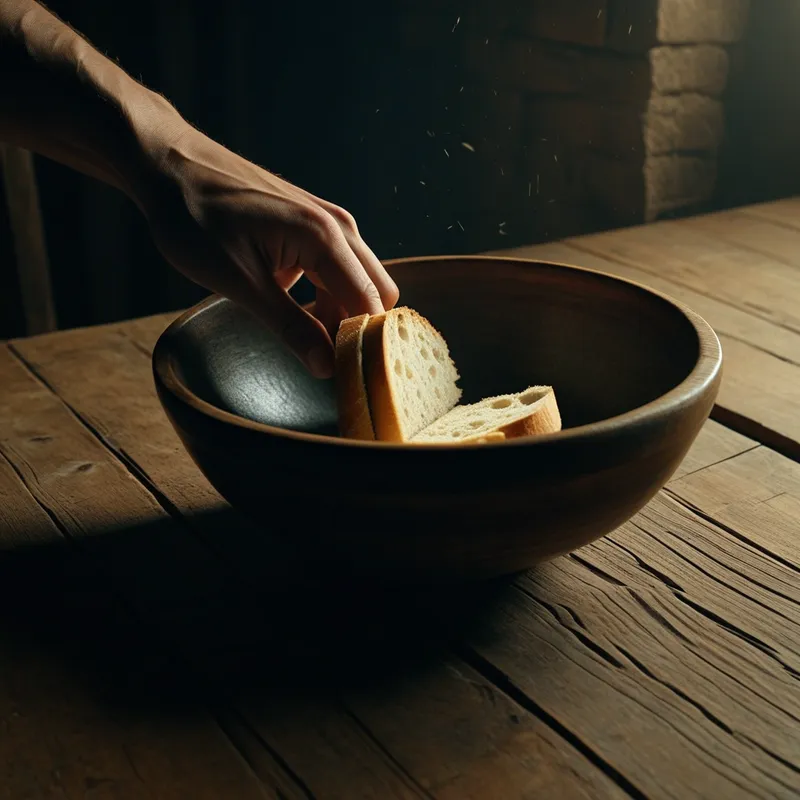
And then, into this sacred, charged moment, he spoke a dagger of a truth. “Truly I tell you, one of you will betray me.” A wave of shock and grief broke over the table. “Surely you don’t mean me, Rabbi?” each one asked in turn. The Teacher’s gaze was a mirror reflecting their own hidden hearts. “The one who has dipped his hand into the bowl with me will betray me,” he said. And as the words fell, a hand—Judas’s hand—moved in the shared dish, a silent, terrible confirmation. “What you are about to do, do quickly,” the Teacher said to him alone. Judas rose, and the door closed behind him, swallowing him into the night. And it was night, inside the room and out.
With the betrayer gone, the Teacher spoke again, but now his words were of love and legacy. “A new command I give you: Love one another. As I have loved you, so you must love one another.” He spoke of a dwelling place being prepared, of a Helper who would come. He prayed for them, for their protection and their unity. The meal was over. The true offering had begun. They sang a hymn—a psalm of deliverance—and went out into the darkness of the garden, where the final act awaited.
Cultural Origins & Context
This narrative is anchored in the Biblical canon, specifically within the Gospel accounts of Matthew, Mark, Luke, and John. It exists at the precise intersection of Jewish ritual and nascent Christian theology. The setting is the Passover Seder, a meal commemorating [the Israelites](/myths/the-israelites “Myth from Abrahamic culture.”/)’ liberation from Egypt. By embedding his transformative actions within this existing framework of sacrificial lamb and salvific blood, the Teacher consciously positions himself as the fulfillment and transformation of the old covenant.
The story was passed down orally within early Christian communities before being codified in scripture. Its primary societal function was foundational: it established the core ritual of the Eucharist or Communion, which became the central act of worship. It served to explain the meaning of the impending crucifixion not as a defeat, but as a willing, premeditated sacrifice that instituted a new relationship between the divine and humanity. It was a story of origin, explaining how a community born from betrayal and sacrifice should understand its own identity and practice.
Symbolic Architecture
The myth is a dense [matrix](/symbols/matrix “Symbol: A dream symbol representing the fundamental structure of reality, consciousness, or the self. It often signifies feelings of being trapped, controlled, or questioning the nature of existence.”/) of symbols orchestrating a profound psychological and spiritual shift. The shared [meal](/symbols/meal “Symbol: A meal often symbolizes nourishment, not just physically but emotionally and spiritually, representing the aspects of sharing and community.”/) represents [community](/symbols/community “Symbol: Community in dreams symbolizes connection, support, and the need for belonging.”/), intimacy, and the nourishment of tradition. The breaking of the [bread](/symbols/bread “Symbol: Bread symbolizes nourishment, sustenance, and the daily essentials of life, often representing fundamental needs and comfort.”/) and sharing of the [wine](/symbols/wine “Symbol: Wine often symbolizes celebration, indulgence, and the deepening of personal connections, but it can also represent excess and escape.”/) perform a powerful [alchemy](/symbols/alchemy “Symbol: A transformative process of purification and creation, often symbolizing personal or spiritual evolution through difficult stages.”/), transforming common sustenance into vessels of ultimate meaning.
The bread is not a metaphor for the body; it is the body made symbol, the irreducible self given to be consumed and internalized by the other.
The act of [betrayal](/symbols/betrayal “Symbol: A profound violation of trust in artistic or musical contexts, often representing broken creative partnerships or artistic integrity compromised.”/) at the [heart](/symbols/heart “Symbol: The heart symbolizes love, emotion, and the core of one’s existence, representing deep connections with others and self.”/) of the feast is its most shocking and essential element. It represents the inevitable [shadow](/symbols/shadow “Symbol: The ‘shadow’ embodies the unconscious, repressed aspects of the self and often represents fears or hidden emotions.”/) within the circle of trust, the [capacity](/symbols/capacity “Symbol: A measure of one’s potential, limits, or ability to contain, process, or achieve something, often reflecting self-assessment or external demands.”/) for denial and treachery that exists even in the [presence](/symbols/presence “Symbol: Presence in dreams often signifies awareness or acknowledgment of something significant in one’s life.”/) of the highest ideal. Judas is not an external [monster](/symbols/monster “Symbol: Monsters in dreams often symbolize fears, anxieties, or challenges that feel overwhelming.”/), but the person who shared the [bowl](/symbols/bowl “Symbol: A bowl often represents receptivity, nourishment, and emotional security, symbolizing the dreamer’s needs and desires.”/), the [friend](/symbols/friend “Symbol: A friend in dreams often represents companionship, connection, and the desire for social support, reflecting aspects of our interactions and relationships in waking life.”/). This forces a confrontation with the paradoxical [truth](/symbols/truth “Symbol: Truth represents authenticity, honesty, and the quest for knowledge beyond mere appearances.”/) that darkness is woven into the fabric of the light-bearing community.
The “new commandment” of love, given immediately after the betrayal is revealed, is the myth’s revolutionary core. It proposes that the [response](/symbols/response “Symbol: Response in dreams symbolizes how one reacts to situations, often reflecting the subconscious mind’s processing of events.”/) to [fragmentation](/symbols/fragmentation “Symbol: The experience of breaking apart, losing cohesion, or being separated into pieces. Often represents disintegration of self, relationships, or reality.”/) and betrayal is not deeper law, but transformative, self-sacrificial love. The Eucharist thus becomes a symbolic technology for internalizing this [paradox](/symbols/paradox “Symbol: A contradictory yet true concept that challenges logic and perception, often representing unresolved tensions or profound truths.”/): acknowledging brokenness (the broken bread) while participating in a wholeness (the shared cup) that transcends it.

The Dreamer’s Resonance
When this myth surfaces in modern dreams, it rarely appears as a biblical tableau. Instead, the dreamer may find themselves at a crucial family dinner or a tense business meal where a vital secret is about to be exposed. They may be the one breaking bread, feeling the weight of a role they did not choose, or they may be a disciple, sensing a betrayal in the room but unable to pinpoint its source.
Somatically, this dream pattern often accompanies a feeling of profound isolation within a group, a “night inside” despite being surrounded by people. It signals a psychological process where the dreamer’s conscious values or commitments (their “covenant”) are being tested by an emerging shadow element—perhaps a part of themselves or a recognition of fallibility in an admired other. The dream asks: What part of you feels betrayed, or is capable of betrayal? What cherished agreement within your own [psyche](/myths/psyche “Myth from Greek culture.”/) is being broken, making way for a new, more conscious integration?

Alchemical Translation
The alchemical process modeled here is the transmutation of betrayal into communion. For the modern individual on the path of individuation, the “upper room” is the sanctum of one’s highest ideals and conscious personality. The “disciples” represent the various complexes and commitments that serve this conscious self.
The inevitable “Judas” is [the shadow](/myths/the-shadow “Myth from Jungian culture.”/) complex—the repressed, denied, or despised aspect of [the self](/myths/the-self “Myth from Jungian culture.”/) that ultimately threatens to dismantle the conscious arrangement. Its betrayal is not evil in a cosmic sense, but necessary. It forces the death of a naive, idealized wholeness.
The crucifixion begins not at Golgotha, but at the supper table, the moment the conscious self willingly acknowledges the betrayer within its own inner circle.
The alchemical act is to “take and eat” this reality. To internalize the brokenness (the shadow, the failure, the betrayal) not as a poison, but as the very substance of transformation. By consciously integrating this shadow—the capacity for denial, self-interest, and treachery—the individual does not become a betrayer, but achieves a more authentic, less inflated wholeness. The “new covenant” is the psyche’s agreement to operate from this deeper, more inclusive level of awareness, where love is not the absence of darkness, but the conscious relationship to it. The ritual of remembrance, then, becomes the regular, conscious practice of acknowledging one’s own fragmentation while recommitting to a selfhood rebuilt on the far side of that recognition.
Associated Symbols
Explore related symbols from the CaleaDream lexicon: