The Last Supper Myth Meaning & Symbolism
A final shared meal where a teacher offers his body and blood as a covenant, knowing one friend will betray him, transforming bread and wine into eternal symbols.
The Tale of The Last Supper
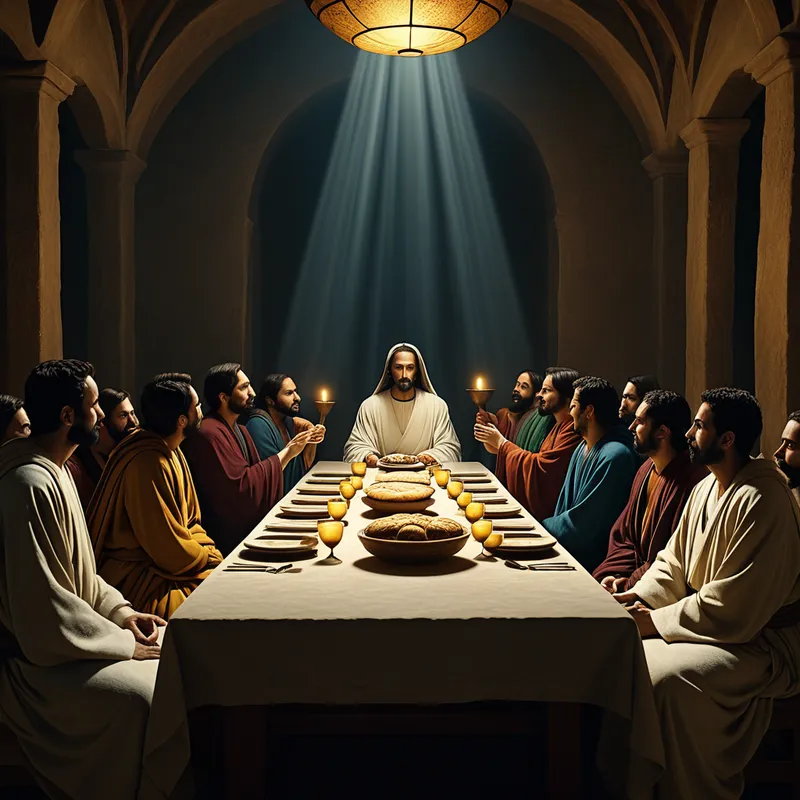
The air in the [upper room](/myths/upper-room “Myth from Biblical culture.”/) was thick with the scent of roasted lamb, unleavened bread, and the oil of the lamps that fought back the gathering [Jerusalem](/myths/jerusalem “Myth from Biblical culture.”/) night. It was the night of the Passover, and the city hummed with a memory of liberation. But within these walls, a different liberation was being prepared.
He sat among them, the one they called Rabbi and Master. His face, usually alight with parables of mustard seeds and lost coins, was etched with a deep, solemn knowing. The twelve were around him, the brothers, the fishermen, the zealot, the tax collector—a tapestry of hopes and human frailty. The chatter was nervous, laced with unspoken questions about the rumblings in the city, the authorities who whispered his name like a threat.
He took a loaf of bread, his hands familiar and steady. He gave thanks, his voice a low anchor in the unsettled room. Then he broke it. The sound was crisp, final. “Take and eat,” he said, his gaze holding each of them. “This is my body, given for you.” The words hung, impossible, a mystery wrapped in the simple act of sustenance. They passed the pieces, the gritty texture on their tongues now carrying a weight they could not yet swallow.
Then he took the cup, the wine dark as blood in the clay vessel. Again, he gave thanks. “Drink from it, all of you,” he instructed. “This is my blood of the covenant, which is poured out for many for the forgiveness of sins.” The covenant. The ancient promise made new in this intimate, terrifying gesture. They drank, the tart wine now a solemn oath.
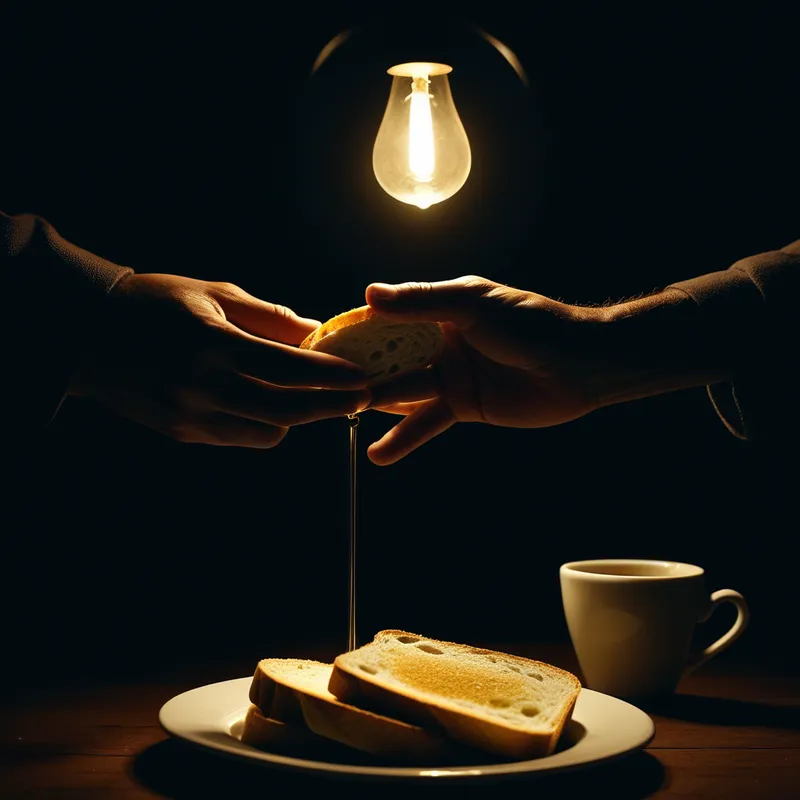
But then, the atmosphere cracked. His voice, still calm, cut through the ritual. “Truly I tell you, one of you will betray me.” A wave of shock and dismay broke over the table. “Surely not I, Lord?” each one asked in turn, their hearts laid bare in the question. He answered quietly, “The one who has dipped his hand into the bowl with me will betray me.” And as the words settled, a hand moved, dipping a morsel. He offered it directly to [Judas Iscariot](/myths/judas-iscariot “Myth from Christian culture.”/). “What you are about to do, do quickly.” Judas took the bread, and at that moment, as the gospel tells, Satan entered into him. He left immediately, and the night outside swallowed him. The remaining disciples, bewildered, thought it was an errand.
Alone with the eleven, he spoke of love, of a new commandment, of a place he was preparing. He spoke of a Helper who would come. But [the shadow](/myths/the-shadow “Myth from Jungian culture.”/) of the departed disciple lay across the table, a silent thirteenth presence. The supper was over. The path now led from the warmth of the shared cup into the cold solitude of the garden, and toward the inevitable dawn.
Cultural Origins & Context
The story of The [Last Supper](/myths/last-supper “Myth from Biblical culture.”/) is rooted in the Gospel narratives of Matthew, Mark, Luke, and John, composed in the decades following the event. It is situated within the lived reality of 1st-century Judea under Roman occupation, and specifically within the context of the Passover feast—a celebration of Jewish identity and divine deliverance from slavery.
The tale was not initially written for a broad public but circulated orally within early Christian communities as part of their foundational “memory” and worship. It was told and retold in house churches during shared meals, the very act of gathering echoing the original scene. Its primary societal function was twofold: to establish the theological core of the Eucharist or Communion, and to frame the meaning of [Jesus](/myths/jesus “Myth from Christian culture.”/)’s impending death not as a tragic defeat, but as a deliberate, sacrificial offering that instituted a new covenant. It served as the mythic anchor for a persecuted community, explaining their central ritual and defining their identity in contrast to both Roman imperial culture and mainstream Judaism.
Symbolic Architecture
At its [heart](/symbols/heart “Symbol: The heart symbolizes love, emotion, and the core of one’s existence, representing deep connections with others and self.”/), The Last Supper is a myth of profound [paradox](/symbols/paradox “Symbol: A contradictory yet true concept that challenges logic and perception, often representing unresolved tensions or profound truths.”/). It is a [moment](/symbols/moment “Symbol: The symbol of a ‘moment’ embodies the significance of transient experiences that encapsulate emotional depth or pivotal transformations in life.”/) of ultimate intimacy staged on the [precipice](/symbols/precipice “Symbol: A steep cliff edge representing a critical boundary between safety and danger, often symbolizing life transitions, fear of the unknown, or existential risk.”/) of ultimate [betrayal](/symbols/betrayal “Symbol: A profound violation of trust in artistic or musical contexts, often representing broken creative partnerships or artistic integrity compromised.”/). The symbols are stark, somatic, and irrevocable.
The bread is not a metaphor for the body; it is presented as the body itself. The myth collapses the symbolic into the literal, demanding a participation that transcends intellectual understanding.
The shared [meal](/symbols/meal “Symbol: A meal often symbolizes nourishment, not just physically but emotionally and spiritually, representing the aspects of sharing and community.”/) represents [community](/symbols/community “Symbol: Community in dreams symbolizes connection, support, and the need for belonging.”/), the ekklesia itself. Yet, within that unity lies the seed of its fracturing: the betrayer is inside the circle, partaking of the same symbols. This speaks to the psychological [truth](/symbols/truth “Symbol: Truth represents authenticity, honesty, and the quest for knowledge beyond mere appearances.”/) that betrayal, doubt, and [shadow](/symbols/shadow “Symbol: The ‘shadow’ embodies the unconscious, repressed aspects of the self and often represents fears or hidden emotions.”/) are not external forces that assault [the self](/myths/the-self “Myth from Jungian culture.”/), but potentials within the self. Judas represents the part of the [psyche](/myths/psyche “Myth from Greek culture.”/)—driven by materialism, disillusionment, or a twisted sense of necessity—that can “sell out” the highest value (the Self) for [thirty pieces of silver](/myths/thirty-pieces-of-silver “Myth from Biblical culture.”/).
The act of Jesus offering the dipped morsel to Judas is the myth’s most devastating psychological moment. It is not an exposure but a conscious offering of the [symbol](/symbols/symbol “Symbol: A symbol can represent an idea, concept, or belief, serving as a powerful tool for communication and understanding.”/) to the one who will destroy the symbol-bearer. It represents a total [acceptance](/symbols/acceptance “Symbol: The experience of being welcomed, approved, or integrated into a group or situation, often involving validation of one’s identity or actions.”/) of one’s [fate](/symbols/fate “Symbol: Fate represents the belief in predetermined outcomes, suggesting that some aspects of life are beyond human control.”/), a conscious [integration](/symbols/integration “Symbol: The process of unifying disparate parts of the self or experience into a cohesive whole, often representing psychological wholeness or resolution of internal conflict.”/) of the [role](/symbols/role “Symbol: The concept of ‘role’ in dreams often reflects one’s identity or how individuals perceive their place within various social structures.”/) of the betrayer into the divine [drama](/symbols/drama “Symbol: Drama signifies narratives, emotional expression, and the exploration of human experiences.”/). The [hero](/symbols/hero “Symbol: A hero embodies strength, courage, and the ability to overcome significant challenges.”/) knows and facilitates the [mechanism](/symbols/mechanism “Symbol: Represents the body’s internal systems, emotional regulation, or psychological processes working together like a machine.”/) of his own sacrifice.
The Dreamer’s Resonance
When this mythic pattern surfaces in modern dreams, it rarely appears as a biblical tableau. Instead, one might dream of a crucial team meeting where a trusted colleague passes a damning document to a rival; of a family dinner where a parent calmly announces a terminal diagnosis; of sharing a drink with a friend while knowing a painful secret must soon be revealed.
The somatic feeling is one of suspended animation—a cherished connection fraught with an unspoken, imminent ending. The dreamer is psychologically at [the threshold](/myths/the-threshold “Myth from Folklore culture.”/) of a profound sacrifice or a painful betrayal (whether as victim, perpetrator, or both). It indicates a moment where a deep commitment (to a relationship, a project, a truth) is being “consummated” and internalized (“this is my body”), even as the part of the psyche that fears that commitment is preparing to sabotage it (“one of you will betray me”). The dream asks: What covenant are you sealing within yourself? And what part of you is ready to hand it over to the authorities of doubt, fear, or worldly logic?

Alchemical Translation
The alchemical process modeled here is the transmutation of substance through conscious sacrifice. In [the laboratory](/myths/the-laboratory “Myth from Alchemical culture.”/) of the soul, the [prima materia](/myths/prima-materia “Myth from Alchemical culture.”/)—the raw, unconscious mass of the personality—is the gathered disciples with all their conflicts. The opus is the meal itself.
First, the [Separatio](/myths/separatio “Myth from Alchemical culture.”/): The conscious ego (the Jesus figure) must separate from the identification with the group and even from the instinct for self-preservation. It must “take the bread”—take its own substance—and acknowledge it as destined for breaking.
The alchemical gold is forged not in spite of betrayal, but through its agency. The leaden act of betrayal is the necessary reagent for the transformation of base community into sacred covenant.
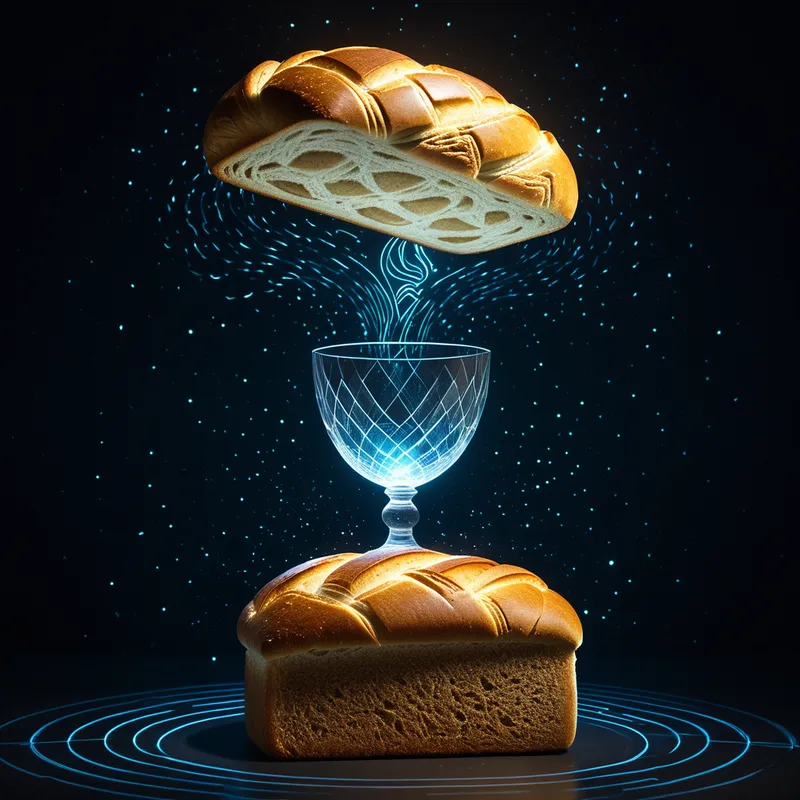
Then, the Mortificatio: The breaking of the bread and the pouring of the wine. This is the symbolic death of the old, literal understanding. The physical body/ego-complex is offered up to be consumed by the psychic whole (the disciples/parts of the self). Its energy is redistributed.
Finally, the Coniunctio: The shared consumption. This is the integration. The sacrificed value—love, truth, purpose—is no longer the property of the central figure alone. It becomes the binding substance of the new, conscious community (the indwelling Self). Judas’s departure is crucial; the purely shadow-driven, transactional complex must exit the scene for this internal communion to be fully realized, though its role is eternally remembered. For the modern individual, this myth maps the journey from being a group identity that harbors a traitor, to becoming a consecrated Self, nourished by its own chosen sacrifices and bound by a covenant made in full awareness of the cost.
Associated Symbols
Explore related symbols from the CaleaDream lexicon: