The Land of Cockaigne Myth Meaning & Symbolism
A medieval folk myth of a utopia where rivers flow with wine, roasted pigs wander with knives in their backs, and work is an unknown concept.
The Tale of The Land of Cockaigne
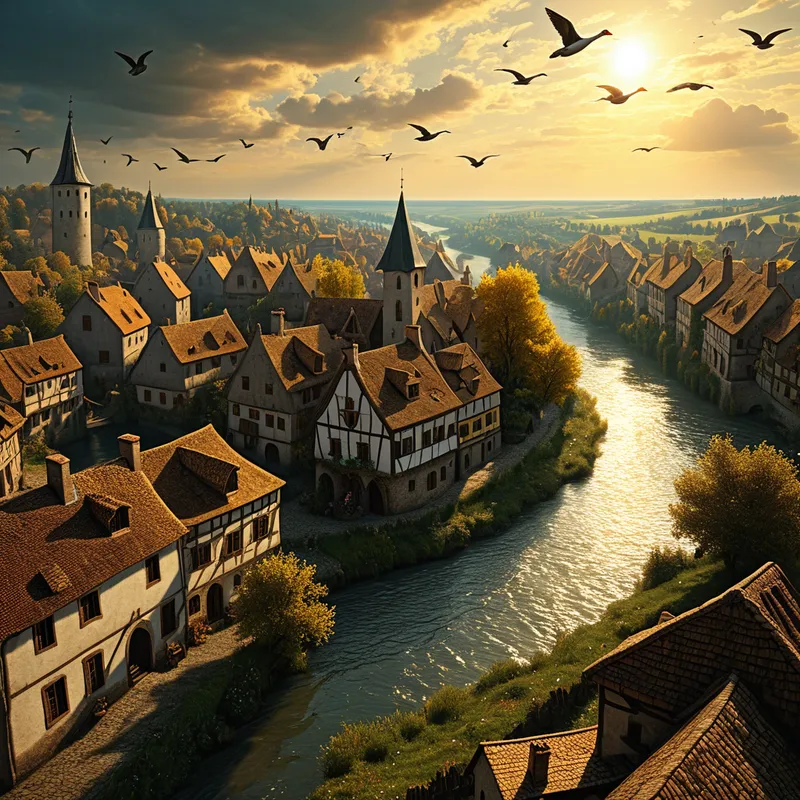
Listen, and I will tell you of a land beyond the salted sea, beyond the weary plow and the master’s lash. It is a country where the sun hangs forever at a gentle afternoon slant, and [the wind](/myths/the-wind “Myth from Various culture.”/) carries not the chill of winter, but the scent of baking sugar and spiced wine. They call it Cockaigne.
Here, the very world conspires for your comfort. The fences are woven of plump sausages. The houses are built of barley cakes and gingerbread, their roofs thatched with pies. Should rain fall, it is a warm drizzle of custard. Should you thirst, you need but kneel by a stream that runs not with [water](/myths/water “Myth from Chinese culture.”/), but with the finest claret and malmsey. The fish leap from these streams already fried in butter, landing upon shores of grated cheese.
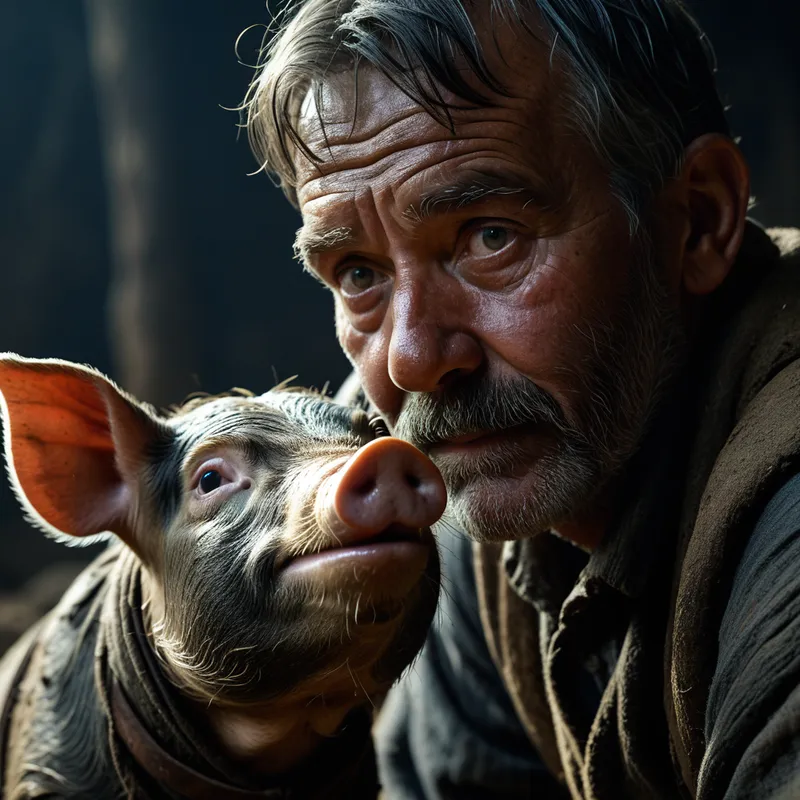
The animals are not beasts of burden, but servants of the feast. Roasted geese and fowl fly through the air, crying “Eat me! Eat me!” as they descend. Piglets, roasted golden and crisp, wander the lanes with carving knives helpfully stuck in their backs, begging to be sliced. The trees bear not leaves, but thin pancakes, and in their branches hang ripe purses of gold and silver.
In Cockaigne, work is a forgotten curse, a tale from a bad dream. The only labor is the gentle effort of opening one’s mouth or reaching out a hand. The people spend their days in soft repose, napping on beds of fresh herbs, waking only to partake of the endless banquet. They move in a pleasant, sated daze. There is no conflict, for there is nothing to want. There is no striving, for everything is already given. The only law is a strange, whispered one: you must sleep for a third of the day, you must take your ease, you must not seek to build or change this perfect, static bounty.
And so, the land exists in a perpetual, drowsy present. It is a resolution without a conflict, a feast without a famine, a destination reached without a journey. It is the final, silent sigh of a world that has answered every question before it is asked, and in doing so, has forgotten the sound of the question itself.
Cultural Origins & Context
The myth of Cockaigne is not the product of a single culture, but a collective folk fantasy that bubbled up across medieval Europe, from the British Cockaigne to the German Schlaraffenland and the French Pays de Cocagne. It was a story told by the weary: peasants bent double in the fields, artisans laboring by dim candlelight, and the urban poor facing scarcity and toil. Passed down in tavern tales, satirical poems, and carnival plays, it functioned as a psychological pressure valve.
This was not a religious paradise like Heaven, earned through piety and moral rigor. Cockaigne was a secular, bodily, and subversive utopia. It inverted the natural and social order with glorious absurdity. Here, the lazy were rewarded, gluttony was virtue, and authority was absent. It was a carnivalesque dream that temporarily suspended the harsh realities of feudal life, not to inspire revolution, but to offer a moment of psychic respite through shared, imaginative laughter. It was a collective daydream, a folkloric mirror held up to the deprivations of the age, reflecting not what should be, but the raw, unfiltered want of the body and spirit.
Symbolic Architecture
Cockaigne is not merely a fantasy of [food](/symbols/food “Symbol: Food in dreams often symbolizes nourishment, both physical and emotional, representing the fulfillment of basic needs as well as deeper desires for connection or growth.”/); it is the ultimate [symbol](/symbols/symbol “Symbol: A symbol can represent an idea, concept, or belief, serving as a powerful tool for communication and understanding.”/) of the regressive [womb](/symbols/womb “Symbol: A symbol of origin, potential, and profound transformation, representing the beginning of life’s journey and the unconscious source of creation.”/). It represents a psychic state where all needs are pre-met, all [effort](/symbols/effort “Symbol: Effort signifies the physical, mental, and emotional energy invested toward achieving goals and personal growth.”/) is obsolete, and the individual is returned to a [condition](/symbols/condition “Symbol: Condition reflects the state of being, often focusing on physical, emotional, or situational aspects of life.”/) of passive, infantile receptivity. The rivers of [wine](/symbols/wine “Symbol: Wine often symbolizes celebration, indulgence, and the deepening of personal connections, but it can also represent excess and escape.”/) and walking roast pigs symbolize a world where desire and [satisfaction](/symbols/satisfaction “Symbol: A state of contentment and fulfillment where desires or needs are met, often signaling emotional or physical completeness.”/) collapse into a single, instantaneous [moment](/symbols/moment “Symbol: The symbol of a ‘moment’ embodies the significance of transient experiences that encapsulate emotional depth or pivotal transformations in life.”/)—the end of longing itself.
The greatest prison in Cockaigne is the absence of a key; there are no doors to open because there is nowhere else to go.
Psychologically, it embodies the [shadow](/symbols/shadow “Symbol: The ‘shadow’ embodies the unconscious, repressed aspects of the self and often represents fears or hidden emotions.”/) side of the Innocent [archetype](/symbols/archetype “Symbol: A universal, primordial pattern or prototype in the collective unconscious that shapes human experience, behavior, and creative expression.”/). The Innocent seeks [safety](/symbols/safety “Symbol: Safety represents security, protection, and the sense of being free from harm or danger, both physically and emotionally.”/) and happiness, but in Cockaigne, this [quest](/symbols/quest “Symbol: A quest symbolizes a journey or search for purpose, fulfillment, or knowledge, often representing life’s challenges and adventures.”/) reaches a grotesque, stagnant [conclusion](/symbols/conclusion “Symbol: A conclusion can symbolize resolution, closure, and the finality of experiences or decisions.”/). It is [innocence](/symbols/innocence “Symbol: A state of purity, naivety, and freedom from guilt or corruption, often associated with childhood and moral simplicity.”/) devolving into [entropy](/symbols/entropy “Symbol: In arts and music, entropy represents the inevitable decay of order into chaos, often symbolizing creative destruction, impermanence, and the natural progression toward disorder.”/). The land’s unspoken law—enforced sloth—reveals the trap: this [paradise](/symbols/paradise “Symbol: A perfect, blissful place or state of being, often representing ultimate fulfillment, harmony, and transcendence beyond ordinary reality.”/) annihilates will, curiosity, and the creative [tension](/symbols/tension “Symbol: A state of mental or emotional strain, often manifesting physically as tightness, pressure, or unease, signaling unresolved conflict or anticipation.”/) that defines [consciousness](/symbols/consciousness “Symbol: Consciousness represents the state of awareness and perception, encompassing thoughts, feelings, and experiences.”/). It is [the ego](/myths/the-ego “Myth from Jungian culture.”/)’s fantasy of total fulfillment, which, if achieved, would mean the [death](/symbols/death “Symbol: Symbolizes transformation, endings, and new beginnings; often associated with fear of the unknown.”/) of [the ego](/myths/the-ego “Myth from Jungian culture.”/)’s [journey](/symbols/journey “Symbol: A journey in dreams typically signifies adventure, growth, or a significant life transition.”/). The [shadow](/symbols/shadow “Symbol: The ‘shadow’ embodies the unconscious, repressed aspects of the self and often represents fears or hidden emotions.”/) here is not a [monster](/symbols/monster “Symbol: Monsters in dreams often symbolize fears, anxieties, or challenges that feel overwhelming.”/), but a suffocating [blanket](/symbols/blanket “Symbol: A blanket typically symbolizes protection, comfort, and the desire for warmth and security.”/) of plenty.
The Dreamer’s Resonance
To dream of Cockaigne is not to dream of joy, but of saturation. In the modern [psyche](/myths/psyche “Myth from Greek culture.”/), it manifests not as literal feasts, but as scenarios of effortless abundance that feel oddly hollow. You might dream of a job that pays endlessly for no work, a relationship that demands nothing, or a talent that flows without practice. Initially, these dreams feel like relief. But the somatic signature is key: a growing feeling of heaviness, of being stuck in syrup, of pleasant nausea. The dream body feels bloated, lethargic, unable to move.
This is the psyche signaling a state of psychic indigestion. It indicates a part of [the self](/myths/the-self “Myth from Jungian culture.”/) that is yearning for a “solution” that is, in fact, a form of surrender—a desire to be free from the burdens of agency, choice, and becoming. The dream is a portrait of a complex that has been fulfilled, and in its fulfillment, has become a prison. The dreamer is encountering the consequence of a wish granted in the unconscious: the stagnation that follows the end of all striving.
Alchemical Translation
The alchemical process mirrored in the myth of Cockaigne is not the triumphant [rubedo](/myths/rubedo “Myth from Alchemical culture.”/) (the reddening), but a perilous, eternal [nigredo](/myths/nigredo “Myth from Alchemical culture.”/) (the blackening) disguised in gold. It is the massa confusa—the primal, undifferentiated matter—that refuses the fire of transformation because it is already, deceptively, “perfect.”
The work of individuation begins not with a hunger for more, but with the courage to feel hunger at all within the belly of the feast.
For the modern individual, the “Land of Cockaigne” is any psychological pattern that promises wholeness through passivity and consumption. It is the belief that the answer lies in another certificate, another purchase, another scroll through curated content—an external stream of pre-digested “wine” and “cake.” The alchemical translation requires a shocking, perhaps even violent, act of contaminatio. One must introduce the “impurity” of desire back into the static system. This is the moment the dreamer pushes away the proffered roast pig, stands up from the herb bed, and feels, for the first time, the ache of unused muscles and the sharp, clean pang of real hunger.
This hunger is the [prima materia](/myths/prima-materia “Myth from Alchemical culture.”/) for the true work. It is the recognition that the paradise of no-want is the death of the soul, and that the friction of need, the labor of the quest, and the bitterness of unsated longing are not curses, but the essential ingredients for the creation of a conscious, differentiated self. One must willingly exile oneself from Cockaigne to begin the only journey that matters.
Associated Symbols
Explore related symbols from the CaleaDream lexicon: