The Lamp of Dharma Myth Meaning & Symbolism
A sacred light is entrusted to humanity, its flame a fragile, eternal promise to illuminate the world's ignorance against the tide of time.
The Tale of The Lamp of Dharma
Listen. In the deep, resonant silence that follows the final teaching, before the great departure, a profound unease settled upon the assembly. The Tathagata had walked [the earth](/myths/the-earth “Myth from Hindu culture.”/), a living sun, scattering the shadows of ignorance with his every word. But now, the hour of his Parinirvana approached. A chill wind of doubt whispered through the hearts of monks and deities alike: When the sun sets, who will hold back the night?
[The Buddha](/myths/the-buddha “Myth from Buddhist culture.”/), perceiving this tremor in the collective heart, did not offer another discourse on emptiness. Instead, he gathered his closest disciples—Sariputta, Moggallana, and the steadfast Ananda—in a grove where the sal trees wept fragrant tears. The air was thick with impending loss.
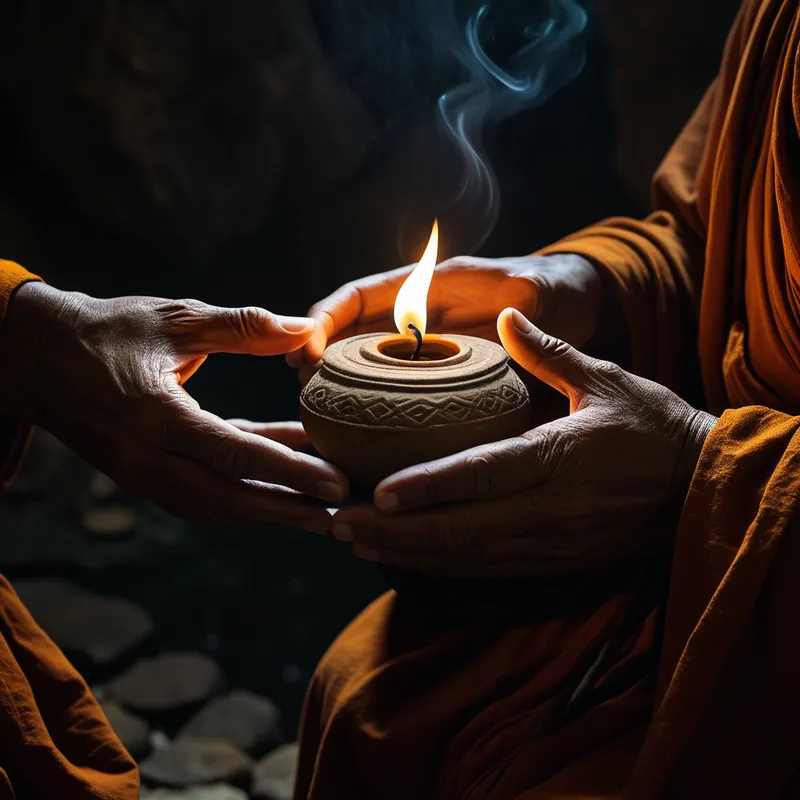
“My friends,” his voice was a river of calm, “the body is impermanent, but the Dharma is deathless. I have lit a lamp in the darkness of [the world](/myths/the-world “Myth from Tarot culture.”/).” He then produced not a scripture, not a relic, but a simple, unadorned clay lamp. With a breath that held the warmth of all compassion, he ignited its wick. The flame did not roar; it was a small, steady, unwavering point of light, pure and clear as a morning star.
“This,” he said, his gaze encompassing [the lamp](/myths/the-lamp “Myth from Alchemical culture.”/), the disciples, and the entire suffering world, “is the Lamp of the Dharma. I bequeath it not to the gods, nor to the heavens, but to you. To all who have ears to hear and hearts to understand. You must keep it alight.”
The disciples stared, their minds racing. How could this fragile flame, vulnerable to the slightest wind of distraction, the rain of doubt, the storm of passion, possibly endure? The Buddha’s eyes held the answer. “It is kept alight not by protecting it in a sealed vault, but by passing it on. Teach the Dharma. Live the Dharma. Let your own understanding be the oil, your ethical conduct the wick, and your meditative concentration the flame. Light another’s lamp from your own. In this way, the light will never be extinguished. It will become a lineage of luminosity, a river of fire flowing through time.”
As he spoke, the simple lamp seemed to transform. Its light did not blaze outward to conquer the dark, but instead drew the darkness inward, dissolving it into itself. The flame became a living teaching: selfless, radiant, and endlessly generous. With a final, profound smile, the Buddha placed the lamp into Ananda’s trembling hands. The weight was not of clay, but of the cosmos. The great teacher then departed, leaving behind not a void, but a single, entrusted point of light in the gathering twilight. The disciples were no longer mourners; they were now guardians, their hearts kindled with a solemn, terrifying, and glorious duty.
Cultural Origins & Context
The parable of the Lamp of Dharma is not a single, fixed myth from a specific [sutra](/myths/sutra “Myth from Hindu culture.”/), but a pervasive and potent metaphor woven throughout the Buddhist textual and oral tradition. Its most famous articulation is in the Mahaparinirvana [Sutra](/myths/sutra “Myth from Hindu culture.”/), where the Buddha’s final instructions center on becoming “islands unto yourselves” with the Dharma as your lamp. This imagery served a critical sociological function in the decades and centuries following the Buddha’s death.
In a religion without a central godhead or a single prophetic voice, the question of authority and continuity was paramount. The myth of the Lamp directly addressed the anxiety of spiritual succession. It democratized enlightenment, shifting the source of light from a singular solar figure (the Buddha) to a communal, living network of practitioners. The lamp became the symbol of the [Sangha](/myths/sangha “Myth from Buddhist culture.”/) itself—its role as the custodian of the teaching. It was told by teachers to students at ordinations, invoked in ceremonies, and painted on temple walls as a visual reminder: the truth is not a fossil to be preserved, but a flame to be transmitted. It grounded the abstract concept of Dharma in a tangible, urgent responsibility carried by every generation.
Symbolic Architecture
The myth’s power lies in its elegant, [multi](/symbols/multi “Symbol: Multi signifies multiplicity and diversity, often representing various aspects of life or identity in dreams.”/)-layered [symbolism](/symbols/symbolism “Symbol: The use of symbols to represent ideas or qualities, often conveying deeper meanings beyond literal interpretation. In dreams, it’s the language of the unconscious.”/). The [Lamp](/symbols/lamp “Symbol: A lamp symbolizes guidance, enlightenment, and the illumination of truth, often representing knowledge or clarity in dark times.”/) is not the Dharma as a [static](/symbols/static “Symbol: Static represents interference, disruption, and the breakdown of clear communication or signal, often evoking feelings of frustration and disconnection.”/) doctrine, but Dharma as active, applied wisdom. It is the process of enlightenment in [motion](/symbols/motion “Symbol: Represents change, progress, or the flow of life energy. Often signifies transition, personal growth, or the passage of time.”/).
The lamp does not fight the darkness; it simply occupies space with light, revealing what was always there.
The [clay vessel](/symbols/clay-vessel “Symbol: The Clay Vessel symbolizes nourishment, potential, and the nurturing aspect of human experience through the creation of art and functionality.”/) represents the [human](/symbols/human “Symbol: The symbol of a human represents individuality, complexity of emotions, and social relationships.”/) [body](/symbols/body “Symbol: The body in dreams often symbolizes the dreamer’s self-identity, personal health, and the relationship they have with their physical existence.”/) and mind—ordinary, fragile, and earthly. It signifies that enlightenment is not for transcendent beings alone but is housed in our very mortal form. The oil symbolizes the fuel of practice: moral discipline (Sila) and accumulated merit. The wick is the focused mind, trained through [meditation](/symbols/meditation “Symbol: Meditation represents introspection, mental clarity, and the pursuit of inner peace, often providing a pathway for deeper self-awareness and spiritual growth.”/) ([Samadhi](/myths/samadhi “Myth from Buddhist culture.”/)). The flame itself is the luminous [insight](/symbols/insight “Symbol: A sudden, deep understanding of a complex situation or truth, often arriving unexpectedly and illuminating hidden connections.”/) (Prajna) that burns away the fuel of ignorance. Crucially, the flame is passed from one lamp to another. This represents the [lineage](/symbols/lineage “Symbol: Represents ancestral heritage, family connections, and the transmission of traits, values, and responsibilities across generations.”/) of teaching, the [guru](/symbols/guru “Symbol: A Guru represents a teacher or guide, often embodying wisdom, knowledge, and spiritual insight.”/)-disciple [relationship](/symbols/relationship “Symbol: A representation of connections we have with others in our lives, often reflecting our emotional state.”/), and the psychological [truth](/symbols/truth “Symbol: Truth represents authenticity, honesty, and the quest for knowledge beyond mere appearances.”/) that understanding is kindled through relationship and shared experience. The act of passing it on prevents the light from becoming a personal possession, transforming it into a communal inheritance.
The Dreamer’s Resonance
When this myth stirs in the modern unconscious, it often manifests in dreams of fragile light sources. One might dream of desperately shielding a candle from a howling wind, of finding an ancient, dusty lantern in an attic and struggling to light it, or of being handed a brilliant light with the terrifying instruction, “Don’t drop it.”
Somatically, this can feel like a pressure in the chest or hands—the weight of responsibility. Psychologically, this dream pattern signals a critical juncture in the dreamer’s development. It often appears when one has internalized a profound piece of wisdom, healing, or creative insight (the lighting of the lamp) and now faces the daunting task of integrating it into daily life and perhaps sharing it with others (the passing on). The “wind” and “darkness” in the dream represent internal and external forces of cynicism, distraction, and fear that threaten to snuff out this nascent understanding. The dream is a call to stewardship of one’s own awakening, highlighting the tension between the private joy of insight and the public responsibility it inherently carries.
Alchemical Translation
The journey of the Lamp is a precise map for the alchemical process of psychic individuation. The initial state is identification with the source—the disciple basks in the reflected light of the teacher (the Buddha). The crisis is the withdrawal of the [projection](/myths/projection “Myth from Alchemical culture.”/)—the teacher departs, plunging the [psyche](/myths/psyche “Myth from Greek culture.”/) into the [nigredo](/myths/nigredo “Myth from Alchemical culture.”/), the dark night of feeling abandoned and incapable.
The lamp is first received, then it must become you, and finally, you must become it for another.
The alchemical work is the transmutation of received wisdom into embodied wisdom. The disciple must internalize the teaching (the oil), discipline the chaotic mind (the wick), and through their own effort, ignite the flame within their own vessel. This is the albedo, the whitening, where one becomes a self-luminous being. But the process is incomplete until the [rubedo](/myths/rubedo “Myth from Alchemical culture.”/), the reddening, occurs: the generous, outward projection of that light. The final stage of the myth—and of individuation—is not hoarding one’s hard-won enlightenment but engaging in the sacred circulation of consciousness. One moves from being a child of the tradition to a parent of the future, completing the cycle. The light is no longer “the Buddha’s” or even “mine,” but becomes a function of the awakened cosmos itself, passed hand to hand through time, an unbroken promise against the dark.
Associated Symbols
Explore related symbols from the CaleaDream lexicon: