
The Lady of the Lake from Arth Myth Meaning & Symbolism
A king's quest for a sacred sword leads to a fateful encounter with a sovereign spirit of the deep, forging a covenant between humanity and the numinous.
The Tale of The Lady of the Lake from Arth
Hear now the whisper from the deep, from the time when [the world](/myths/the-world “Myth from Tarot culture.”/)’s bones were still soft with newness. In the high, lonely kingdom of Arth, where mountains wore crowns of perpetual mist and [the wind](/myths/the-wind “Myth from Various culture.”/) sang through pine needles, there ruled a king whose heart was a hollow throne. His name was lost to the ages, but his lack was not. He had a kingdom of stone and timber, loyal hearts and strong arms, but he lacked the one [thing](/myths/thing “Myth from Norse culture.”/) that makes a king more than a man: a true symbol of his covenant with the land itself. A sword, they said. Not a blade forged in mortal fire, but one born of the world’s own dreaming, a shard of sovereign law.
Driven by this hollow ache, the king left his hall and walked the secret paths where only stags and spirits tread. For seven days and seven nights, he followed the song of hidden [water](/myths/water “Myth from Chinese culture.”/), a sound like a silver thread pulled taut against the silence of the stone. It led him to a place the maps refused to know: Llyn yr Holl Ddyfnder, the Lake of All Depth. It lay in a bowl of black rock, a mirror so perfect it held not [the sky](/myths/the-sky “Myth from Persian culture.”/), but another, stranger sky beneath. The air was cold and still, thick with the scent of wet stone and ancient moss.
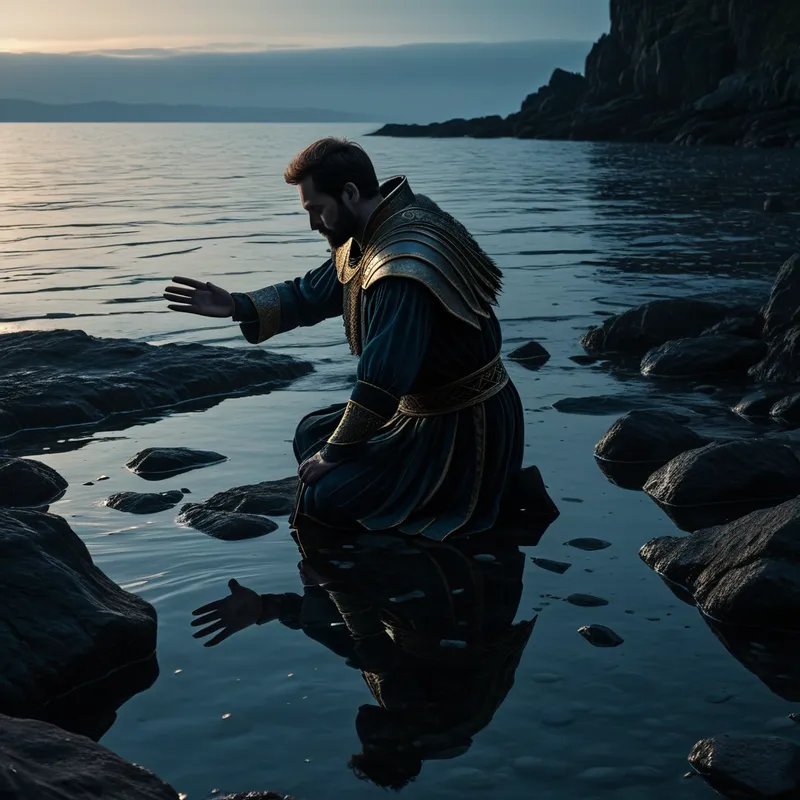
He stood upon the shore, a man of dust and breath before the timeless water. He had no words of power, no golden offering. All he had was his need, raw and unadorned. He knelt, and into the silence, he poured his kingship—not his triumphs, but his fears; not his strength, but his terrible, gnawing lack. “I am a king of surfaces,” his silence said. “Give me a truth from the deep.”
The water did not stir. No ripple answered. Then, as the last light of day bled into the water, a circle of calm began to form at the lake’s very heart. From this stillness, she arose. She was not a woman, though she wore a form akin to one. She was the lake given consciousness, the depth made manifest. Her hair was [the fall](/myths/the-fall “Myth from Biblical culture.”/) of midnight water, her eyes held the chill of abyssal springs, and about her brow was a circlet of living lilies and submerged starlight. She was the [Lady of the Lake](/myths/lady-of-the-lake “Myth from Celtic culture.”/).
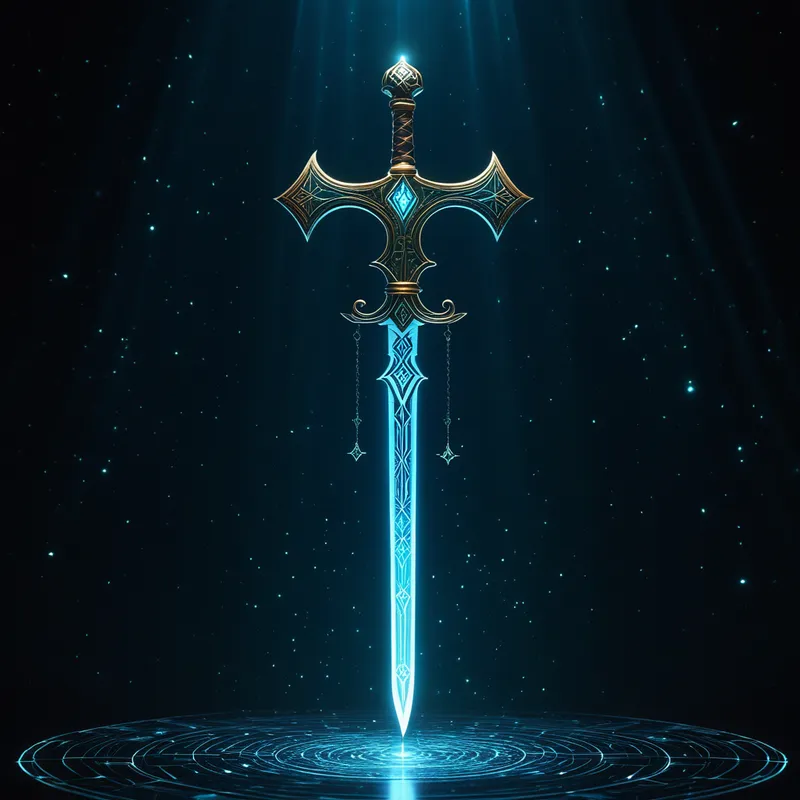
Without a word, she lifted her arm. From the unbroken plane of water rose a blade. It was not thrust upward; it was presented, as a truth is presented. It gleamed with a cold, [inner light](/myths/inner-light “Myth from Buddhist culture.”/), neither silver nor steel, but the essence of clarity itself—Caledfwlch, the Hard Light. Its hilt was set with a single, depthless gem that seemed to hold the lake’s entire memory.
Her gaze was a weight upon his soul. The offering was clear, but so was the condition, spoken not in sound but directly into the chamber of his heart: This power is not to hold, but to wield. Its edge is duty. Its point is sacrifice. It connects you not to your will, but to mine. The hand that draws it from the deep must be ready to return it.
The king, his breath caught in his chest, reached out. His fingers closed around the hilt. A shock, cold and pure, raced up his arm—the shock of touching a law older than kingdoms. He drew the sword from the water, and as it cleared the surface, a single, perfect drop fell from its tip back into the lake, a seal upon their pact. The Lady did not smile. She simply sank, dissolving back into [the mirror](/myths/the-mirror “Myth from Various culture.”/) from which she came, leaving the king alone on the shore, holding a light that was also a weight, a gift that was also a chain, forever binding the fate of Arth to the will of the deep.
Cultural Origins & Context
The myth of [the Lady of the Lake](/myths/the-lady-of-the-lake “Myth from Arthurian culture.”/) from Arth is a cornerstone of what scholars term the Global/Universal narrative stratum. It is not the property of one tribe or nation, but appears in resonant forms across continents, from the lake-dwelling numina of ancient Europe to the spirit-guardians of sacred waters in Asia and the Americas. In the context of Arth, it is a foundational charter myth, a story that explains and legitimizes the very nature of sacred kingship and humanity’s relationship with the numinous, untamed world.
It was traditionally told not as mere entertainment, but as a ritual recitation during the coronation of a new monarch or at ceremonies renewing the seasonal covenants with local waters and lands. The tellers were often the Druith, a class who served as intermediaries between the human community and the spirit of place. The societal function was profound: it established that true authority is not seized, but received. It is a loan from a deeper, older sovereignty represented by the natural world (the Lady). It taught that leadership is a form of service to a power greater than oneself, and that the symbols of power (the sword) carry immense responsibility and a destined return to their source.
Symbolic Architecture
At its core, this myth maps the encounter between the conscious ego (the [King](/symbols/king “Symbol: A symbol of ultimate authority, leadership, and societal order, often representing the dreamer’s inner power or external control figures.”/)) and the animating [spirit](/symbols/spirit “Symbol: Spirit symbolizes the essence of life, vitality, and the spiritual journey of the individual.”/) of the unconscious, the [Sophia](/myths/sophia “Myth from Gnostic culture.”/) or World [Soul](/symbols/soul “Symbol: The soul represents the essence of a person, encompassing their spirit, identity, and connection to the universe.”/) (the [Lady](/symbols/lady “Symbol: The symbol of the ‘Lady’ often signifies femininity, grace, and the complexities of the female experience, representing aspects of nurturing, intuition, and empowerment.”/)). The [king](/symbols/king “Symbol: A symbol of ultimate authority, leadership, and societal order, often representing the dreamer’s inner power or external control figures.”/)’s hollow [throne](/symbols/throne “Symbol: A seat of authority, power, and sovereignty, representing leadership, divine right, or social hierarchy.”/) is [the ego](/myths/the-ego “Myth from Jungian culture.”/)’s realization of its own insufficiency. His [journey](/symbols/journey “Symbol: A journey in dreams typically signifies adventure, growth, or a significant life transition.”/) is the beginning of a psychic [quest](/symbols/quest “Symbol: A quest symbolizes a journey or search for purpose, fulfillment, or knowledge, often representing life’s challenges and adventures.”/), moving from the known world of the [persona](/symbols/persona “Symbol: The social mask or outward identity one presents to the world, often concealing the true self.”/) (the [kingdom](/symbols/kingdom “Symbol: A kingdom symbolizes authority, belonging, and a sense of identity within a larger context or community.”/)) into the wild, unmapped territory of [the Self](/myths/the-self “Myth from Jungian culture.”/).
The lake is the unconscious itself—deep, still, reflective, and containing hidden treasures and sovereign truths.
The sword, Caledfwlch, is the archetypal [symbol](/symbols/symbol “Symbol: A symbol can represent an idea, concept, or belief, serving as a powerful tool for communication and understanding.”/) of spiritual [authority](/symbols/authority “Symbol: A symbol representing power structures, rules, and control, often reflecting one’s relationship with societal or personal governance.”/), discrimination, and focused [consciousness](/symbols/consciousness “Symbol: Consciousness represents the state of awareness and perception, encompassing thoughts, feelings, and experiences.”/). It is forged in the deep (the unconscious) but must be wielded in the world (consciousness). The Lady does not give it freely; she presents it under a sacred [covenant](/symbols/covenant “Symbol: A binding agreement or sacred promise between parties, often carrying deep moral, spiritual, or social obligations and consequences.”/). This is the critical psychic law: [insight](/symbols/insight “Symbol: A sudden, deep understanding of a complex situation or truth, often arriving unexpectedly and illuminating hidden connections.”/), power, or consciousness retrieved from the unconscious comes with a moral [obligation](/symbols/obligation “Symbol: A perceived duty or responsibility imposed by social norms, relationships, or internalized expectations, often involving a sense of being bound to act.”/). It must be integrated responsibly, and one must remain connected to its [source](/symbols/source “Symbol: The origin point of something, often representing beginnings, nourishment, or the fundamental cause behind phenomena.”/), acknowledging that it is not solely one’s [property](/symbols/property “Symbol: Property often represents one’s personal value, possessions, or self-worth.”/).
The single drop falling back is the symbol of reciprocity—the ego must give something back to the unconscious, often in the form of acknowledgment, reverence, or the sacrifice of purely ego-driven aims. The myth warns that to sever this [connection](/symbols/connection “Symbol: Connection symbolizes relationships, communication, and bonds among individuals.”/), to believe the power is solely one’s own, is to invite a psychic [drought](/symbols/drought “Symbol: Drought signifies a period of emotional scarcity, lack of resources, or feelings of deprivation leading to anxiety or intense longing.”/), where the deep waters will no longer yield their wisdom.
The Dreamer’s Resonance
When this mythic pattern stirs in the modern dreamer, it often manifests as a profound encounter at a body of water—a well, a pool, a vast ocean. The dreamer stands on the brink, and from the water emerges a figure of immense, tranquil authority (often feminine, but sometimes an androgynous or elemental form) offering a tool, a key, a weapon, or a stone. The emotional tone is one of awe, solemnity, and deep, somatic chill.
Psychologically, this dream signals a critical moment of readiness to receive a piece of one’s own sovereignty from the depths of the [psyche](/myths/psyche “Myth from Greek culture.”/). The “hollow king” is the dreamer’s conscious identity feeling incomplete, lacking authentic purpose or authority in their own life. The offering from the deep represents a new capacity for discrimination (the sword), a core truth, or a mandate for one’s life path emerging from the Self. The somatic chill is the body registering contact with the numinous—it is the shock of the real. The dream is an invitation to, and a preparation for, taking up this inner authority, with the implicit understanding that it will change one’s relationship to the world and demand a new level of psychological responsibility.

Alchemical Translation
The myth of the Lady of the Lake is a perfect allegory for the alchemical stage of [Separatio](/myths/separatio “Myth from Alchemical culture.”/) and the Jungian process of individuation. The king’s initial state is one of confusion—his identity is bound to external kingship, which feels hollow. His quest is the [nigredo](/myths/nigredo “Myth from Alchemical culture.”/), the darkening and descent into the unknown (the journey to the lake).
The encounter at the lake is the albedo, the washing in the lunar, silver waters of the unconscious. Here, in the reflective stillness, the coniunctio or [sacred marriage](/myths/sacred-marriage “Myth from Alchemy culture.”/) occurs—not a romantic union, but the marriage of conscious need with unconscious provision. The ego (king) and the anima/Self (Lady) forge a covenant.
The drawing of the sword is the moment of psychic transmutation: a piece of the unconscious’s structuring power (the sword as Logos) is extracted and integrated into the conscious personality.
This is the creation of the Function Transcendente, a new, guiding principle that is neither purely conscious nor unconscious, but a product of their interaction. For the modern individual, this translates to the hard-won achievement of an authentic, inner-directed authority. It is the moment one stops looking for validation externally (the empty throne) and instead draws upon a deep, inner wellspring of truth and discrimination. The “return of the sword” clause is the ongoing requirement of the individuated life: to remain in dialogue with the unconscious, to honor the source of one’s being, and to understand that one’s unique expression of power is ultimately in service to the greater, mysterious whole from which it came. The king returns to his kingdom transformed, not because he has conquered, but because he has been chosen by the deep, and has accepted the solemn, shining burden of its gift.
Associated Symbols
Explore related symbols from the CaleaDream lexicon: