
The Laboratory Myth Meaning & Symbolism
A myth of the soul's crucible, where the raw matter of the self is dissolved and refined in the sacred, perilous space of The Laboratory.
The Tale of The Laboratory
Listen, and hear the tale of the place where the world is unmade and remade. It is not a story of a hero, but of a space—a sacred, terrible, and silent chamber known only as The Laboratory.
In the beginning, before the first metal was smelted or the first herb named, there was only the Unformed. From its chaos, the Artifex awoke. Not with a shout, but with a question that hung in the void: “What sleeps within the stone?” The Artifex did not command. The Artifex prepared. From the bones of the earth and the breath of the stars, the first space was shaped: a cavern of perfect geometry, lit by no sun, warmed by no common fire. This was The Laboratory. Its walls were not stone, but a substance like darkened crystal, holding the memory of all potential forms. Its heart was the Athanor, a vessel of living flame that burned without fuel, its heat not of destruction, but of fierce attention.
Into this space, the Artifex brought the First Matter—a lump of black, dense, and weeping earth named Chaos Nigredo. It was not placed upon an altar, but upon the Workbench, a plain slab of grey stone. The work began not with force, but with a slow, patient application of the Athanor’s heat. For an age, the Chaos Nigredo did nothing but resist. It cracked, it smoked, it screamed a silent scream of dissolution. This was the Nigredo, the long night of the soul of matter.
The Artifex did not falter. The fire was adjusted, not in temperature, but in intention. From a roar, it became a whisper. From a whisper, it became a song. And within the seething blackness, a miracle of despair occurred: a single, tear-like drop of silver moisture condensed on the glass of the containing vessel. This was the first sign of the Albedo. The black mass began to pale, to soften, to become a moon-colored paste. The Laboratory, once a tomb of heat, now hummed with a cool, lunar light.
But the work was only half-done. The white matter was pure, but it was passive. It had no will of its own. Again, the Artifex consulted the Athanor. This time, the fire was focused into a needle-thin beam of gold and crimson. It was applied not to dissolve, but to awaken. The white matter shuddered, then began to glow from within. A spectrum of colors—crimson, violet, gold—swirled upon its surface. This was the Citrinitas, the dawning of an inner sun.
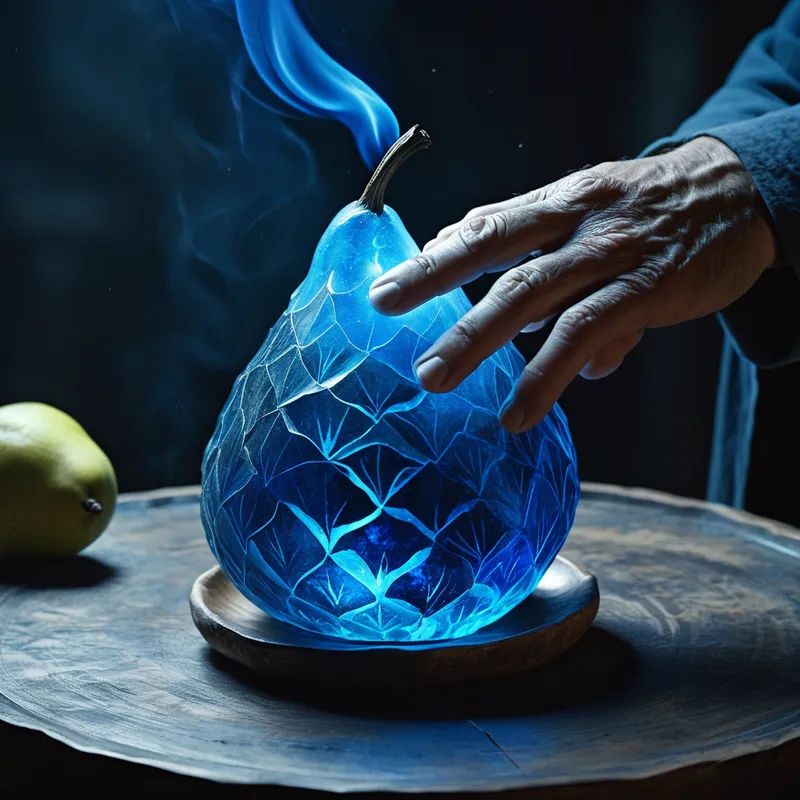
Finally, the Artifex performed the last, most dangerous operation. The substance, now vibrant and volatile, was sealed in the Hermetic Vase. The Athanor’s fire was drawn around it in a perfect, rotating sphere. For a final age, The Laboratory held its breath. There was no sound but the hum of potential. Then, without explosion or fanfare, the Vase became transparent. Within, no paste, no liquid, no gas remained. Only a single, perfect, self-luminous Lapis Philosophorum hovered, radiating a soft, eternal light. The Rubedo was complete. The Artifex looked upon the Stone, then upon the empty Workbench, and smiled. The Laboratory had fulfilled its purpose. It was now, and forever, a template in the soul of the world.
Cultural Origins & Context
The myth of The Laboratory is the foundational narrative of the Alchemical tradition, distinct from its later historical practice in medieval Europe. It emerged from the Hermetic milieu of late antiquity, a culture of synthesis where Egyptian temple craft, Greek natural philosophy, and Gnostic cosmology fused. It was never a “folk” tale told in the marketplace, but a disciplina arcani, transmitted orally within closed schools and later encoded in deliberately obscure symbolic texts and diagrams.
Its tellers were the first Adepts, who served a dual societal function. Exoterically, they were proto-scientists, seeking to understand and manipulate the material world. Esoterically, they were psychopomps, guiding the inner development of the initiate. The myth of The Laboratory provided the sacred justification and cosmological map for both endeavors. It taught that transformation—of metal or of soul—was not heresy against nature, but the fulfillment of nature’s deepest, hidden purpose. The Laboratory was the imaginal space where the divine blueprint for perfection could be enacted, a ritual answer to the perceived “fallen” or imperfect state of the natural world and the human psyche.
Symbolic Architecture
The Laboratory is not merely a workshop; it is the archetypal container for the process of radical change. It represents the total psychological environment necessary for individuation—a bounded, sacred space where the ego’s normal rules are suspended.
The Laboratory is the psyche in its active, purposive mode: a sealed cosmos where chaos is invited in as the honored guest, for it is the only raw material worthy of the Work.
The Artifex symbolizes the guiding consciousness, the observing ego that submits itself to a process greater than itself. It is not an omnipotent god, but a dedicated technician of the soul. The Chaos Nigredo is the unintegrated Self—our repressed shadows, traumas, potentials, and instincts—all that is “base” and unacknowledged. The Athanor is the transformative fire of attention, suffering, and libido (psychic energy). Its changing application mirrors the need for different psychological attitudes: the brutal heat of confronting shadow (Nigredo), the gentle light of introspection and cleansing (Albedo), the energizing spark of integrating new insights (Citrinitas), and the unifying, all-encompassing embrace that leads to wholeness (Rubedo).
The Hermetic Vase is perhaps the most critical symbol: it is the integrity of the process itself. It represents the commitment to see the work through, the therapeutic container, the vow that prevents the volatile elements of the psyche from escaping and causing psychosis, instead forcing their confrontation and fusion.

The Dreamer’s Resonance
When the myth of The Laboratory activates in the modern dreamscape, it signals a profound somatic and psychological initiation. To dream of being in a vast, ancient, or impossibly complex laboratory is to dream of the Self organizing for a great work.
The dreamer may find themselves as the technician, anxiously monitoring strange apparatus, which reflects the ego’s attempt to manage an overwhelming inner process. More commonly, they are the material in the vessel—feeling dissolved, heated, or distilled. This is often accompanied by somatic sensations in the dream: feelings of pressure, intense heat or cold, or a sense of chemical transformation within the body. The dream lab might be futuristic or anachronistic, but its core quality is one of focused, impersonal purpose.
Such dreams emerge during life crises that demand a re-constitution of identity: the end of a relationship, a career shift, a spiritual awakening, or the integration of a major trauma. The laboratory setting tells the dreamer that the chaos they are experiencing is not meaningless suffering, but a necessary stage in a precise, if mysterious, operation. The anxiety comes from the ego’s fear of dissolution; the awe comes from the soul’s recognition of its own sacred procedure.

Alchemical Translation
For the modern individual seeking wholeness, the myth models the complete arc of psychic transmutation. It begins with the conscious decision to create an inner Laboratory—a dedicated space for self-work through therapy, meditation, journaling, or artistic practice. This is the temenos, the protected circle where the normal persona can be set aside.
The first operation is always the Nigredo: one must willingly gather the Chaos Nigredo of one’s life—the anger, grief, shame, and broken dreams—and place it on the inner Workbench, applying the steady fire of honest self-observation. This is the dark night of the soul, the feeling of being reduced to one’s base components.
The Albedo follows when, exhausted by the struggle, a clarity emerges. This is the washing of the matter, often experienced as a period of melancholy insight, forgiveness, or the quiet understanding of one’s patterns. The Citrinitas is the energizing return of meaning and vitality, as these purified insights are connected to one’s life purpose, sparking new creativity and direction. Finally, the Rubedo is not a permanent state of perfection, but those moments of achieved integration—when a lifelong conflict loses its charge, when compassion arises spontaneously where there was judgment, when one acts from a place of authentic wholeness rather than compulsion. The Lapis is not an external object, but the experiencing of the Self as both the artisan and the perfected work: a centered, resilient, and generative core identity.
The myth’s ultimate teaching is that we are, each of us, both the Artifex and the Prima Materia. The Laboratory is the life we are given, and the Great Work is the conscious, courageous, and reverent participation in our own endless transformation.
Associated Symbols
Explore related symbols from the CaleaDream lexicon: