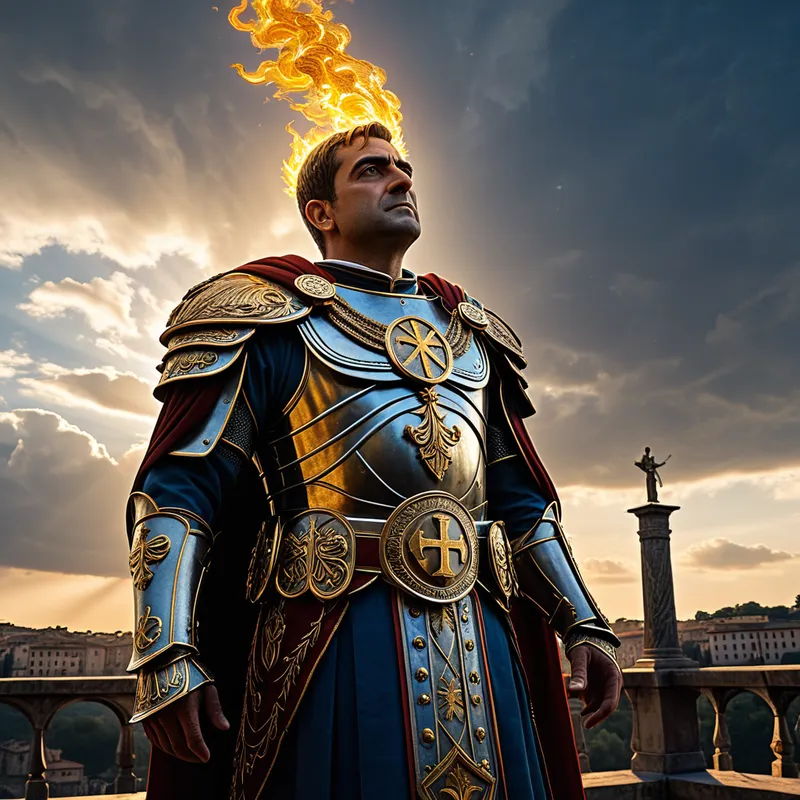
The Labarum of Constantine Myth Meaning & Symbolism
A Roman emperor receives a divine vision before battle, uniting the symbols of empire and faith into a new standard for the soul.
The Tale of The Labarum of Constantine
The air over the Pons Milvius was thick with the coming storm, not of clouds, but of iron and blood. The Tiber flowed darkly below, a silent witness to the armies gathering on its banks. In his tent, Flavius Valerius Constantinus, the Emperor of the West, could not find rest. The weight of the morrow pressed upon his chest—a civil war against his brother-in-arms, Maxentius, a battle for the very soul of Rome. The old gods seemed distant, their voices silent in the metallic clatter of preparation.
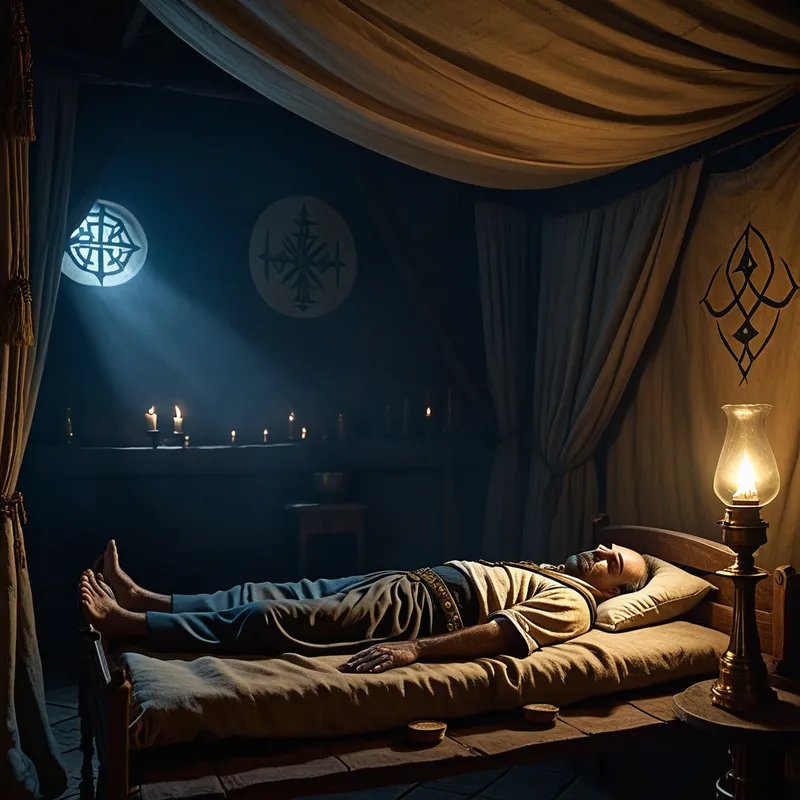
As the sun died in the west, a profound unease settled over the camp. Constantine dismissed his advisors and sought solitude. Sleep, when it came, was not a gentle release but a descent into a realm of piercing light. In the vision-drenched space between worlds, the fabric of [the sky](/myths/the-sky “Myth from Persian culture.”/) tore open. Not with violence, but with a silent, overwhelming radiance. A symbol, foreign and yet profoundly familiar, burned itself into the firmament: the Chi-Rho, the first two letters of Christos, woven from living flame and starlight. It was not merely seen; it was known.
A voice, resonant and clear as a mountain spring, spoke not to his ears but into the marrow of his being: “In this sign, conquer.” The command was absolute, devoid of negotiation, a decree from a source of authority that made the [imperial purple](/myths/imperial-purple “Myth from Roman culture.”/) seem like a child’s cloth. Constantine awoke, gasping, the afterimage of the symbol seared onto his sight. The tent was dark, but the vision illuminated his mind with a cold, certain fire.
At dawn, he summoned his artisans. The dream was recounted not as a curious anecdote, but as a divine mandate. “Craft the standard,” he ordered. “Let the symbol of the vision be our guide.” They worked with frantic haste. From the heart of the imperial insignia, they wrought a new standard—the Labarum. A gilded spear became its spine. From its crossbar hung the imperial purple banner, rich and deep. And at its apex, encircled by a wreath of gold, shone the Chi-Rho. Below it, suspended, was a portrait of the emperor and his sons—the old world gazing upon the new sigil.
The legions assembled, their eyes drawn to this strange new talon leading them. As they marched to the bridge, the Labarum caught the morning sun, a beacon of fused allegiances. The battle was joined, a chaos of shouting men and shattering shields. But around the Labarum, the story goes, the emperor’s troops fought with a ferocity born of conviction. Maxentius’s forces, fighting under the old, unseeing standards, faltered and broke. The usurper himself was cast into the Tiber, weighed down by his own armor. On that day, [the river](/myths/the-river “Myth from Buddhist culture.”/) did not just carry a fallen rival; it carried away an epoch. Constantine stood victorious, his gaze fixed not on the spoils, but on the symbol that had led him there, now stained with dust and glory, a bridge between heaven and empire.
Cultural Origins & Context
This is not a myth born in the misty age of heroes, but one etched into the parchment of history at a precise, tectonic moment. The tale of the Labarum originates in the 4th century AD, a time when the Imperium Romanum was a colossal, weary giant, internally divided and spiritually adrift. The old Pax Deorum felt increasingly hollow, while the once-persecuted Christian cult had grown into a pervasive, vital force within the empire’s very body.
The primary sources are the Christian historians Eusebius of Caesarea and Lactantius, who wrote shortly after the events. For them, the story was not mere record-keeping; it was sacred history, a foundational myth for a new Christian empire. It served a potent societal function: to legitimize Constantine’s rule and his subsequent favor of Christianity as divinely ordained, weaving the emperor’s personal fate into the grand narrative of God’s providence. It transformed a political and military victory into a cosmic turning point, signaling the moment the empire’s genius shifted its allegiance from the Capitoline Hill to the [Golgotha](/myths/golgotha “Myth from Christian culture.”/).
Symbolic Architecture
At its core, the myth of the Labarum is a profound [allegory](/symbols/allegory “Symbol: A narrative device where characters, events, or settings represent abstract ideas or moral qualities, conveying deeper meanings through symbolic storytelling.”/) of [synthesis](/symbols/synthesis “Symbol: The process of combining separate elements into a unified whole, representing integration, resolution, and the completion of a personal journey.”/) and the [birth](/symbols/birth “Symbol: Birth symbolizes new beginnings, transformation, and the potential for growth and development.”/) of a new ruling principle from the [collision](/symbols/collision “Symbol: A sudden, forceful impact between objects or forces, often representing conflict, unexpected change, or the meeting of opposing elements in life.”/) of opposites. It is not a [story](/symbols/story “Symbol: The symbol of ‘Story’ represents the narrative woven through our lives, embodying experiences, lessons, and emotions that shape our identities.”/) of simple [conversion](/symbols/conversion “Symbol: A fundamental transformation in artistic style, technique, or medium, often representing a profound personal or creative shift.”/), but of alchemical [fusion](/symbols/fusion “Symbol: The merging of separate elements into a unified whole, often representing integration of self, relationships, or conflicting aspects of identity.”/).
The vision does not destroy the emperor; it recruits him. The Labarum does not replace the standard; it subsumes it, making the old power a vessel for the new meaning.
Constantine represents the archetypal Ruler at a [crisis](/symbols/crisis “Symbol: A crisis symbolizes turmoil, urgent challenges, and the need for immediate resolution or change.”/) point. His existing [paradigm](/symbols/paradigm “Symbol: A fundamental model or framework in arts and music that shapes creative expression, perception, and cultural understanding.”/)—the [logic](/symbols/logic “Symbol: The principle of reasoning and rational thought, often representing order, structure, and intellectual clarity in dreams.”/) of Roman statecraft and traditional cult—has failed to provide the certainty needed for his ultimate battle. The [vision](/symbols/vision “Symbol: Vision reflects perception, insight, and clarity — often signifying the ability to foresee or understand deeper truths.”/) offers a new, transcendent [authority](/symbols/authority “Symbol: A symbol representing power structures, rules, and control, often reflecting one’s relationship with societal or personal governance.”/). The Chi-Rho is the invading [symbol](/symbols/symbol “Symbol: A symbol can represent an idea, concept, or belief, serving as a powerful tool for communication and understanding.”/) of the emergent Self, a [pattern](/symbols/pattern “Symbol: A ‘Pattern’ in dreams often signifies the underlying structure of experiences and thoughts, representing both order and the repetitiveness of life’s situations.”/) of meaning from the unconscious that demands recognition and [integration](/symbols/integration “Symbol: The process of unifying disparate parts of the self or experience into a cohesive whole, often representing psychological wholeness or resolution of internal conflict.”/). The command “In this sign, conquer” is the [psyche](/myths/psyche “Myth from Greek culture.”/)’s imperative to use this new central [symbol](/symbols/symbol “Symbol: A symbol can represent an idea, concept, or belief, serving as a powerful tool for communication and understanding.”/) as the organizing principle for the coming conflict of [life](/symbols/life “Symbol: The symbol of ‘Life’ represents a journey of growth, interconnectedness, and existential meaning, encompassing both the joys and challenges that define human experience.”/).
The resulting Labarum is the symbol made manifest, the tangible [product](/symbols/product “Symbol: This symbol represents tangible outcomes of one’s efforts and creativity, often reflecting personal value and identity.”/) of this psychic integration. It is a perfect [image](/symbols/image “Symbol: An image represents perception, memories, and the visual narratives we create in our minds.”/) of synthesis: the imperial purple (worldly power), the [military](/symbols/military “Symbol: The military symbolizes discipline, authority, and often the need for structure or control in one’s life.”/) standard ([structure](/symbols/structure “Symbol: Structure in dreams often symbolizes stability, organization, and the framework of one’s life, reflecting how one perceives their environment and personal life.”/) and order), and the divine monogram (transcendent meaning) are irrevocably joined. The old [identity](/symbols/identity “Symbol: Identity represents the sense of self, encompassing personal beliefs, cultural background, and social roles.”/) (the portrait of Constantine) is now literally beneath the new symbol, re-contextualized by it.
The Dreamer’s Resonance
When this mythic pattern stirs in the modern dreamer, it often manifests as a moment of decisive, numinous insight on the eve of a great life challenge. One might dream of a blinding light revealing a simple, enigmatic symbol—a glyph, a mathematical equation, a unique shape—that carries an absolute sense of “truth.” The dreamer awakens with a somatic certainty, a gut-level conviction that this symbol holds the key to navigating an impending “battle”: a career crossroads, a relational reckoning, or an internal crisis of faith.
Psychologically, this is [the Self](/myths/the-self “Myth from Jungian culture.”/) intervening in a state of ego-doubt. The old coping strategies (the “old gods”) have lost their potency. The dream-vision is the unconscious delivering a new standard, a core image around which the personality can re-organize for the task ahead. The process is one of receiving a mandate, not through rational analysis, but through a revelatory experience that bypasses doubt. The dreamer is in the role of Constantine: a ruler of their own psyche who must have the courage to adopt the strange new banner and march under it.
Alchemical Translation
The alchemical journey modeled here is the Opus Magnum of the ruling principle. The [prima materia](/myths/prima-materia “Myth from Alchemical culture.”/) is the conflicted psyche of the leader, torn between old, fading loyalties and an emerging, undefined call. The “vision” is the [nigredo](/myths/nigredo “Myth from Alchemical culture.”/) suddenly pierced by the illuminating flash of the albedo, a moment of divine madness that provides clarity.
The battle is the necessary rubedo, the fiery process where the new symbol is tested in the forge of reality. Victory is not the annihilation of the old self, but its subordination to a higher synthesis.
For the modern individual, the “Labarum” is the unique, personal symbol of integration that emerges from such a crisis. It is the new “standard” one carries forward—a renewed philosophy, a creative identity, a spiritual practice—that successfully marries one’s foundational history and competencies (the “empire” of the personal past) with a transcendent value or meaning that has broken through from the depths. One does not abandon who they were; they become the standard-bearer for what they are now called to be. The myth teaches that true authority is finally bestowed not by external power, but by the courage to heed the vision and wield the synthesized symbol in the wars of [the world](/myths/the-world “Myth from Tarot culture.”/).
Associated Symbols
Explore related symbols from the CaleaDream lexicon: