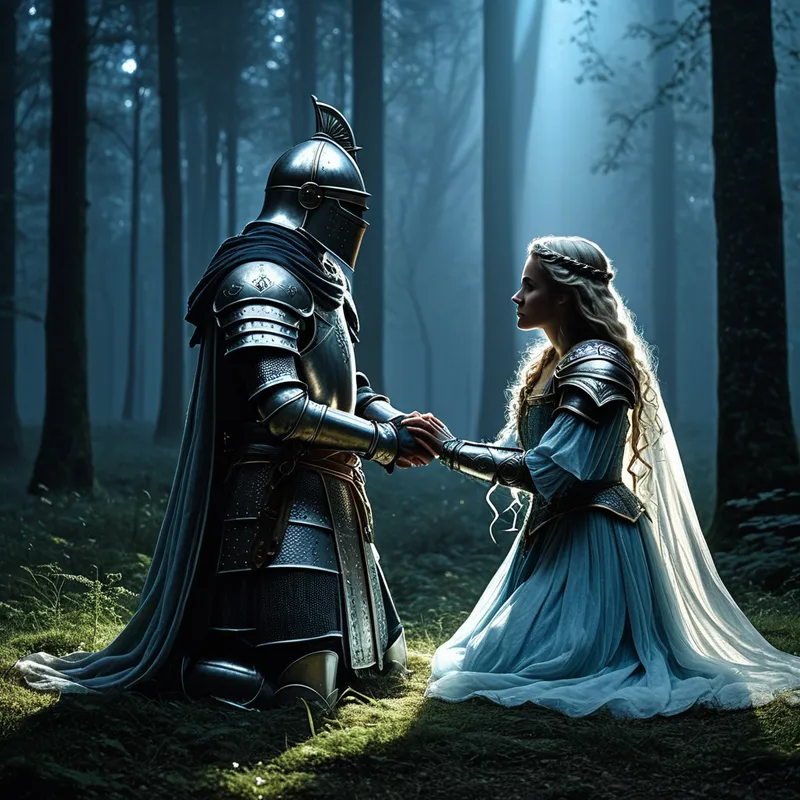
The Knight and His Lady Myth Meaning & Symbolism
A knight's quest for his vanished lady becomes a descent into the underworld, revealing the sacred bond between mortal courage and eternal feminine wisdom.
The Tale of The Knight and His Lady
Listen, and let the mists of the Harz descend. In a time when the world was half-woven from dream and deed, there lived a knight. He was not the greatest in land or title, but in his heart burned a loyalty as pure and hard as the steel of his sword. His world was his lady—a being of such grace that sunlight seemed to hesitate upon her hair, and her voice held the quiet music of forest springs. She was his north star, his hearth-light, the reason his armor felt like a second skin of purpose.
One autumn, as the leaves bled gold and crimson, she vanished. Not with a cry or a struggle, but as if the twilight itself had breathed her in. The castle halls grew hollow, echoing only with her absence. The knight searched every known path, every sunlit glade, until his horse faltered and his hope grew thin as old parchment. It was a weathered woodsman, his eyes like knots in an ancient oak, who whispered of the other path. “She has been taken,” he murmured, “not by man or beast, but by the Old Powers. To the Bergfrau of the deepest mountain, the guardian of the stone heart. The way is through the door that does not face the sun.”
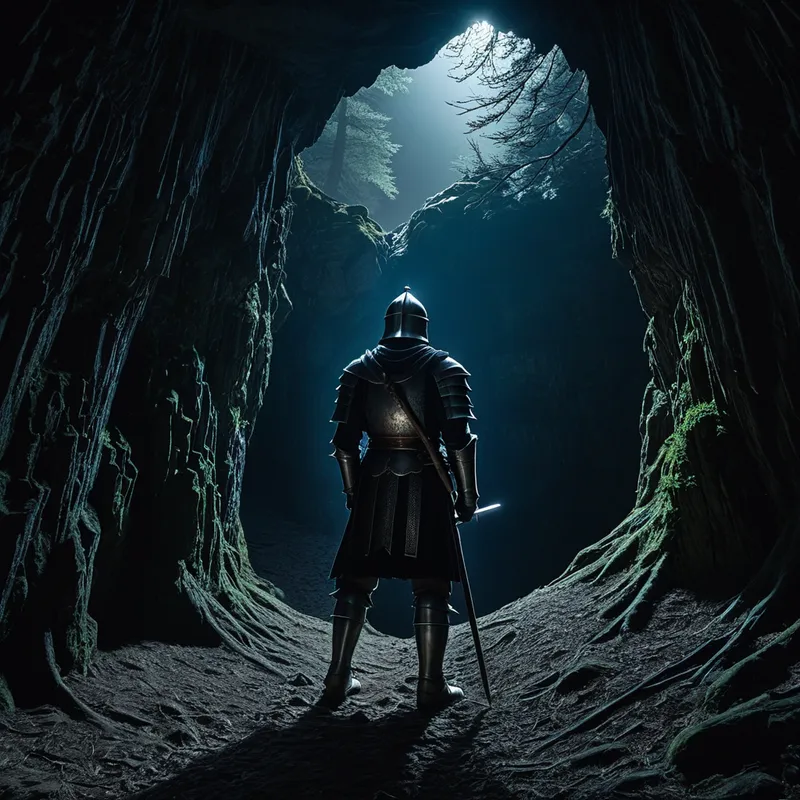
Driven by a love that had become a quiet, relentless agony, the knight forsook the world of light. He found the cave mouth—a ragged wound in the side of the mountain, exhaling air cold and ancient. Leaving his steed, his banner, all trappings of his surface life, he entered the belly of the earth. The descent was a baptism in darkness. Water dripped like forgotten time. Strange phosphorescent fungi cast ghastly shadows that seemed to clutch at him. Whispers, not in words but in feelings—of despair, of tempting oblivion—wound through the tunnels. His armor became a cage of cold; his body ached for the sun. Yet, he pressed on, guided only by the faint, fading memory of her face.
After a journey that felt like an age, he emerged not into a cavern, but into a cavernous hall of crystalline beauty. Walls of amethyst and quartz refracted a light with no source. And there, upon a throne of living rock, sat his lady. But she was changed. Her beauty was now of the earth—immovable, eternal, and terrifyingly distant. Beside her stood the Bergfrau, her form both matronly and severe, carved from the mountain’s will.
“You have come for what is mine,” the Bergfrau’s voice echoed, not unkindly, but with the finality of tectonic plates shifting. “She is of the deep earth now. To take her, you must leave behind what you are. Your armor, your name, your very memory of the sun. Will you dwell here, in eternal twilight, for the sake of a love that your world above has already forgotten?”
The knight did not hesitate. He unbuckled his sword, letting it fall with a clatter that was the sound of his old life ending. Piece by piece, he removed his plate and mail, standing shivering and vulnerable in the subterranean chill. “I am nothing without her,” he said, his voice raw. “I choose the twilight.”
In that moment of utter surrender, the Bergfrau’s stern visage softened. The crystalline light in the hall warmed, turning from cold violet to a gentle gold. The lady on the throne stirred, and the earthly majesty in her eyes melted into the familiar, human warmth he remembered. “The test was not of your strength,” the Bergfrau said, “but of your essence. You have proven that your devotion is not to the idea of a knight, but to the truth of the heart. That which is given in true sacrifice is returned, transformed.”
The knight and his lady returned to the world above, but they were not as they were. He wore no armor, yet carried an unshakable peace. She walked with a new gravity, her feet knowing the secrets of the deep earth. They were bound not by courtly vow alone, but by a shared passage through the dark, a union forged in the underworld and brought back to bless the land of light.
Cultural Origins & Context
The myth of the Knight and His Lady, in its most profound Germanic iterations, is less a single story and more a narrative pattern that permeates Minnesang tradition, folktales, and local Sagen. It synthesizes the courtly ideal of Minne (courtly love) with far older, chthonic strands of pre-Christian belief. The knight represents the ordered, striving world of medieval chivalric society, while the lady—and her captor, the Bergfrau or sometimes a dwarf-king—connects to the autonomous, powerful, and often perilous realm of the feminine divine and the spirits of the land.
These tales were told in hearth-side gatherings and later recorded by folklorists like the Brothers Grimm. Their function was multifaceted: to model an idealized, devotional form of love that transcended mere possession; to map the psychological landscape of loss, quest, and transformation; and to acknowledge the enduring power of the local genius loci, the spirit of place, which demanded respect and sacrifice. The underworld descent is a classic katabasis, a motif found globally but here rendered in distinctly Germanic texture—the mountain cave, the crystalline hall, the earthy, sovereign female power.
Symbolic Architecture
At its core, this myth is a blueprint for the soul’s journey toward wholeness. The Knight symbolizes the conscious ego—the armored identity, the societal role, the willful striving self. His Lady represents the Anima, the soul-image, the connection to life’s deeper meaning, beauty, and eros. Her disappearance signifies an anima loss—a state of spiritual dryness, depression, or existential crisis where life loses its color and music.
The quest begins not when the world is lost, but when the soul within the world vanishes.
The Bergfrau is the mythic representation of the Anima in its most profound, transformative, and “other” aspect. She is not a villain, but the guardian of the treasure. She is the unconscious itself, which demands a price for the return of what is precious. The descent into the mountain is the necessary journey into the unconscious, the shadowlands of the psyche. The surrender of armor and sword is the critical moment of ego dissolution—the letting go of defensive identities, of the need to control and conquer, in order to be receptive to a greater truth.

The Dreamer’s Resonance
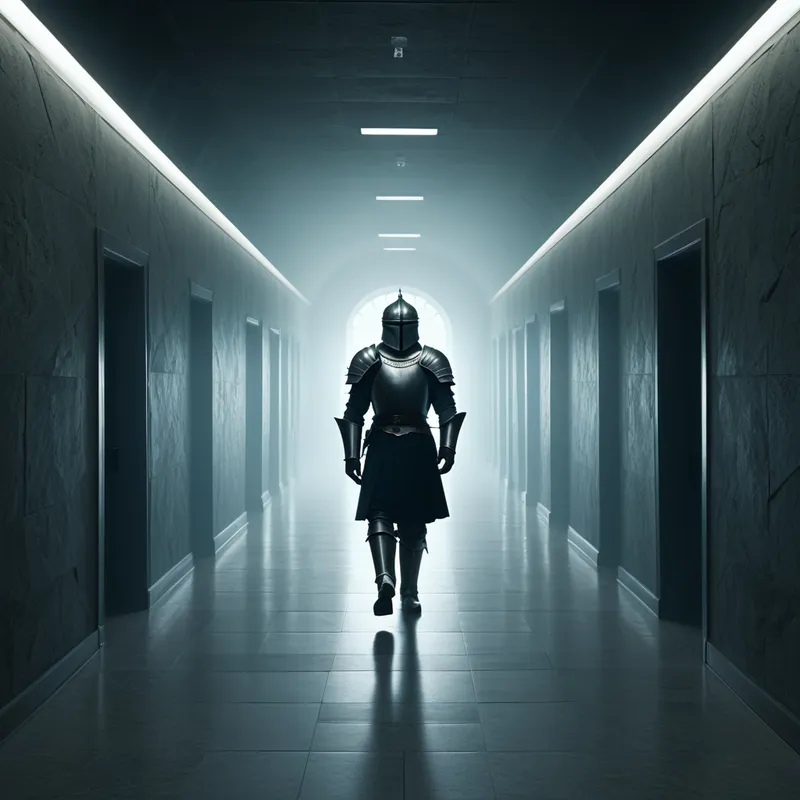
When this myth stirs in modern dreams, it rarely appears in full medieval regalia. Instead, one might dream of a profound, aching search for a lost partner or a forgotten feeling in a labyrinthine, institutional building (the modern “underworld”). The somatic experience is often one of weightedness, of moving through resistance, or of a chilling cold—the body registering the psyche’s descent.
The dream-ego (the dreamer) may be desperately trying to solve a puzzle, fix a machine, or navigate endless corridors to reach someone or something vitally important. This is the knight’s quest translated. The moment of confrontation with a formidable, earthy, or uncanny female figure (a stern administrator, a silent guide, a towering natural element) mirrors the meeting with the Bergfrau. The psychological process is one of confronting the non-negotiable conditions of the deep Self. The dream invites the dreamer to ask: What rigid identity (my “armor”) must I shed? What am I truly willing to sacrifice for the return of my soul’s connection?
Alchemical Translation
The myth is a perfect allegory for the alchemical solutio and coniunctio. The knight’s conscious, solar world (the animus principle) is separated from the lady’s lunar, soul world (the anima principle). Wholeness requires a descent—the nigredo or dark night of the soul—into the moist, chaotic depths of the mountain (the unconscious).
The armor does not protect the journey; it prevents it. True strength is found in vulnerability before the depths.
The surrender of his knightly trappings is the alchemical dissolution of the old, hardened personality. He is reduced to his essence, his prima materia. The Bergfrau, as the personified unconscious, acts as the alchemical vessel and the transformative agent. Her acceptance is the catalyst. The return of the transformed couple to the upper world symbolizes the individuated state—not a rejection of the conscious world, but its redemption. The conscious ego (knight) and the soul (lady) are now in sacred marriage, each enriched by the knowledge of the other’s realm. For the modern individual, this translates to the process where one’s professional, social identity (the knight) must willingly engage with and be transformed by the often-ignored depths of feeling, intuition, and soul-purpose (the lady), facilitated by a courageous encounter with the autonomous, structuring power of the unconscious itself. The result is not a life of mere surface duty, but one of grounded, incarnate meaning.
Associated Symbols
Explore related symbols from the CaleaDream lexicon: