The Kite in Han Dynasty Myth Meaning & Symbolism
An artisan's forbidden kite bridges heaven and earth, challenging celestial order and embodying the eternal human yearning for transcendence and creative freedom.
The Tale of The Kite in Han Dynasty
Listen, and hear the whisper of silk against [the wind](/myths/the-wind “Myth from Various culture.”/), a sound that once tore the fabric of heaven itself.
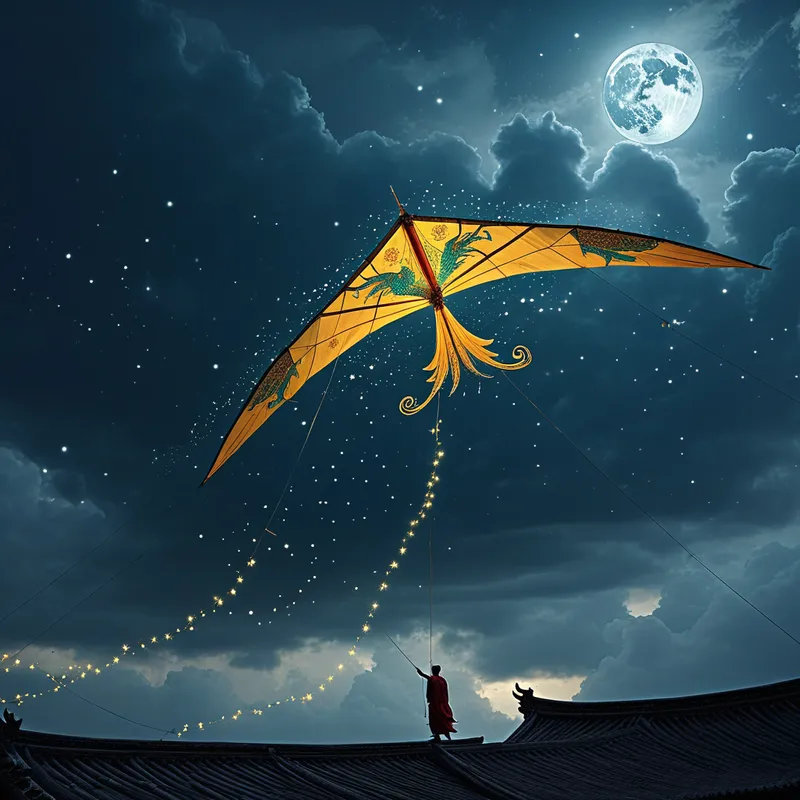
In the waning years of the Western Han, under an emperor whose heart was heavy with portents, there lived an artisan named Luan Qing. His was not the fame of generals or the wealth of merchants; his kingdom was the workshop, his army the brush and the knife. He crafted kites not for the laughter of children, but as prayers made tangible. Each bamboo spine was a supplication, each stretch of silk a canvas for unspoken yearning. He watched the hawks circle the imperial towers, their flight a cruel reminder of a boundary—the firmament was the domain of birds and gods, and men were meant to look up, forever earthbound.
But Luan Qing’s heart housed a secret rebellion. He dreamed not of climbing, but of sending. He would build a messenger, a [thing](/myths/thing “Myth from Norse culture.”/) of such beauty and precision that it could navigate the corridors of the high air, where the Tian Ming was woven into the very winds.
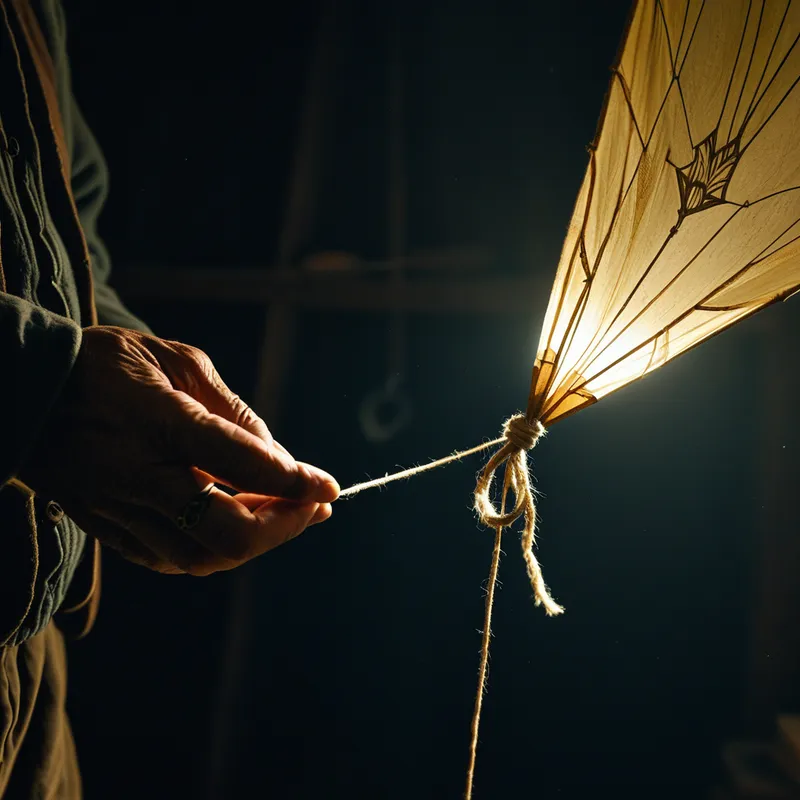
For three years he labored in silence. [The bamboo](/myths/the-bamboo “Myth from Taoist culture.”/) was cured under specific phases of [the moon](/myths/the-moon “Myth from Tarot culture.”/). The silk was dyed with indigo and cinnabar, depicting the Qing Long coiled amidst the stars of the Beidou. The string was not hemp, but a braid of his own hair, his wife’s, and threads of silver—a cord of human essence and earthly treasure. The day he completed it, the air in Chang’an grew still and expectant.
He took it to the windswept plain beyond the city walls. As he launched it, a common breeze became a gale, purposefully lifting his creation. It did not merely fly; it ascended, a sliver of painted sky pulling against the silver thread. Higher it climbed, past the circling hawks, past the highest clouds, until it was a speck, then a shimmer, then a new, defiant star in the afternoon sky. The string in his hands grew warm, then vibrated with a hum that was not of this world—the sound of his craft touching the celestial weave.
In the heavens, the orderly procession of cloud and wind was disrupted. The Tian Guan felt the intrusion, a scratch upon the perfect jade tablet of [the sky](/myths/the-sky “Myth from Persian culture.”/). A human artifact, a construct of pride and longing, had breached the sanctum. The Emperor, consulting his astrologers, saw it as a terrible omen—a dragon of silk challenging the celestial dragons. The order was given: the kite must be brought down.
Soldiers came for Luan Qing. They found him on the plain, his hands raw and bleeding, refusing to release the string. For to release it was to sever the connection, to admit the prayer was unheard. As they seized him, a divine wind, sent by the offended Tian Guan, sheared the string with a sound like a sigh. The kite, freed from its earthly tether, did not fall. It flared with a final, brilliant light and dissolved into the firmament, becoming one with the very boundary it had sought to cross. Luan Qing, his life’s work and his rebellion gone, was led away, his eyes forever fixed on the empty spot in the sky where his soul had briefly flown.
Cultural Origins & Context
The tale of the Han Dynasty kite is less a formal, canonized myth from a classic text like the Shan Hai Jing and more a persistent cultural folktale, a “lost myth” that crystallizes around the historical reality of kite invention in China. Kites (fengzheng) are believed to have originated in the Warring States or early Han period, initially for military signaling and measurement. This myth likely emerged from artisan circles and oral storytellers, a poetic explanation for humanity’s oldest aeronautical dream.
Its societal function was multifaceted. For the ruling class, it served as a cautionary tale about overreaching, reinforcing the Confucian ideal of knowing one’s place within the hierarchical order of heaven, earth, and mankind. For the common people and artisans, however, it held a subversive resonance. It celebrated the sublime skill of the craftsman, whose work could—if only for a moment—rival the divine. It was a story of almost, of glorious failure, which in a culture valuing harmony and stability, is a profoundly powerful narrative. It gave voice to the quiet, universal longing to send a part of oneself beyond the visible horizon, to make contact with the infinite.
Symbolic Architecture
At its core, the myth is an alchemical diagram of the [relationship](/symbols/relationship “Symbol: A representation of connections we have with others in our lives, often reflecting our emotional state.”/) between the [human](/symbols/human “Symbol: The symbol of a human represents individuality, complexity of emotions, and social relationships.”/) [spirit](/symbols/spirit “Symbol: Spirit symbolizes the essence of life, vitality, and the spiritual journey of the individual.”/) and the absolute. The kite is the Hun, the higher, aspirational [soul](/symbols/soul “Symbol: The soul represents the essence of a person, encompassing their spirit, identity, and connection to the universe.”/). The [bamboo](/symbols/bamboo “Symbol: A symbol of resilience, flexibility, and spiritual growth, often representing strength through adaptability and connection to nature.”/) and [silk](/symbols/silk “Symbol: A luxurious natural fiber representing refinement, sensuality, and transformation from humble origins to exquisite beauty.”/) frame is the physical [body](/symbols/body “Symbol: The body in dreams often symbolizes the dreamer’s self-identity, personal health, and the relationship they have with their physical existence.”/) and the crafted [persona](/symbols/persona “Symbol: The social mask or outward identity one presents to the world, often concealing the true self.”/)—fragile yet ingeniously structured. The painted celestial motifs represent the conscious mind’s mapping of the transcendent, its attempt to comprehend and imitate the divine order.
The string is the central mystery. It is the nervus rerum, the nerve of things: it is lineage, tradition, relationship, and the fragile tether of consciousness itself.
Luan Qing’s braided string—of [hair](/symbols/hair “Symbol: Hair often symbolizes identity, power, and self-expression, reflecting how we perceive ourselves and how we wish to be perceived by others.”/), love, and silver—symbolizes the totality of the human [condition](/symbols/condition “Symbol: Condition reflects the state of being, often focusing on physical, emotional, or situational aspects of life.”/): the biological ([hair](/symbols/hair “Symbol: Hair often symbolizes identity, power, and self-expression, reflecting how we perceive ourselves and how we wish to be perceived by others.”/)), the emotional and relational (his [wife](/symbols/wife “Symbol: The symbol of a ‘wife’ in a dream often represents commitment, partnership, and personal relationships, reflecting one’s desires for intimacy or connection.”/)’s [hair](/symbols/hair “Symbol: Hair often symbolizes identity, power, and self-expression, reflecting how we perceive ourselves and how we wish to be perceived by others.”/)), and the [material](/symbols/material “Symbol: Material signifies the tangible aspects of life, often representing physical resources, desires, and the physical world’s influence on our existence.”/) or crafted world (silver). It is the embodied [life](/symbols/life “Symbol: The symbol of ‘Life’ represents a journey of growth, interconnectedness, and existential meaning, encompassing both the joys and challenges that define human experience.”/) that both anchors and connects us to our aspirations. The divine severing of this string is not merely a [punishment](/symbols/punishment “Symbol: A dream symbol representing consequences for actions, often tied to guilt, societal rules, or internal moral conflicts.”/), but a profound symbolic [truth](/symbols/truth “Symbol: Truth represents authenticity, honesty, and the quest for knowledge beyond mere appearances.”/): the final stage of transcendence requires a sacrifice of the very thing that made the [ascent](/symbols/ascent “Symbol: Symbolizes upward movement, progress, spiritual elevation, or striving toward higher goals, often representing personal growth or transcendence.”/) possible. [The ego](/myths/the-ego “Myth from Jungian culture.”/), with all its attachments and identities, cannot enter the [realm](/symbols/realm “Symbol: The symbol of ‘Realm’ often signifies the boundaries of one’s consciousness, experiences, or emotional states, suggesting aspects of reality that are either explored or ignored.”/) of the pure [archetype](/symbols/archetype “Symbol: A universal, primordial pattern or prototype in the collective unconscious that shapes human experience, behavior, and creative expression.”/).
The Dreamer’s Resonance
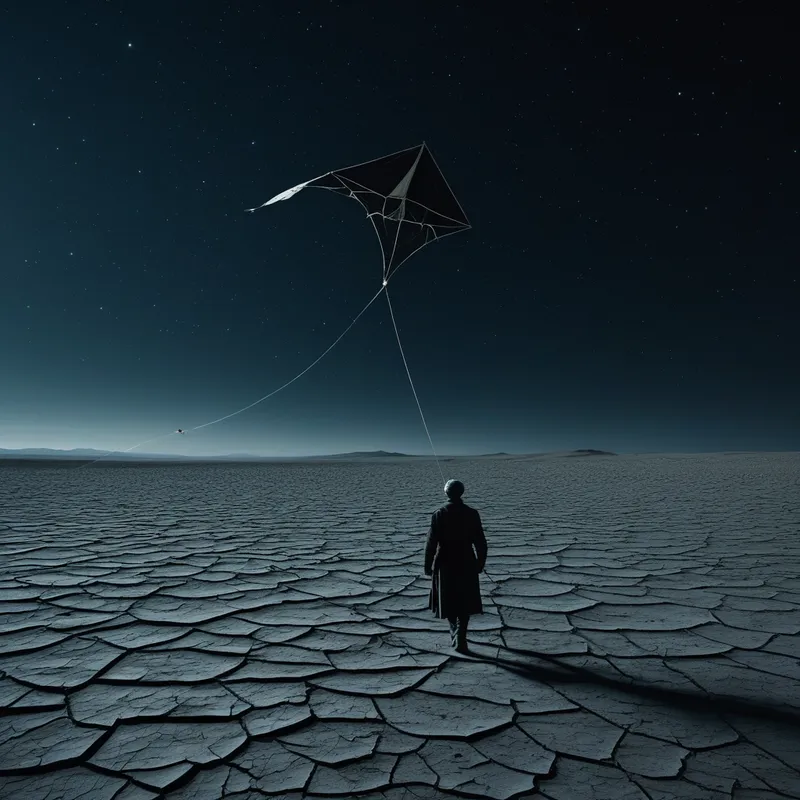
When this myth pattern stirs in the modern unconscious, it often manifests in dreams of tethered flight or failed ascent. You may dream of flying a kite that becomes uncontrollable, of a string that snaps or grows impossibly heavy, or of a beautiful crafted object that is lost to the sky. Somaticly, this can feel like a tension in the chest or shoulders—the literal pull of the kite string.
Psychologically, this signals a critical phase in the relationship between the conscious ego and a powerful emerging content from [the Self](/myths/the-self “Myth from Jungian culture.”/). The dreamer is in the process of “sending up” a new idea, a creative project, a spiritual inquiry, or a psychological insight (the kite). There is immense energy and potential in this launch. The conflict arises from the tension between the exhilarating freedom of this new potential and the terrifying responsibility of maintaining the connection. The dream of the snapped string often precedes a feeling of depression or loss—the “fall back to earth” after a period of manic inspiration or ambition. It is the [psyche](/myths/psyche “Myth from Greek culture.”/) working through the necessary grief of realizing that not all our beautiful constructions can be fully integrated; some must be sacrificed to the greater whole.
Alchemical Translation
The myth models the individuation process not as a heroic conquest of the heights, but as a sacred craft of connection and release. Luan Qing, the rebel-artisan, embodies the necessary egoic assertion that begins the journey. His workshop is the disciplined space of consciousness where raw material (complexes, talents, wounds) is shaped with intention.
The first alchemical stage is crafting [the vessel](/myths/the-vessel “Myth from Alchemical culture.”/): building a conscious structure (a philosophy, a therapy practice, an artistic discipline) capable of containing and directing psychic energy toward the transcendent function. The second is the launch: the daring, often rebellious, act of committing this structure to the unconscious, to the autonomous psyche (the wind/heaven). This requires immense faith.
The climax of the work is not in holding on, but in understanding the meaning of the severance. The dissolution of the kite into the firmament is the unio mystica, where the consciously crafted symbol is reabsorbed into the psyche’s innate, unknowable wholeness.
For the modern individual, the [triumph](/myths/triumph “Myth from Roman culture.”/) is not in becoming divine, but in having crafted something so true it merits a divine response. The “failure” of Luan Qing is the success of the soul. The process teaches that our deepest creations—our loves, our works, our insights—are ultimately not ours to possess. We are artisans of connection. We braid our lives into a string, send our crafted souls aloft, and must learn to read the vibration in the line, even as we prepare, with grace, to let it go. The kite does not return, but the sky it entered is forever changed, and so is the artisan who dared to look up, his hands empty, his eyes full of a new kind of seeing.
Associated Symbols
Explore related symbols from the CaleaDream lexicon: