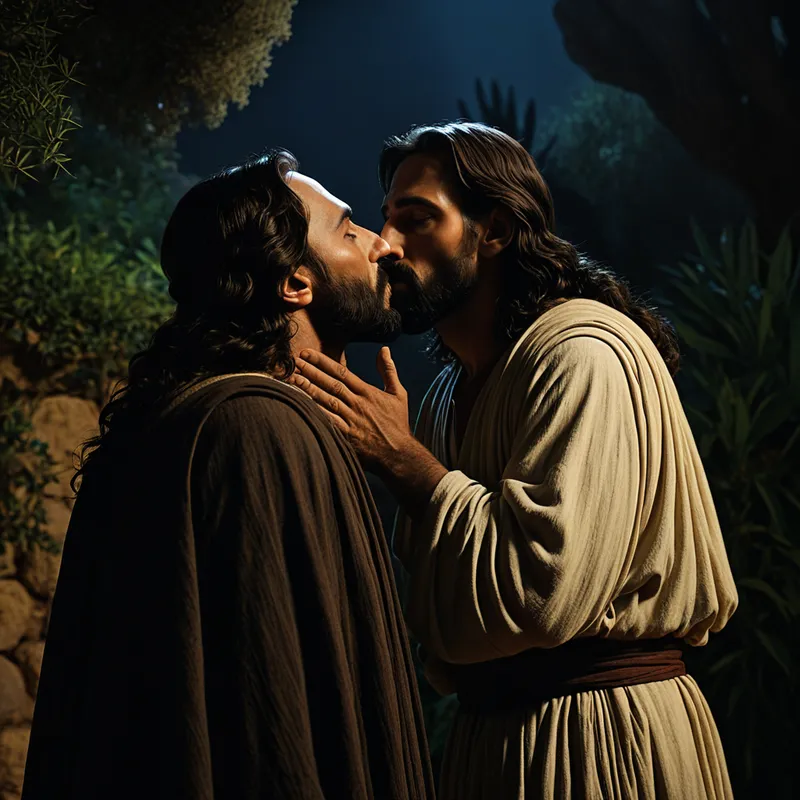
The Kiss of Judas Myth Meaning & Symbolism
The moment a sacred bond is weaponized, where a gesture of love becomes the signal for destruction, forcing a confrontation with ultimate shadow.
The Tale of The Kiss of Judas
The night was a cloak of held breath. In the olive grove called Gethsemane, the ancient trees stood as silent witnesses, their gnarled limbs holding the weight of centuries and now, the weight of impending fate. The air was cool, scented with crushed herbs and the metallic hint of distant rain. Among the shadows, a man knelt. His name was Jesus of Nazareth, and the weight upon him was not of wood or stone, but of a knowing so profound it pressed him into the earth. “Let this cup pass from me,” he whispered to the darkness, his prayer a raw thread in the vast silence. His closest friends, his chosen companions, slept a stone’s throw away, their bodies heavy with wine and unwitting peace.
Then, a disturbance. The quiet was shattered by the clank of armor, the crackle of torches, and the murmur of a mob. A wedge of light and noise carved through the sacred dark. At its head walked a familiar figure: Judas Iscariot. His steps were measured, his face a carefully composed blank, but his eyes were deep wells of a storm no one else could see. He had bargained with the temple authorities, the keepers of order, for thirty pieces of silver. The signal was intimate, specific: “The one I shall kiss is the man; seize him.”
He approached the kneeling teacher. The world narrowed to the space between two faces. The torchlight danced on features once lit by shared laughter, by the fire of profound teachings on mountainsides and the gentle lamplight of shared meals. Judas leaned in. The gesture was one of familial love, of disciple to rabbi, of friend to friend. In that culture, a kiss was a sign of deep respect, of kinship, of peace. But here, in this moment, it was being inverted. His lips met the cheek of Jesus.
“Friend,” Jesus said, his voice a calm pool in the tumult, “why are you here? Do you betray the Son of Man with a kiss?”
At the word, the spell broke. The soldiers surged forward, hands rough on the teacher’s robes. The disciples, startled from sleep, cried out in confusion and fled into the night’s embrace. Judas stood frozen for a heartbeat, the silver heavy in his purse, the kiss burning on his lips—a seal not of devotion, but of delivery. He vanished into the chaos he had orchestrated, leaving behind the man he had loved, now surrounded by the cold glint of spears. The garden, once a place of prayer, was now a stage for the world’s most profound and terrible transaction.

Cultural Origins & Context
This story is the dark heart of the Passion narratives, recorded in all four canonical Gospels. It emerged from a first-century Judea under Roman occupation, a time of political tension, messianic hope, and apocalyptic expectation. The tale was not a standalone folklore but a pivotal chapter in the foundational story of a new religious movement, passed down orally by early communities before being codified in scripture.
Its tellers were the followers of The Way, grappling with the traumatic and paradoxical event of their leader’s execution. The kiss of Judas served a crucial societal and theological function. It answered the agonizing question of “how could this happen?” by personifying the mechanism of betrayal not as a distant, faceless enemy, but from within the innermost circle. It framed the arrest not as a mere political accident, but as a necessary step in a divine drama of sacrifice and redemption. The kiss became the ultimate symbol of hypocrisy and the corruption of sacred trust, a warning and a mirror for the community about the perils of spiritual failure.
Symbolic Architecture
The kiss of Judas is not merely an act of treachery; it is the corruption of a universal symbol. The kiss represents union, love, recognition, and peace. To weaponize it is to violate the fundamental grammar of human connection.
The most profound betrayals are not committed by strangers, but by the self we have entrusted with our love, using the very language of that love to enact the violation.
Judas represents the shadow of the disciple, the part of the psyche that remains attached to worldly logic (the silver), political solutions, and a refusal to accept a path of suffering and spiritual surrender. He is the archetypal Orphan who, feeling ultimately separate, seeks to force the outcome, to control the narrative, even if it means destroying the source of his belonging. The kiss is his attempt to bridge an unbearable cognitive dissonance: performing the gesture of love while enacting the deed of betrayal. It is the ego’s attempt to sanitize its own complicity.
Conversely, Jesus in this moment embodies the acceptance of this shadow. His calm address, “Friend, why are you here?” accepts the betrayal as part of the totality of the human experience he has incarnated. He receives the poisoned kiss without retaliation, absorbing its toxic meaning into a larger framework of purpose.

The Dreamer’s Resonance
When this mythic pattern stirs in the modern dreamer, it signals a profound interior crisis of trust and identity. To dream of being betrayed by a kiss, or of being the one who gives it, often surfaces when one is at a crossroads of integrity.
Somatically, it may accompany a feeling of nausea, a hollow pit in the stomach, or a literal sensation of coldness on the cheek—the ghost of the toxic kiss. Psychologically, the dreamer is confronting their own “Judas complex”: the part of themselves that sabotages their highest calling or deepest relationships for a short-term gain, security, or out of a twisted sense of necessity. It may manifest when one feels they are “selling out” their authentic values (their inner Christ) for social approval, financial security, or to avoid conflict (the thirty pieces of silver). The dream is an urgent dispatch from the psyche, indicating that a sacred inner contract has been violated by one’s own hand.

Alchemical Translation
The alchemical journey of individuation requires not only embracing our light but consciously integrating our shadow. The myth of Judas’s kiss models this brutal, necessary phase.
The first operation is Nigredo, the blackening. The kiss is the moment of profound darkness, where what was golden (trust, love, community) is revealed to contain its opposite. The ego’s idealized self-image is shattered. The alchemist must not flee from this blackness but dwell in it, as Jesus dwelled in the garden’s agony.
The kiss of Judas is the prima materia of the soul’s transformation—the vile, base matter that, through the heat of conscious suffering, must be transmuted.
The second operation is Separatio. The kiss forces a brutal differentiation. The part that clings to literal, transactional reality (Judas) must be distinguished from the part that holds a transpersonal, sacrificial purpose (the Christ principle). This is not about casting out Judas, but about seeing his function clearly. His subsequent despair and suicide in the narrative warn of the fate of the shadow when it is not integrated but only acted out and then rejected.
The final movement is toward Coniunctio, a higher union. This is not the simple kiss of friendship, but a more conscious integration. The transformed individual can acknowledge their own capacity for betrayal, their own inner mercenary, without being ruled by it. They understand that the path to wholeness sometimes moves through the betrayal of old, naive loyalties—betraying a limiting self-concept to serve a larger Self. The poisoned kiss, once fully metabolized by consciousness, becomes the seal not of death, but of a harder, wiser rebirth. The silver of betrayal is alchemized into the refined gold of self-knowledge.
Associated Symbols
Explore related symbols from the CaleaDream lexicon: