The Kaustubha Gem Myth Meaning & Symbolism
A luminous jewel emerges from the churning of the cosmic ocean, claimed by Vishnu as the ultimate symbol of perfected consciousness and divine sovereignty.
The Tale of The Kaustubha Gem
In the time before time, when the universe was young and its laws still fluid, a great weariness had fallen upon the cosmos. The devas were weakened, their radiance dimmed by the curse of a sage. The asuras, ever hungry for dominion, saw their chance. The world teetered on the brink of an unending twilight. From this primordial exhaustion, a desperate plan was conceived—not for war, but for a cosmic endeavor that would require the strength of all.
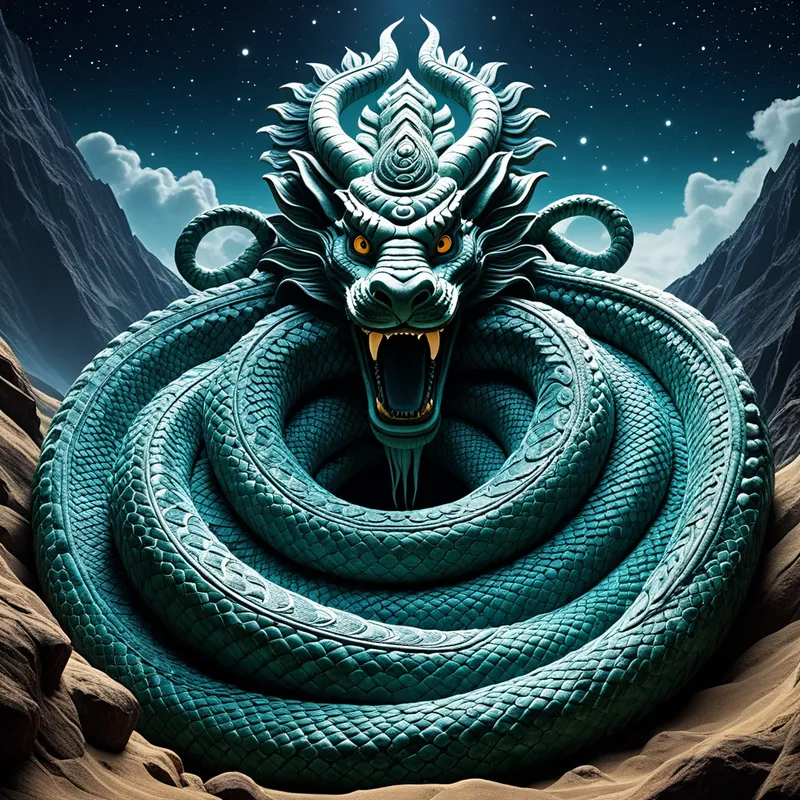
They would churn the Ocean of Milk, the Kshirasagara, to extract amrita. But how to stir a sea of stars? The mighty mountain Mandara was uprooted to be the churning rod. The great serpent-king Vasuki offered himself as the rope. The Kurma, the cosmic tortoise, dove to the bottom of existence to bear the mountain on his immovable shell. And so the factions gathered—gods at Vasuki’s tail, demons at his head—and began to pull.
The universe groaned with the strain. The ocean frothed and boiled, heaving not with water, but with the raw substance of potential. First came a poison so potent it threatened to end all things, swallowed by Shiva to save creation. Then, wonders and terrors emerged: the celestial cow, the wish-fulfilling tree, the moon. The churning was an agony of birth.
And then, from the very heart of the tumult, a light began to gather. It was not a flash, but a slow, inevitable coalescence of all the ocean’s latent splendor. It rose from the depths, a concentration of pure, ambient radiance, drawing the gaze of every being. It was a gem. Not merely a stone, but a living teardrop of solidified dawn, a lens focusing the first light of creation. It pulsed with a serene, sovereign intelligence. It did not blaze; it presided.
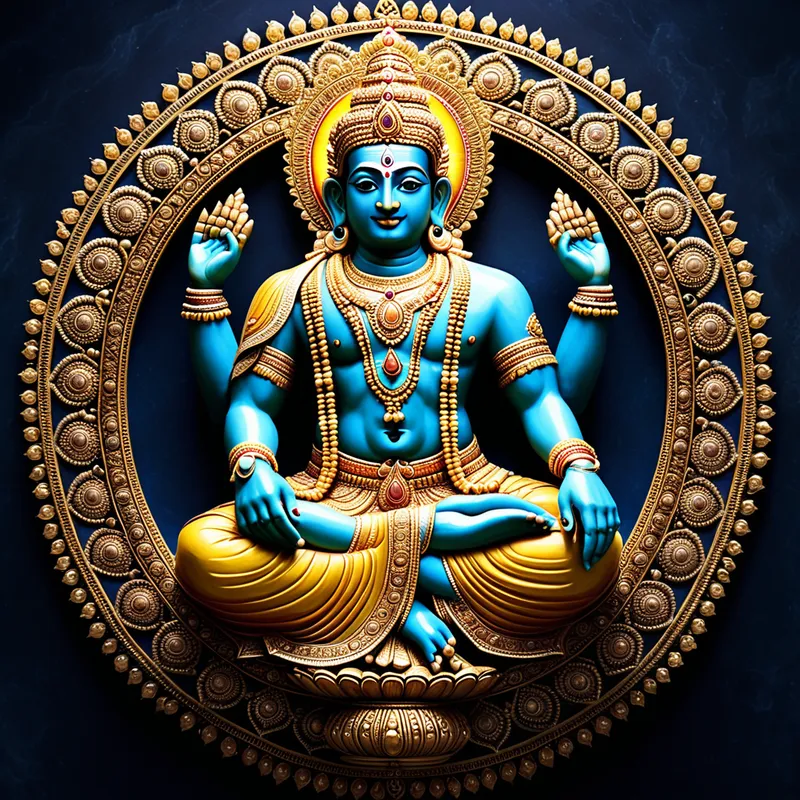
A silent understanding passed through the assembled hosts. This was not a tool, nor a weapon, nor a source of mere power. It was an attribute of sovereignty itself. And there was only one whose nature could match its essence: Vishnu, who had guided the endeavor from within, who rested upon the serpent Shesha in the causal ocean. Without contest, without need for claim, the gem floated to him. It came to rest upon his chest, over his heart, becoming the centerpiece of his being. The Kaustubha had found its wearer. The churning continued, but the first and greatest treasure had been claimed. The universe now had a heart of light.
Cultural Origins & Context
The myth of the Kaustubha is embedded within the grand narrative of the Samudra Manthan, a story told and retold across millennia in texts like the Mahabharata, the Vishnu Purana, and the Bhagavata Purana. It was never a standalone fable, but the glittering climax in the first act of a cosmic drama. Passed down by storytellers, priests, and temple sculptors, its function was multifaceted.
For the ancient listener, it was a cosmological map. It explained the origin of celestial objects (the moon, the sun-god’s chariot), divine beings, and the very landscape of the cosmos. Societally, it modeled a profound truth: that the greatest treasures, and the means to immortality, often require uneasy alliances and monumental, shared effort. The devas and asuras, eternal opposites, had to cooperate, however temporarily, to achieve a goal beyond either of them. The story served as a metaphor for the Vedic sacrificial ritual—the churning itself is a yajna (sacrifice) on a universal scale, where the friction of opposites (order and chaos) generates the nectar of renewal. The Kaustubha, emerging first, signified that before immortality (amrita), one must first establish the principle of enlightened, stable consciousness.
Symbolic Architecture
The Kaustubha is not a gem to be owned; it is an emblem to be embodied. Its symbolism is an intricate architecture of consciousness.
The true jewel is not found in the earth, but forged in the churning of one’s own depths. It is the crystallized moment when chaos yields not to order, but to a presiding intelligence.
Psychologically, the Ocean of Milk represents the unconscious—not a dark, troubled sea, but a Kshirasagara, a nourishing, primordial source of potential. It is the unmanifest psyche, rich with latent archetypes, talents, and terrors. The churning is the necessary, often painful, process of engaging with this depth. It is the friction of confronting our inner opposites: our noble aspirations (devas) and our shadowy, driving passions (asuras). The poison (Halahala) that emerges first is the unavoidable toxicity—the repressed pain, rage, or fear—that must be acknowledged and contained (by Shiva, the transformative principle) for the work to continue.
The Kaustubha, then, is the first and most precious product of this inner work: the emergence of the conscious Self. It is not the ego, which is partial and identified with one side of the churn. It is the central, organizing principle that can hold the totality. Its placement on Vishnu’s chest is critical. It rests over the Anahata (heart) chakra, the center of balance and integration. The gem symbolizes a consciousness that has been earned through ordeal, that radiates a calm, non-grasping authority. It does not do; it is. It is the jewel of perfected attention, the “I Am” presence that witnesses the churn of life without being shattered by it.

The Dreamer’s Resonance
When this myth stirs in the modern dreamer, it rarely appears as a literal gem. Its pattern manifests as a somatic and psychological process. You may dream of being in the middle of a vast, tense collaboration—a work project or family drama—where you are forced to cooperate with an “opposite” (a rival, a disliked part of yourself). The dream atmosphere is one of immense strain and potential.
Somatically, you might feel the dream-body engaged in a great, rhythmic pulling, a deep muscular engagement that speaks of an inner labor. The rising action is the emergence of “poisons”: dream images of vomiting dark liquid, being surrounded by toxic fumes, or facing a terrifying creature from a deep place. This is the psyche’s way of dramatizing the necessary confrontation with shadow material.
The resolution is not a battle won, but a presence attained. The dream may shift to a profound calm. You might find yourself simply wearing something—a pendant, a badge, a piece of clothing—that feels intrinsically, unshakably yours. It carries a quiet weight of authority and rightness. You have not defeated the other side; you have, through the struggle, consolidated a center. This is the Kaustubha moment in the dreamscape: the birth of a more integrated, sovereign Self-awareness from the churn of inner conflict.
Alchemical Translation
The myth of the Kaustubha is a precise alchemical manual for the process Jung termed individuation—the journey toward psychic wholeness. It models the stages of psychic transmutation for anyone seeking to move beyond a fragmented life.
First, one must acknowledge the need for the Opus Magnum (Great Work). This is the “cosmic weariness,” the feeling that one’s current consciousness is insufficient, that life is dim. One must then gather the inner opposites—the spiritual ideals and the base instincts—and commit them to the work. This is the agreement to churn.
The alchemical vessel is the totality of one’s life experience. The churning is active engagement: therapy, creative expression, meditation, or any disciplined practice that stirs the depths. The first product is always the Nigredo, the blackening: depression, confusion, the surfacing of old wounds (the poison). This must be “held” by the transformative function of the psyche (Shiva) without being destroyed by it.
Individuation does not aim for perfection, but for a wearable truth. The gem is not flawless clarity, but a complex crystal that refracts all light, even the dark, into a coherent pattern.
As one persists, other “treasures” emerge: new skills (the celestial cow), inner peace (the moon), a sense of connection (the goddess of prosperity). But the Kaustubha comes first. In psychological terms, this is the crystallization of the observing Self. It is the moment you realize you are not the thoughts churning, nor the emotions being pulled, but the stable center that contains the process. This is the “alchemical stone,” the philosopher’s stone of the soul—not a thing that grants immortality, but a state of consciousness that perceives the eternal within the temporal.
To wear the Kaustubha is to move through the world from this integrated center. Actions flow from a place of inner authority rather than reaction. One becomes, like Vishnu, the preserver of one’s own cosmos, sustaining balance from a heart adorned with the hard-won light of self-knowledge. The churning never truly ends—life sees to that—but you are no longer at the rope. You are the wearer of the gem.
Associated Symbols
Explore related symbols from the CaleaDream lexicon: