
The Iroquois Confederacy Myth Meaning & Symbolism
A prophet's vision of a great tree of peace transforms warring nations into a powerful, enduring league governed by a sacred law.
The Tale of The Iroquois Confederacy
Listen. In a time when the earth was soaked with the blood of brothers, when the longhouses of the five nations—Kanienʼkehá꞉ka, Onʌyoteʼa·ka·, Onöñda’gegá’, Gayogo̱ho꞉nǫʼ, and Onödowáʼga꞉—echoed not with the laughter of children but with the grim preparations for the next raid. The forests were a place of fear, the rivers ran with suspicion. It was a world turned inward upon its own pain, a cycle of vengeance without end, where grief was the only true harvest.
From across the shining waters of Kaniatario, a figure came. He was not born of woman, but was a manifestation of a divine purpose. They called him the Deganawida. He traveled in a canoe of white stone, which glided across the water without paddle, a vessel as pure and unyielding as his message. His face was said to be radiant, his words not of this earth. He carried a simple, impossible proposition: that the war must end. That strength was not in taking lives, but in weaving them together.
His first disciple was not a mighty warrior, but a man broken by the very world the Peacemaker sought to mend: Hiawatha. Once a fierce man, Hiawatha was hollowed out by a bottomless sorrow. In his rage and grief, he had become a monster, a tool of the dark-hearted Tadodaho, a sorcerer-chief whose mind and body were as twisted as the snakes that writhed in his hair. Tadodaho thrived on the chaos, his power fed by the endless conflict.
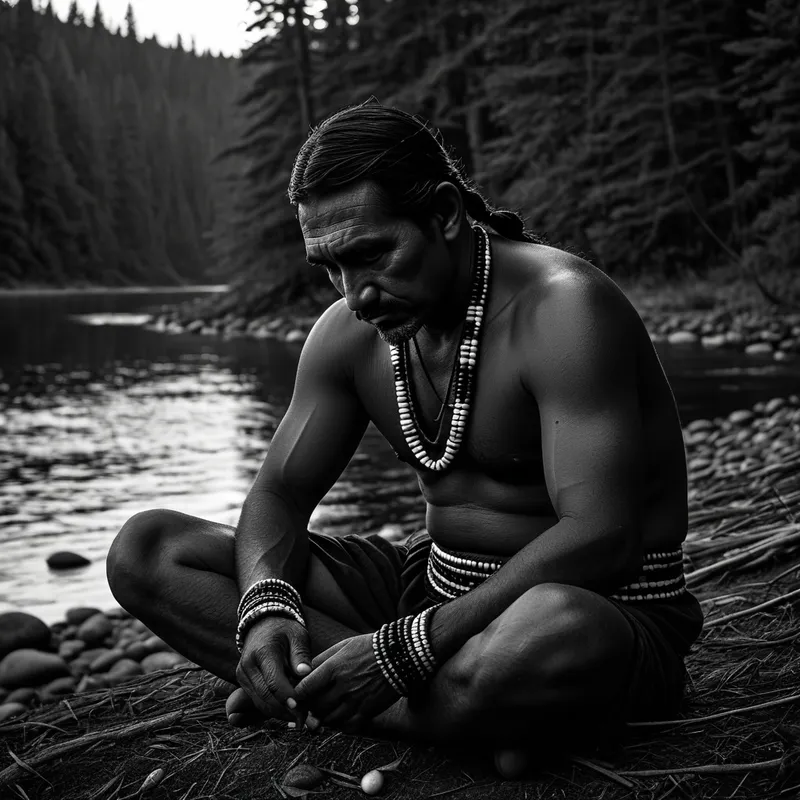
The Peacemaker found Hiawatha by a river, washing the ashes of mourning from his hands. He spoke not of vengeance, but of cleansing. He offered the Condolence Ceremony, using strings of shell beads to wipe the tears from Hiawatha’s eyes, clear the obstruction from his ears, and open his throat to speak again. With each bead, a weight lifted. Hiawatha’s grief, once a prison, became his purpose. Together, they began the long work.
They traveled from nation to nation, speaking the Great Law of Peace. They uprooted a great white pine tree, casting the weapons of war into the cavern below. They replanted the tree, the Tree of Peace, and upon it placed an eagle, a sentinel to watch for dangers from afar. Beneath its spreading roots, they buried the hatchet forever. One by one, the nations saw the truth in the words, felt the strength in the proposed unity. All but one.
Tadodaho remained in his fortified village on Onondaga Lake, a knot of malevolent will. The final journey to him was the most perilous. The Peacemaker, Hiawatha, and the chiefs of the converted nations approached, singing the Peace Hymn. They found Tadodaho not as a mere man, but as a living embodiment of the disorder they sought to heal—his hair a nest of serpents, his body contorted. With supreme courage, they did not attack. They offered the Condolence Ceremony to him. They combed the snakes from his hair, straightening his body with the medicine of compassion and law. As the last serpent fell away, Tadodaho’s mind cleared. He saw, for the first time, the longhouse they had built in words—a great metaphorical shelter where all five nations could live in harmony, each with their own fire, but with one shared roof. He accepted the central fire, becoming the spiritual leader of the new Confederacy. The Great Peace was born.
Cultural Origins & Context
This is not a myth lost to antiquity, but a living constitutional narrative. The Haudenosaunee Confederacy, formed perhaps between the 12th and 15th centuries, is one of the world’s oldest continuously operating participatory democracies. The story of the Peacemaker, Hiawatha, and Tadodaho is the sacred history of its founding. It was and is preserved through oral tradition, recited in precise detail by specially designated Hoyaneh (chiefs) and Iakoiane during the Condolence Ceremony for installing new leaders.
Its societal function is profound and practical. It is not merely a story of origin; it is the operating system of the culture. The narrative encodes the Gayanashagowa, detailing concepts of equity, representation, checks and balances, and the process of consensus-building. It provides the ritual technology—the Condolence Ceremony—for healing grief and resolving disputes, recognizing that unhealed psychic wounds in leaders are a direct threat to the body politic. The myth served as a constant reminder that law and governance are not dry administrative tasks, but sacred acts of maintaining cosmic and social balance.
Symbolic Architecture
At its core, the myth is a blueprint for the transformation of chaos into cosmos, of vengeance into law, and of fragmented individuality into collective sovereignty.
The White Stone Canoe represents the vessel of a transcendent idea, an principle that is unassailable, pure, and moves by a power beyond ordinary human effort. It is consciousness itself arriving from the “other side” of the lake—the unconscious or the divine—to intervene in a stalled reality.
The Peacemaker is the archetype of the unifying principle, the logos that speaks order into chaos. He is not a warrior-hero, but a healer-statesman. His power is in vision and persuasion, not conquest.
Hiawatha symbolizes the redeemed human vessel. His journey is from identification with the shadow (his rage and service to Tadodaho) to becoming the empowered speaker for the light. His grief is not erased but alchemized; his personal tragedy becomes the empathetic foundation for his political and healing work. He represents the necessary human partnership with the divine idea—the one who must do the hard, earthly work of implementation.
Tadodaho is perhaps the most profound symbol: the embodied shadow of the entire system. He is not an external enemy to be destroyed, but the internalized chaos, paranoia, and trauma within the community that must be healed and integrated. His transformation is the ultimate act of the myth: peace is not achieved by eliminating the “monster,” but by healing it and offering it a central, honored role. The snakes in his hair are the tangled, poisonous thoughts of separatism; combing them out is the act of applying reasoned law and compassion to disorder.
The Tree of Peace is the axial mundi of the new world. Its roots—the Great Law—spread to all nations, offering nourishment and connection. The weapons buried beneath it signify that the foundation of this new society is not military might, but a conscious renunciation of intra-tribal violence. The eagle atop is the vigilant higher consciousness, the ability to see the long view and perceive distant threats.
The Dreamer’s Resonance
When this mythic pattern stirs in the modern dreamer, it often signals a profound internal conflict between fragmented parts of the self moving toward a difficult, necessary integration.
Dreaming of a tangled, dark forest where paths lead to dead-ends or ambushes may reflect the “state of nature” within the psyche—warring complexes, old griefs (Hiawatha’s sorrow), and self-sabotaging patterns (Tadodaho’s influence) that create internal civil war. The dreamer feels lost in their own mind.
Dreaming of a radiant figure offering a simple, clear solution to an intractable problem mirrors the arrival of the Peacemaker. This could manifest as a dream guide, a sudden lucid insight, or a symbol of pristine clarity (like the white canoe). It is the emergent Self presenting a new organizing principle.
Dreaming of the act of combing tangled hair, straightening a crooked room, or untangling knots is the somatic signature of the Condolence Ceremony applied inwardly. The dreamer is performing the psychic work of “straightening out” twisted thoughts and emotions, clearing the channels of perception. To dream of burying a weapon is a powerful indicator of consciously forsaking an old, internalized mode of attack—perhaps self-criticism, cynicism, or a defensive posture—to create space for peace.

Alchemical Translation
The myth of the Confederacy is a masterclass in the Jungian process of individuation—the forging of a coherent, responsible Self from the multitude of conflicting inner “nations.”
The initial state is one of inflation with the shadow. The ego is identified with a single, powerful complex—like Hiawatha with his grief-rage or Tadodaho with his tyrannical control—and projects all otherness onto enemy “tribes” within (other desires, talents, or vulnerabilities). This is psychic civil war, exhausting and fruitless.
The alchemical agent is the transcendent function, symbolized by the Peacemaker. It is the third thing that arises from the unconscious, which holds the tension between opposites (war/peace, vengeance/law) and produces a new, previously unimaginable solution: confederation. It is the birth of a meta-perspective.
Individuation is not about becoming a perfectly unified, conflict-free monad. It is about becoming a skillful confederacy of the psyche, where different complexes—the warrior, the mourner, the thinker, the leader—are not exterminated, but given a rightful place and governed by a central, compassionate law.
The Condolence Ceremony is the practical ritual of this alchemy. Psychologically, it is the act of holding space for one’s own grief, anger, and fear—not to be ruled by them, but to acknowledge them, “wipe the tears,” and clear the senses so one can see and hear reality anew. It is the prerequisite for inner governance.
Finally, the integration of Tadodaho is the ultimate goal. This is the acceptance and healing of one’s own deepest wound, the most twisted and “monstrous” part of the personality. We do not achieve wholeness by killing our inner demon, but by confronting it with courage, offering it compassion, and discovering that its terrifying energy, once straightened and brought into the council, becomes a vital source of wisdom and protective power. The seat of the central fire is often in what was once the darkest place. The league is not forged in spite of the shadow, but including it, thereby creating a peace that is durable, conscious, and truly whole.
Associated Symbols
Explore related symbols from the CaleaDream lexicon: