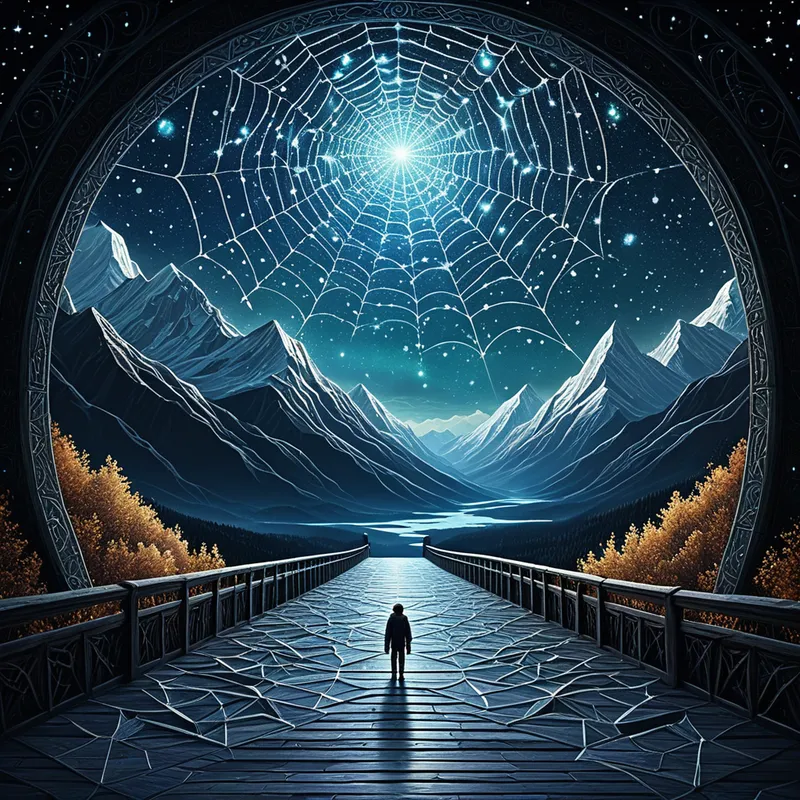
The Imaginal Realm Myth Meaning & Symbolism
A journey into the world between worlds, where the mind's images become living realities, demanding courage and transformation from those who enter.
The Tale of The Imaginal Realm
Listen, and let [the veil](/myths/the-veil “Myth from Various culture.”/) between what is and what could be grow thin.
There is a place that is not a place, a time that is not a time. It exists in the breath between waking and sleep, in the shimmer on [the horizon](/myths/the-horizon “Myth from Various culture.”/) at dusk. They call it the Imaginal Realm. To speak of its geography is to speak of the soul’s own cartography. Here, thoughts are not private whispers but public works. A fear, left unchecked, sprouts thorns and grows into a tangled forest of doubt. A cherished hope becomes a luminous fruit, heavy with potential nectar. The air itself is thick with the perfume of memory and the ozone-tang of prophecy.
Into this realm, not by map or compass but by necessity, comes the Seeker. Perhaps they are a shaman, fevered and hollow-eyed from a [vision quest](/myths/vision-quest “Myth from Native American culture.”/). Perhaps they are an artist, driven mad by a beauty they cannot capture. Or perhaps they are simply a person who has lost their way in [the world](/myths/the-world “Myth from Tarot culture.”/) of stone and schedule, whose heart has become a dry riverbed. They cross over at a moment of rupture—a profound grief, an ecstatic joy, a question with no earthly answer. The solid world dissolves like salt in [water](/myths/water “Myth from Chinese culture.”/), and they find themselves standing on the shores of a sea of shifting colors.
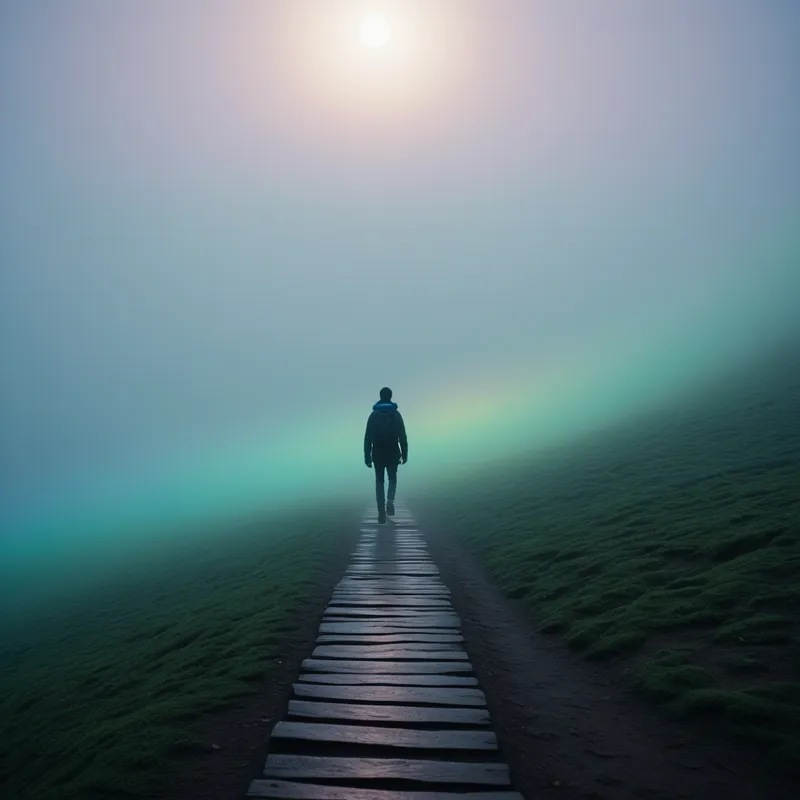
The journey is the first and only law. The Seeker must walk, though the path is made of their own footprints appearing only as they step. They are met by the Daimons of the place. These are not gods of Olympus, remote and thunderous, but intimate intelligences. A figure woven from the sorrow of a lost love may block [the way](/myths/the-way “Myth from Taoist culture.”/), weeping rivers that flood the path. A creature of brilliant, sharp-edged light, born from a moment of pure insight, may offer a key that burns to the touch. The conflict is not with monsters, but with meaning. Every encounter is a reflection, every landscape a facet of the Seeker’s own inner world, made terrifyingly, beautifully real.
The rising action is a symphony of recognition and terror. To navigate, the Seeker must converse with these fragments of themselves. They must argue with their own embodied anger, bargain with their personified fear, and sometimes, simply sit and listen to the lament of a forgotten childhood joy. The realm tests not their strength, but their sincerity. A lie congeals into a prison of glass. An evasion becomes a maze of mirrors. Only the raw, unvarnished truth of feeling can alter the terrain.
The resolution is never an escape. It is a transformation. After trials that are psychological in essence but mythological in scale, the Seeker arrives at the heart of the realm—a space that might be a still pool, an empty throne, or a single, silent bell. Here, they face not a final foe, but a profound integration. The warring Daimons, the fragmented landscapes, are gathered, witnessed, and acknowledged. In that act of profound hospitality to the contents of their own soul, the realm itself shifts. The path home appears, not as a retreat, but as a return bearing a new shape. The Seeker steps back into the waking world, forever altered. The scent of that other air lingers on them. Their eyes hold the light of a world where image is the primary substance of reality.
Cultural Origins & Context
The myth of the Imaginal Realm is not the property of a single culture with a fixed canon, but a perennial pattern emerging across time and tradition. It is the underlying grammar of the visionary experience. We find its contours in the menog state of Zoroastrian mysticism, the world of Barzakh in Sufi thought that separates yet connects the divine and the mortal. It is the Sambhogakaya, the realm of blissful imagery. It is the “mundus imaginalis” articulated by Henry Corbin in his studies of Islamic mysticism, a cosmological plane as real as the physical and intellectual worlds.
This myth was never just a story told around a fire; it was a map given by the elders, the shamans, and the poets to those preparing for liminal states. It was passed down in the instructions for vision quests, in the symbolic diagrams of alchemical texts, and in the coded language of mystical poetry from Rumi to Blake. Its societal function was crucial: it provided a container and a language for experiences that defied ordinary logic—ecstatic trance, prophetic dreams, creative inspiration, and psychological breakdown. It said, in essence: You are not mad. You have journeyed to another country. Here is what you might find, and here is how you might return, whole.
Symbolic Architecture
Psychologically, the Imaginal [Realm](/symbols/realm “Symbol: The symbol of ‘Realm’ often signifies the boundaries of one’s consciousness, experiences, or emotional states, suggesting aspects of reality that are either explored or ignored.”/) is the objective [reality](/symbols/reality “Symbol: Reality signifies the state of existence and perception, often reflecting one’s understanding of truth and life experiences.”/) of the unconscious. It is not merely “inside our heads” in a subjective sense, but a psychic ecosystem with its own laws, inhabitants, and topography. The [Seeker](/symbols/seeker “Symbol: A person actively searching for meaning, truth, or a higher purpose, often representing the dreamer’s own quest for identity or fulfillment.”/) represents the conscious ego, venturing beyond its familiar borders into the vast, self-regulating [psyche](/myths/psyche “Myth from Greek culture.”/).
The journey into the imaginal is the ego’s humble pilgrimage to the seat of the Self.
The shifting [landscape](/symbols/landscape “Symbol: Landscapes in dreams are powerful symbols representing the dreamer’s emotional state, personal journey, and the broader context of life situations.”/) symbolizes the fluid, symbolic [nature](/symbols/nature “Symbol: Nature symbolizes growth, connectivity, and the primal forces of existence.”/) of unconscious content, which resists literal interpretation but speaks in the [language](/symbols/language “Symbol: Language symbolizes communication, understanding, and the complexities of expressing thoughts and emotions.”/) of [metaphor](/symbols/metaphor “Symbol: A figure of speech where one thing represents another, often revealing hidden connections and deeper truths through symbolic comparison.”/). The Daimons are the archetypal forces and complexes—the inner critic, the orphaned [child](/symbols/child “Symbol: The child symbolizes innocence, vulnerability, and potential growth, often representing the dreamer’s inner child or unresolved issues from childhood.”/), the [anima](/symbols/anima “Symbol: The feminine archetype within the male unconscious, representing soul, creativity, and connection to the inner world.”/) or [animus](/symbols/animus “Symbol: In Jungian psychology, the masculine inner personality in a woman’s unconscious, representing logic, action, and spiritual guidance.”/)—that possess autonomy and power when unrecognized. The [path](/symbols/path “Symbol: The ‘path’ symbolizes a journey, choices, and the direction one’s life is taking, often representing individual growth and exploration.”/) that appears only underfoot signifies the fact that meaning in the unconscious is not pre-ordained but created through the courageous act of engagement itself. The final [integration](/symbols/integration “Symbol: The process of unifying disparate parts of the self or experience into a cohesive whole, often representing psychological wholeness or resolution of internal conflict.”/) at the [heart](/symbols/heart “Symbol: The heart symbolizes love, emotion, and the core of one’s existence, representing deep connections with others and self.”/) of the realm symbolizes [the ego](/myths/the-ego “Myth from Jungian culture.”/)‘s alignment with the central, ordering principle of the psyche, the Self.
The Dreamer’s Resonance
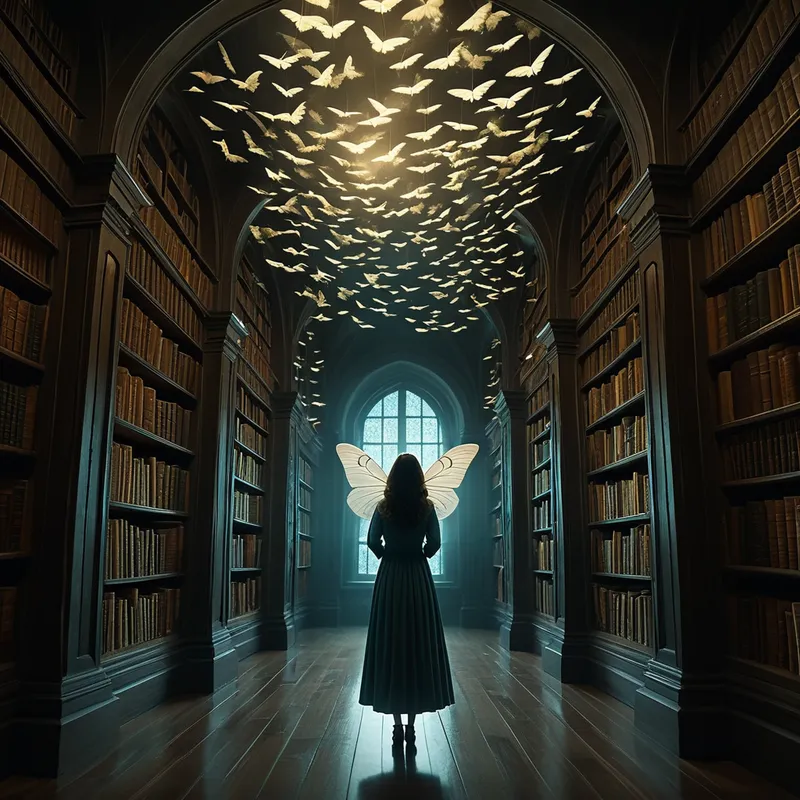
When this myth activates in modern dreams, it often manifests as dreams of inexplicable, vividly real otherworlds. You may dream of a city with impossible architecture, a forest where the trees have clock faces, or an endless hotel with rooms that contain frozen moments from your life. The somatic feeling is one of both awe and profound disorientation—the gut-knowledge that the rules have changed.
This dream pattern signals a critical phase of psychic process. The conscious attitude has become too rigid, too one-sided, and the unconscious is compelling a descent into its own logic to restore balance. The dreamer is not just having a weird dream; they are being taken on a forced tour of their own ignored inner realities. The strange landscapes are unintegrated emotional territories. The bizarre entities are dissociated aspects of the personality demanding audience. To dream of the Imaginal Realm is to be in the midst of a psychic initiation, where old structures of identity are dissolving so that new, more comprehensive ones can form.
Alchemical Translation
The alchemical process mirrored in this myth is [solutio](/myths/solutio “Myth from Alchemical culture.”/)—the dissolution of the fixed, known element (the conscious ego) into the aqua permanens, the permanent water of the unconscious. The Seeker’s ordeal is the “dark night of the soul” where all certainties melt. But this dissolution is not an end; it is the necessary precondition for coagulatio—the re-solidification into a new, more resilient form.
The imaginal realm does not seek to destroy the traveler, but to baptize them in the waters of their own deepest being.
For the modern individual, the myth models the journey of individuation. Our “ordinary world” is often a [persona](/myths/persona “Myth from Greek culture.”/)-built life of roles and expectations. The call to the imaginal is the midlife crisis, the creative block, the depression that asks, “Is this all there is?” Crossing [the threshold](/myths/the-threshold “Myth from Folklore culture.”/) requires surrendering the old identity. Navigating the realm means facing, with brutal honesty, [the shadow](/myths/the-shadow “Myth from Jungian culture.”/), the complexes, the unlived life. The integration at the heart is the birth of a consciousness that can hold paradox, tolerate ambiguity, and engage with the inner world as a legitimate partner in reality-creation. One returns not with a trophy, but with a capacity—the ability to perceive the imaginal dimension shimmering within the concrete world, to recognize that every object, every relationship, every moment is also a living symbol in the soul’s ongoing myth.
Associated Symbols
Explore related symbols from the CaleaDream lexicon: