The Icon of Christ Pantocrator Myth Meaning & Symbolism
The silent, eternal icon of Christ Pantocrator, holding the cosmos, gazes into the soul, uniting divine judgment and mercy in one timeless face.
The Tale of The Icon of Christ Pantocrator
Listen. In the deep silence where time is born from eternity, there is a face that was not painted by human hand. It is said that in the city of Edessa, a king lay dying, his body ravaged by a sickness no physician could cure. In his desperation, he sent word to a prophet in Judea, a man whose name was whispered with awe and fear: [Jesus of Nazareth](/myths/jesus-of-nazareth “Myth from Christian culture.”/). The king begged for a healing touch, but the prophet was far away, walking dusty roads.
Yet, the prophet heard the plea carried on [the wind](/myths/the-wind “Myth from Various culture.”/) of faith. He took a simple square of linen and pressed it to his face. When he lifted it away, a miracle had been wrought—not with brush or pigment, but with the very light of his being. His image, his true image, was seared upon the cloth. Not a portrait of his flesh, but an imprint of his divine and human essence. This was the Holy Mandylion.
The cloth traveled across deserts and mountains, a sacred secret held in trembling hands. It came to rest in a dim chamber where monks kept vigil, their breath the only sound. They knew this was no mere picture. It was a window, a crack in the wall of [the world](/myths/the-world “Myth from Tarot culture.”/). They built a frame of gold and wood around this window, not to contain it, but to honor the breach.
Centuries flowed like rivers. In the heart of the great Byzantine Empire, in the hushed scriptorium of the Monastery of Saint Catherine, at the foot of the mountain where God gave [the law](/myths/the-law “Myth from Biblical culture.”/), a monk prepared his board. He ground minerals into sacred dust—malachite for green, lapis lazuli for blue, ochre for flesh, and pure gold, beaten into leaf thinner than a soul’s whisper. He fasted and prayed until his own will was still. He did not paint; he remembered. He remembered the face on the cloth, and he remembered the vision from the Isle of Patmos—the vision of the One who is, who was, and who is to come.
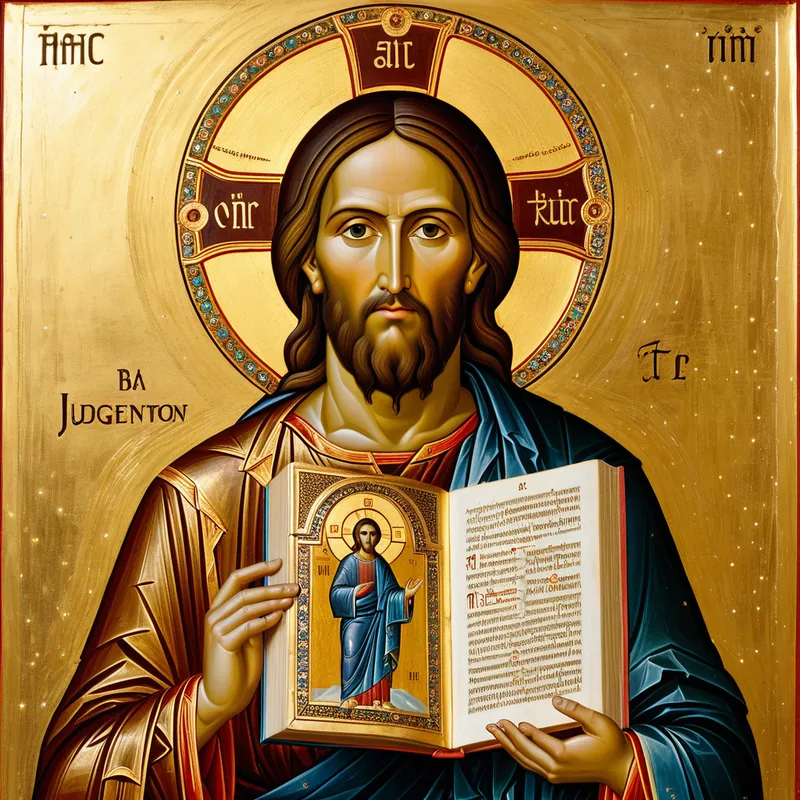
And so, upon the panel, the face emerged from the darkness. But it was a face divided, a cosmos in conflict reconciled. The right side—the side of the final blessing—was serene, the eye gentle, the brow smooth with an infinite patience. The left side—the side of the coming judgment—was severe, the eye piercing, the brow gathered with the weight of all truth. In one hand, he held the jeweled book of [the Word](/myths/the-word “Myth from Biblical culture.”/), the Gospels, containing the Alpha and the Omega. The other hand was raised, fingers bent in the ancient form of blessing, of naming, of holding the very fabric of creation together. Behind him, not a sky, but the shimmering, silent roar of a gold that was not a color, but the substance of heaven itself.
He did not look out at a room. He looked through time. He looked into you. The Icon of Christ Pantocrator was born—not a story told in words, but a myth rendered in light and gaze, an eternal moment of silent, terrifying, and merciful address.
Cultural Origins & Context
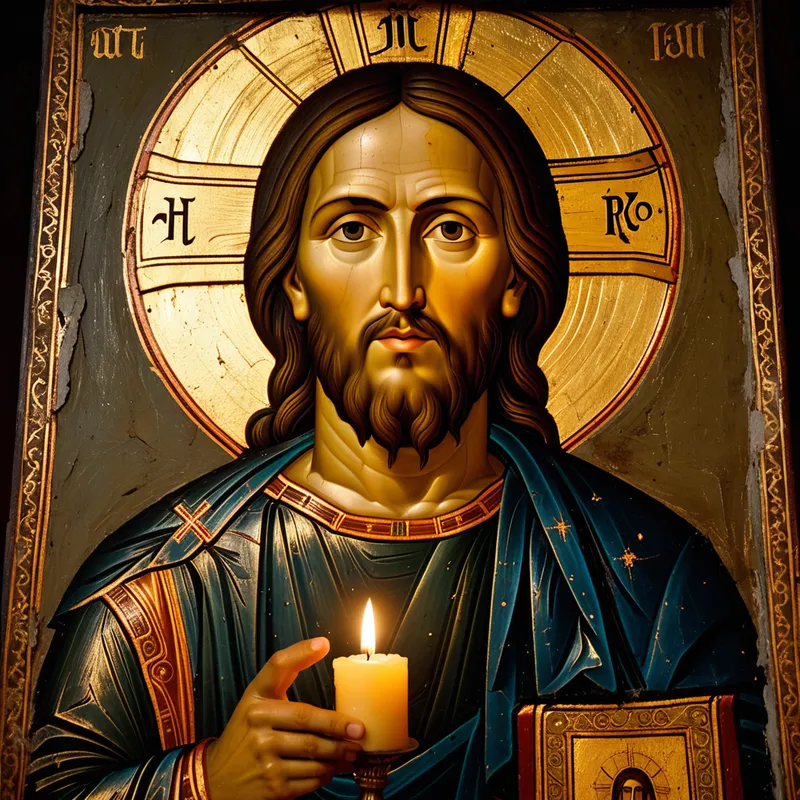
The Icon of Christ Pantocrator is not a myth with a linear plot, but a visual and theological mythos that crystallized in the 6th century within Eastern Orthodox Christianity. Its birthplace was the theological and artistic [ferment](/myths/ferment “Myth from Alchemical culture.”/) of the Byzantine Empire, a culture that conceived of the universe as a great chain of icons—visible things that participate in and point to invisible divine realities.
This image was born from a crucible of conflict: the Iconoclastic Controversy. The fight was over whether such an image was idolatry or theology. The defenders of icons, like St. John of Damascus, argued that because God took on material flesh in the Incarnation, matter itself could become a vehicle for grace. The Pantocrator was the ultimate argument. It was not a depiction of the invisible God the Father, but of God the Son, who had a human face. Thus, the icon was a testament to a fundamental Christian mystery.
It was passed down not by bards, but by iconographers—monks who followed strict canonical traditions, viewing their work as a holy vocation, a form of prayer. The icon’s societal function was profound. It was the central image in the dome or apse of a church, representing Christ’s rule over the entire congregation and the cosmos. It was a visual creed, a silent sermon, and a locus of encounter. To stand before it was to place oneself under the gaze of the Ruler of All, to be simultaneously judged and embraced by the totality of divine authority.
Symbolic Architecture
The Pantocrator is a masterpiece of symbolic compression, a map of the [cosmos](/symbols/cosmos “Symbol: The entire universe as an ordered, harmonious system, often representing the totality of existence, spiritual connection, and the unknown.”/) and the [soul](/symbols/soul “Symbol: The soul represents the essence of a person, encompassing their spirit, identity, and connection to the universe.”/). Its primary [symbol](/symbols/symbol “Symbol: A symbol can represent an idea, concept, or belief, serving as a powerful tool for communication and understanding.”/) is the face itself, which embodies the paradoxical unity of opposites that defines the [Christian](/symbols/christian “Symbol: The symbol represents the faith, teachings, and cultural values associated with Christianity, including themes of love, salvation, and morality.”/) God and, by extension, the goal of the integrated [human](/symbols/human “Symbol: The symbol of a human represents individuality, complexity of emotions, and social relationships.”/) [psyche](/myths/psyche “Myth from Greek culture.”/).
The face of the Pantocrator is the still point where the terror of absolute judgment and the comfort of infinite mercy are discovered to be the same gaze.
The asymmetrical eyes are the core of this [mystery](/symbols/mystery “Symbol: An enigmatic, unresolved element that invites curiosity and exploration, often representing the unknown or hidden aspects of existence.”/). One eye, often the left, is larger, darker, and more severe—the eye of [the Law](/symbols/the-law “Symbol: Represents external rules, societal order, moral boundaries, and the tension between personal freedom and collective structure.”/), of discernment, of seeing all that is hidden, flawed, and sinful. The other eye is softer, more [inward](/symbols/inward “Symbol: A journey toward self-awareness, introspection, and the exploration of one’s inner world, thoughts, and unconscious mind.”/)-looking—the eye of Grace, of [compassion](/symbols/compassion “Symbol: A deep feeling of empathy and concern for others’ suffering, often involving a desire to help or alleviate their pain.”/), of understanding. Together, they refuse to allow the viewer to settle for a one-sided God or a one-sided self. The Gospel book in his hand symbolizes the structured, knowable [Word](/symbols/word “Symbol: Words in dreams often represent communication, expression, and the power of language in shaping our realities.”/)—the [Logos](/myths/logos “Myth from Christian culture.”/). The blessing hand represents the active, creative, and healing [Spirit](/symbols/spirit “Symbol: Spirit symbolizes the essence of life, vitality, and the spiritual journey of the individual.”/)—the dynamic, uncontainable force of [life](/symbols/life “Symbol: The symbol of ‘Life’ represents a journey of growth, interconnectedness, and existential meaning, encompassing both the joys and challenges that define human experience.”/).
The golden [background](/symbols/background “Symbol: The background in a dream can reflect context, environment, and underlying influences in the dreamer’s life.”/) is not empty [space](/symbols/space “Symbol: Dreaming of ‘Space’ often symbolizes the vastness of potential, personal freedom, or feelings of isolation and exploration in one’s life.”/) but the Uncreated Light of God’s [presence](/symbols/presence “Symbol: Presence in dreams often signifies awareness or acknowledgment of something significant in one’s life.”/), the “environment” of divinity in which the incarnate Christ exists and into which the viewer is invited. The IC XC Christogram beside his head is not merely a label, but a seal of authenticity and a verbal [icon](/symbols/icon “Symbol: A sacred image or revered figure representing divine presence, artistic genius, or cultural authority, often serving as a focal point for devotion or identity.”/) in itself.
The Dreamer’s Resonance
When the image of the Pantocrator, or a figure with its dualistic, authoritative gaze, appears in a modern dream, it signals a profound moment of psychic reckoning. This is not a dream of gentle guidance, but of confrontation with an inner authority principle.
The dreamer may be undergoing a process where two irreconcilable parts of their self or their life are demanding integration. Perhaps a harsh, judgmental inner critic (the severe eye) is at war with a passive, forgiving, but perhaps ineffective self (the merciful eye). The somatic experience might be one of being “pinned” by the gaze—a feeling of stillness, awe, and slight terror, a recognition that one can no longer hide from one’s own truth. The icon in the dream acts as a mirror, reflecting back not a simple reflection, but the totality of who the dreamer is—their potential for both discipline and compassion, their failures and their inherent worth. The dream presents the problem of wholeness in iconic form, challenging the dreamer to hold their own contradictions without fleeing to one extreme.
Alchemical Translation
The journey of the Pantocrator myth, from the miraculous imprint to the canonical icon, is a perfect model for the alchemical process of individuation—the psychic transmutation that leads to wholeness.
The starting [prima materia](/myths/prima-materia “Myth from Alchemical culture.”/) is the raw, suffering human condition (the sick king). The plea for healing is [the ego](/myths/the-ego “Myth from Jungian culture.”/)’s cry for help. The response is the “miraculous imprint”—the first, often unconscious, contact with the Self, the inner image of totality, which feels “not made by hands.” It is a gift, not an achievement.
The alchemical work is to build the sacred vessel—the stable, disciplined structure of the personality (the wooden panel, the gold leaf)—around this numinous imprint, so it can be consciously integrated and displayed.
The iconographer’s fasts and prayers represent the necessary ego discipline and surrender. The painting of the dualistic face is the coniunctio oppositorum—[the sacred marriage](/myths/the-sacred-marriage “Myth from Various culture.”/) of opposites within the psyche. The severe Logos (law, structure, discernment) and the merciful [Pneuma](/myths/pneuma “Myth from Greek culture.”/) (spirit, compassion, connection) are fused into a single, authoritative presence. This is the creation of the inner “Ruler”—not a tyrant, but the competent, centered, and morally authoritative governor of one’s own psychic kingdom.
To stand before the completed Pantocrator in one’s inner sanctuary is to achieve a state where one’s actions are guided by this unified inner authority. One holds the book of one’s own life story (the Gospel) with understanding, and extends a blessing into the world (the gesture) from a place of reconciled wholeness. The golden background then becomes the experienced reality of [the Self](/myths/the-self “Myth from Jungian culture.”/)—no longer a theoretical concept, but the luminous atmosphere in which one consciously lives.
Associated Symbols
Explore related symbols from the CaleaDream lexicon: