The Hunt of Actaeon in Greek m Myth Meaning & Symbolism
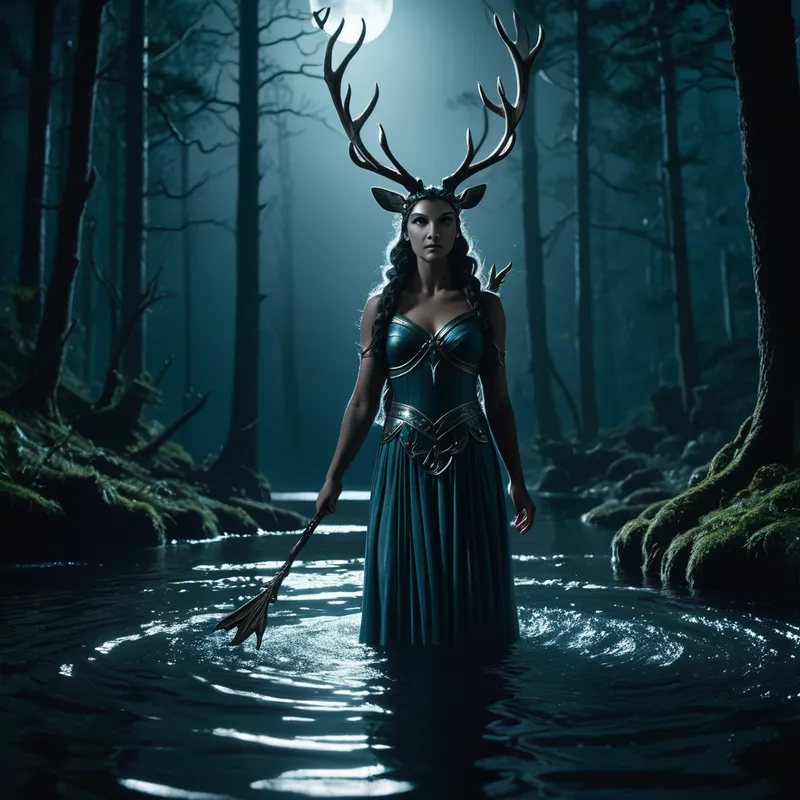
A mortal hunter, Actaeon, accidentally sees the goddess Artemis naked. In her wrath, she transforms him into a stag, and his own hounds tear him apart.
The Tale of The Hunt of Actaeon in Greek m
The heat of the noon sun lay heavy upon the land of Boeotia. Actaeon, grandson of the great king Cadmus, called to his companions, his voice ringing through the still, pine-scented air. “Enough!” he declared, wiping sweat from his brow. “The day is spent, and the deer have fled to cooler shadows. Let us rest.” His fellow hunters, weary and grateful, turned back toward Thebes, their laughter fading into the green gloom.
But a restless fire burned in Actaeon’s heart. The hunt was not yet done for him. Drawn by an unseen thread, he wandered deeper into the forest, away from the known paths, following the music of a hidden stream. [The world](/myths/the-world “Myth from Tarot culture.”/) grew hushed, sacred. The light took on a liquid, green-gold quality, filtering through leaves like a temple’s veil.
He pushed through a final thicket of laurel and myrtle, and the breath caught in his throat.
There lay a secluded grotto, a natural basin of crystalline [water](/myths/water “Myth from Chinese culture.”/) embraced by smooth rock and [ferns](/myths/ferns “Myth from Celtic culture.”/). And in its center, bathing in the shimmering pool, was Artemis. The goddess of the wild stood revealed, her form a sculpture of divine power and untouched grace. [Water](/myths/water “Myth from Chinese culture.”/) droplets clung to her skin like stars. Her silver bow and quiver lay upon a mossy stone, and her [nymphs](/myths/nymphs “Myth from Greek culture.”/), her sacred attendants, moved about her in a silent, graceful dance, pouring [water](/myths/water “Myth from Chinese culture.”/) from polished urns.
A twig snapped beneath Actaeon’s sandal.
The world froze. The laughter of the nymphs died, replaced by a silence so profound it was a sound unto itself. Artemis turned. Her eyes, grey as a winter storm and just as merciless, found him. There was no fear in her gaze, only a cold, rising tide of wrath that seemed to chill the very air. He had trespassed upon the ultimate sanctuary. He had seen what no mortal, no man, was ever permitted to see.
The goddess did not reach for her bow. She did not need to. She scooped a handful of the clear, fateful water and flung it into Actaeon’s face. Her voice, when it came, was not a shout but a decree, a law of nature spoken into being.
“Now go,” she commanded, “and tell, if you can, of seeing me unveiled.”
The water was not cold. It was a fire of transformation. A seizing agony racked his body. He fell to his knees, but his knees were no longer his own. A terrible itching spread across his scalp as bone erupted, branching and growing—a crown of antlers. His neck stretched, his senses swam and sharpened. The scent of the forest flooded him: the fear-sweat of a rabbit, the damp earth, his own terror. He tried to cry out, but from his throat issued only the panicked bellow of a stag.
He stumbled toward a still pool, driven by a remnant of human consciousness. The face that stared back was not his. Great, liquid brown eyes, a long muzzle, and that massive, burdensome rack of antlers. He was a stag, a prize for any hunter.
Then he heard them. The baying. Familiar, beloved, hungry. His own hounds, Pamphagus and Dorceus, Nebrophonus and [Laelaps](/myths/laelaps “Myth from Greek culture.”/), and all the others. They had caught a new scent, a strong scent of fear. They did not know him. They knew only the quarry.
He fled. His own powerful limbs, now four, carried him with desperate speed through thickets that tore at his hide. But the baying grew closer, a chorus of fate. They cornered him by a rocky outcrop. The first hound leapt, its teeth sinking into his flank. Then another, and another. He saw, in a flash of horrible clarity, the eyes of his favorite dog, confused yet driven by primal instinct. There was no recognition, only the hunt.
The great stag that was Actaeon fell. The hounds of his own making, the companions of his life, became the instruments of his death, tearing and rending under the silent, watching trees, until nothing remained of [the hunter](/myths/the-hunter “Myth from African culture.”/) but the spoils of the hunt.
Cultural Origins & Context
This haunting story comes to us from the rich tapestry of Hesiod, and later, with elaborated pathos, from the Roman poet Ovid in his [Metamorphoses](/myths/metamorphoses “Myth from Greek culture.”/). It is a cornerstone of Greek mythological tradition, told and retold by bards and playwrights. Its function was multifaceted. On one level, it was a stark aition for a curious rock formation in Boeotia said to resemble a stag, or for the fierce temperament of certain dog breeds.
On a deeper, societal level, it served as a powerful didactic narrative. It reinforced sacred boundaries—between mortal and divine, profane and sacred, male and female autonomy. Artemis, as the protector of young women and the untamed wild, represented a sphere utterly inviolable. The myth taught about hubris not in the sense of arrogant challenge, but in the catastrophic error of accidental, yet profound, transgression. It explored the cruel, impersonal mechanics of fate and divine [justice](/myths/justice “Myth from Tarot culture.”/), where an error with no malicious intent could still invoke absolute annihilation.
Symbolic Architecture
At its core, the myth of Actaeon is an archetypal [drama](/symbols/drama “Symbol: Drama signifies narratives, emotional expression, and the exploration of human experiences.”/) of [consciousness](/symbols/consciousness “Symbol: Consciousness represents the state of awareness and perception, encompassing thoughts, feelings, and experiences.”/) meeting the unconscious, of [the ego](/myths/the-ego “Myth from Jungian culture.”/) stumbling unprepared into the numinous.
To see the goddess naked is to perceive a truth for which one is not prepared; it is consciousness achieving a perspective it cannot integrate, and being shattered by the revelation.
Actaeon, the hunter, represents the directed, striving consciousness. He is master of his domain, tracking and naming the beasts of the field. The sacred [grove](/symbols/grove “Symbol: A grove symbolizes a sacred space of nature, tranquility, and introspection, often associated with spiritual growth and connection.”/) of Artemis is the [temenos](/myths/temenos “Myth from Greek culture.”/), the sacred precinct of the unconscious, specifically the [realm](/symbols/realm “Symbol: The symbol of ‘Realm’ often signifies the boundaries of one’s consciousness, experiences, or emotional states, suggesting aspects of reality that are either explored or ignored.”/) of the [anima](/symbols/anima “Symbol: The feminine archetype within the male unconscious, representing soul, creativity, and connection to the inner world.”/) in its most powerful, primal, and autonomous form. His “seeing” is not voyeurism, but a [moment](/symbols/moment “Symbol: The symbol of a ‘moment’ embodies the significance of transient experiences that encapsulate emotional depth or pivotal transformations in life.”/) of unintended, overwhelming [insight](/symbols/insight “Symbol: A sudden, deep understanding of a complex situation or truth, often arriving unexpectedly and illuminating hidden connections.”/). He witnesses the [anima](/symbols/anima “Symbol: The feminine archetype within the male unconscious, representing soul, creativity, and connection to the inner world.”/) in her divine, untamed state, separate from and indifferent to masculine control or desire.
The transformation into a stag is the psychic consequence. The conscious mind, unable to bear the [weight](/symbols/weight “Symbol: Weight symbolizes burdens, responsibilities, and emotional loads one carries in life.”/) of this [revelation](/symbols/revelation “Symbol: A sudden, profound disclosure of truth or insight, often through artistic or musical means, that transforms understanding.”/), is regressed and subsumed by instinct. The stag is a [symbol](/symbols/symbol “Symbol: A symbol can represent an idea, concept, or belief, serving as a powerful tool for communication and understanding.”/) of virile, instinctual [life](/symbols/life “Symbol: The symbol of ‘Life’ represents a journey of growth, interconnectedness, and existential meaning, encompassing both the joys and challenges that define human experience.”/), but also of sacredness and [vulnerability](/symbols/vulnerability “Symbol: A state of emotional or physical exposure, often involving risk of harm, that reveals authentic self beneath protective layers.”/)—the hunted [king](/symbols/king “Symbol: A symbol of ultimate authority, leadership, and societal order, often representing the dreamer’s inner power or external control figures.”/) of the [forest](/symbols/forest “Symbol: The forest symbolizes a complex domain of the unconscious mind, representing both mystery and potential for personal growth.”/). Actaeon becomes the very [thing](/myths/thing “Myth from Norse culture.”/) he pursued, consumed by the unconscious forces he once commanded. His own hounds symbolize the fragmented aspects of his own [psyche](/myths/psyche “Myth from Greek culture.”/)—his trained instincts, his passions, his loyalties—now turned against him in self-annihilation.
The Dreamer’s Resonance
When this myth stirs in the modern dreamer, it signals a profound and often terrifying encounter with a taboo Self. To dream of being chased by one’s own animals, or of transforming into an animal while being observed, or of accidentally witnessing a powerful, naked feminine figure in a wild setting, points to a critical psychological moment.
Somatically, one might awaken with a racing heart, a feeling of being exposed, or a deep, inarticulate shame. Psychologically, this is the process of a long-held identity—the “hunter” ego, competent and in control—being dismantled by an encounter with a deeper truth of the psyche. The dreamer is going through a “seeing” that cannot be unseen. It may relate to confronting the raw power of one’s own creativity, sexuality, or intuitive nature (the Artemis principle) in a way that feels destructive to the old self. The dream warns of the peril of meeting a numinous content without the requisite humility and psychological container, resulting in a feeling of being hunted by one’s own life, disintegrated by one’s own talents or drives.

Alchemical Translation
The alchemical journey modeled here is not of triumphant conquest, but of necessary, if brutal, dissolution ([solutio](/myths/solutio “Myth from Alchemical culture.”/) and mortificatio). Actaeon’s fate is [the dark night of the soul](/myths/the-dark-night-of-the-soul “Myth from Christian Mysticism culture.”/) that precedes any genuine transformation.
The alchemical vessel shatters; the fixed identity of the hunter is dissolved in the waters of the unconscious, and the old king must die.
For the modern individual, the “Hunt of Actaeon” describes the process when a life role, a career, or a cherished self-image (the Hunter) accidentally brushes against a more authentic, soul-level calling or truth (the Goddess in her grove). The confrontation feels like a curse because it destroys the old life. The transformation into the stag is the beginning of individuation—being forced into one’s own instinctual, natural state, however vulnerable. The tearing apart by the hounds is the painful but necessary deconstruction of the ego-complex.
The [triumph](/myths/triumph “Myth from Roman culture.”/), hidden within the tragedy, is that the rigid, mortal “Actaeon” must die for any deeper Self to emerge. The alchemical goal is not to avoid the grove, but to learn how to approach it with reverence, to receive its visions without being annihilated by them. One must become not the hunter who invades, nor the stag who is destroyed, but perhaps the grove itself—the container that can hold the sacred and the wild within. The myth ends in death, but the process it initiates is one of psychic transmutation: from naive consciousness to a hard-won knowledge of the sacred, terrible, and transformative power at the core of being.
Associated Symbols
Explore related symbols from the CaleaDream lexicon: