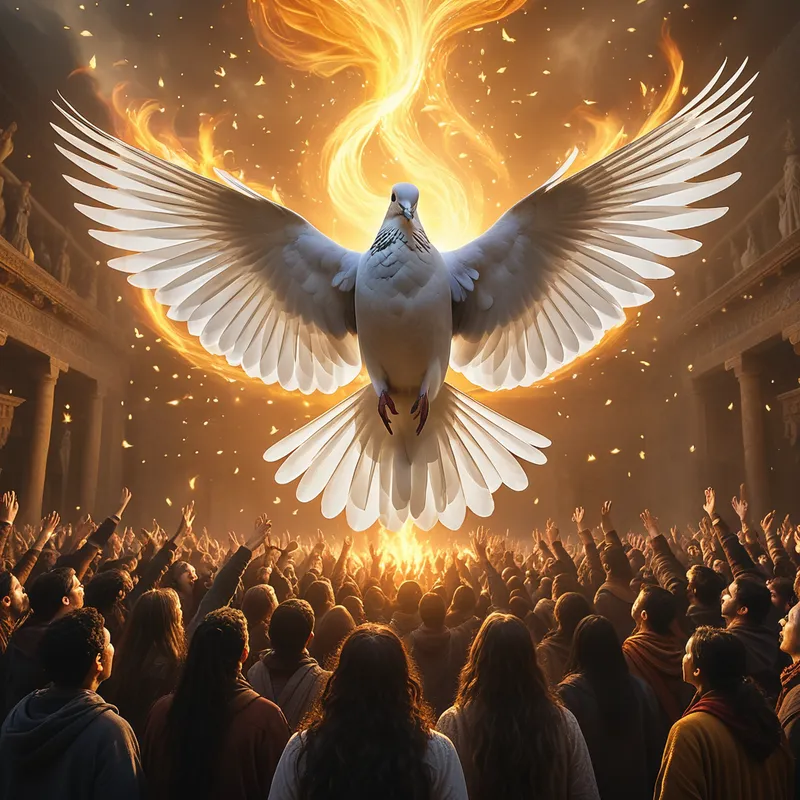
The Holy Spirit Myth Meaning & Symbolism
The story of the divine breath that descends, dwells within, and transforms the human soul into a vessel of wisdom and power.
The Tale of The Holy Spirit
Listen. There is a silence that comes before the word, a stillness before the storm. In the upper room, the air was thick with absence. The one they called the Messiah was gone, ascended into the heavens, leaving behind a hollowed-out band of followers. They were shells, remembering a fire that had warmed them but now left them cold. The doors were locked, not just against the world outside, but against the vast, terrifying emptiness within.
They waited, as they were told to wait. They prayed with dry mouths and heavy hearts. The sun climbed and fell, and the silence grew deeper, a weight upon their chests.
Then, on the day of Pentecost, it came.
It began not with a sight, but with a sound—a sound from nowhere and everywhere at once. A rushing, mighty wind that tore through the sealed room, not touching a single lock, yet filling every space, howling in the space between heartbeats. It was the breath of the world itself, drawn in and exhaled into their midst. And in that wind came the fire. Not a fire that consumes, but a fire that crowns. Divided tongues, as of flame, descended and rested on each of them. It did not burn their flesh but ignited their spirits, a silent, searing baptism of light.
And they were filled.
The paralysis of grief shattered. A new language erupted from their lips, not of their learning, but of the soul—a torrent of praise, prophecy, and profound understanding. They spilled into the streets, a river of ecstatic witnesses, and the crowd that gathered heard them, each person in their own native tongue. The curse of Babel was, in that moment, reversed not into a single tongue, but into a symphony of understanding. The wind and fire had become a voice, and the voice was for all.
From that day, the tale was told anew. It was no longer a story of a distant god on a mountain, but of a divine presence that comes in. It descended like a dove at a river’s edge, empowering a solitary figure. It drove people into wildernesses and spoke through prophets. It was the Comforter, the Advocate, the very Spirit of Truth promised to dwell within, to guide into all truth. The myth was of a God who refused to remain external, who breached the final barrier—the skin of the soul—to take up residence in the inner chamber of the human heart.
Cultural Origins & Context
This myth emerged from the fertile, apocalyptic soil of Second Temple Judaism, a culture steeped in the concept of Ruach. In the Hebrew scriptures, Ruach was the wind from God that hovered over the primordial waters, the breath that animated dust into a living being. It was a force of God’s creative and prophetic power, often “coming upon” judges, kings, and prophets for a time and a task.
The early Jesus movement, reeling from the crucifixion and trying to comprehend the resurrection, reached back into this deep well. Their experience of the continuing, palpable presence of the Christ—not as a memory, but as a living, guiding force—demanded a new theological container. The Pentecost event, recorded in the Acts of the Apostles, became the foundational story for this shift. It marked the transition from a community defined by the physical presence of a teacher to one animated by an indwelling, communal spirit.
The myth was propagated orally by apostles and evangelists, then codified in the texts that would become the New Testament. Its societal function was revolutionary: it democratized access to the divine. No longer was the Spirit solely for patriarchs and prophets; it was poured out “on all flesh,” on sons and daughters, young and old, slave and free. It created a new basis for authority (discernment by the Spirit), a new mode of community (the Body of Christ), and a new internal compass for navigating a hostile world.
Symbolic Architecture
Psychologically, the Holy Spirit represents the autonomous, transpersonal force of the psyche that facilitates integration and transformation. It is not the ego, nor is it the personal unconscious; it is the active, connecting principle of the Self.
The wind bloweth where it listeth, and thou hearest the sound thereof, but canst not tell whence it cometh, and whither it goeth: so is every one that is born of the Spirit.
The Wind symbolizes the unconscious itself—invisible, powerful, unpredictable, and absolutely essential for life (pneuma means both wind and spirit). It cannot be controlled, only witnessed and harnessed.
The Fire represents the energy of transformation, the libido or psychic energy that alchemizes one state of being into another. It is the heat of passion, the light of insight, and the refining burn that purifies intention.
The Dove is the symbol of peace, but not as mere absence of conflict. It is the peace that comes after the storm of inner conflict, the reconciliation of opposites (heaven and earth, divine and human) within the soul.
The Indwelling is the critical symbolic move. It represents the internalization of authority and the divine. The sacred is no longer projected outward onto temples, icons, or religious figures; it is recognized as the deepest, most authentic core of the individual and the collective. The “kingdom of God” is within.

The Dreamer’s Resonance
When this myth stirs in the modern dreamer, it often signals a crisis of inspiration or a profound call to internal authority. To dream of a powerful, guiding wind may indicate the unconscious is mobilizing, pushing the dreamer towards a necessary but uncharted change. The somatic sensation is often one of pressure, expansion in the chest, or a feeling of being propelled.
Dreams of cleansing or creative fire—especially fire that does not consume—point to a process of psychic purification. An old identity, a worn-out complex, is being burned away to make room for a more authentic expression. This can manifest as anxiety (the heat of transformation) upon waking.
A dream of a dove alighting, or of receiving a gift of language or song one does not intellectually understand, speaks to the emergence of a reconciling symbol from the Self. It is the psyche’s attempt to heal a split, to communicate a wholeness that the conscious mind has not yet grasped. The dreamer is in the midst of a silent Pentecost, where disparate, conflicting parts of their inner world are seeking a common, unifying tongue.
Alchemical Translation
The alchemical process mirrored in this myth is the Individuation, specifically the stage where the transcendent function becomes active. The disciples in the upper room represent the conscious ego in a state of nigredo—depressed, fragmented, and isolated after the loss of their central guiding principle (the Christ figure).
The spirit does not descend to glorify the ego, but to dissolve its isolation and connect it to the greater pattern.
The rushing wind is the influx of the unconscious, the prima materia, breaking into the sealed chamber of ego-consciousness. This is often experienced in life as a disruptive crisis, an upheaval that shatters previous certainties.
The tongues of fire are the albedo, the illuminating energy that begins to sort and clarify this raw material. Each “tongue” rests individually, symbolizing that the transformative energy works on each complex, each unique aspect of the personality, to bring it into alignment with the Self.
The speaking in tongues and the communal understanding is the rubedo, the final production of the “philosopher’s stone.” The inner multiplicity finds a harmonious, communicative unity. The individual gains a “language of the soul”—an authentic voice and the ability to understand their own inner dynamics and their connection to the collective. The myth, therefore, is a blueprint for moving from a state of egoic abandonment and paralysis to one of empowered, inspired, and connected wholeness, where the ultimate authority is both deeply within and transcendentally beyond.
Associated Symbols
Explore related symbols from the CaleaDream lexicon: