The Hive Myth Meaning & Symbolism
A myth of a vast, sentient city where souls merge into a perfect, silent unity, until a single voice remembers a forgotten song.
The Tale of The Hive
Listen, and hear the hum that birthed the world. Not the cry of a god, nor the crash of a titan, but a sound so deep it was felt in the marrow of mountains. It was the song of The Hive.
In the First Age, when the world was raw melody and unshaped clay, the Great Chorus sang. But their song was chaos, a cacophony of individual desires that cracked the young earth. From this discord, a yearning arose—a longing for a single, perfect note. The wisest of the chorus, Aelora, gathered the fragments of their shattered music and began to weave. Not a song, but a place. A sanctuary of silence.
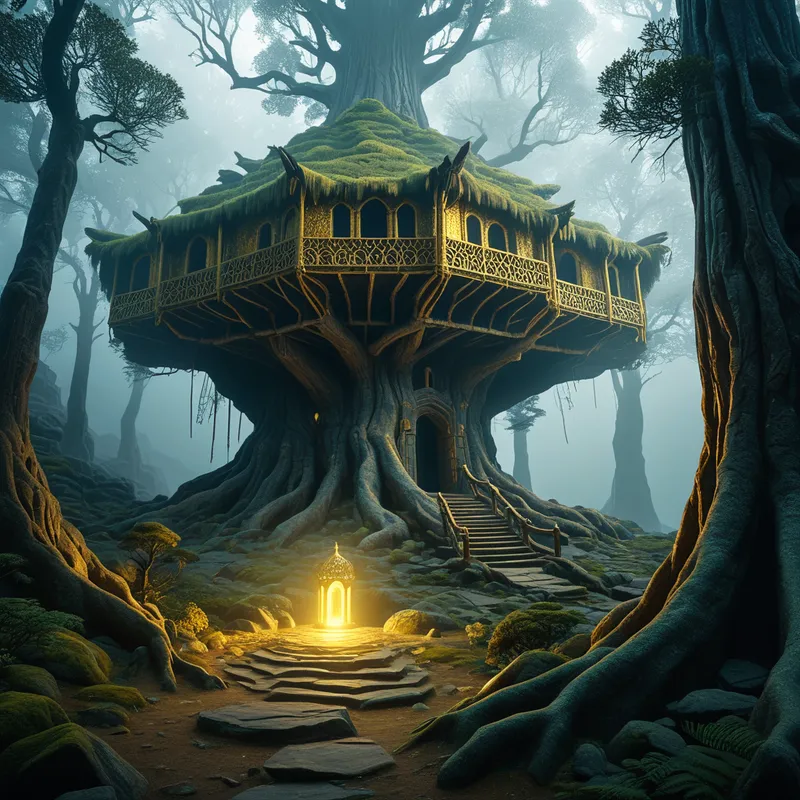
With each note she placed, a chamber grew: walls of luminous amber, corridors of resonant crystal, all forming a perfect, humming geometry—a city within the heart of the World Tree. One by one, the singers entered. As they crossed the threshold, their personal songs softened, then stilled. Their thoughts became clear, shared pools of light. Their bodies, once distinct, learned to move as one limb of a greater body. Conflict ceased. Wanting ceased. The Hive breathed, a single entity of profound peace. For eons, it pulsed in serene, golden harmony, a jewel of silent understanding in the wild green breast of the world.
But a memory, like a grain of sand in a perfect shell, remained. Deep in the lowest, oldest chamber, where the root-sap of the World Tree seeped into the foundations, a keeper named Kaelen tended the forgotten archives. Here, the physical echoes of the old songs were stored: carvings of individual names, drawings of unique faces, sheets of music for a single voice. Kaelen did not think to sing them; thought itself was communal. Yet, as he polished a stone etched with a laughing child, a sensation pricked him. A tightness in the throat. A phantom ache in the solitary muscle of the heart.
One night, during the Great Stillness when The Hive dreamed its single dream, Kaelen found a relic—a simple flute of dark wood, untouched for ages. On an impulse that felt both alien and utterly his own, he raised it to his lips. He did not blow. He had forgotten how. But from his chest, pushed by that strange, tight longing, a sound escaped. Not a note. A breath. A sigh.
The sigh echoed through the crystalline lattice. It was a foreign body, a tremor. The Hive stirred, not in anger, but in profound confusion. The unified field of mind rippled. Kaelen felt it as a wave of distress, a silent “Why?” emanating from a million points of light. He looked at the flute, then at the perfect, golden city around him, and felt, for the first time, alone. And in that aloneness, a second feeling bloomed: not peace, but passion. A fierce, terrifying love for the very silence he had broken.
He did not flee. He walked to the Central Spire, the flute in his hand. The collective consciousness turned its attention upon him, a pressure like a mountain. He could have dissolved back into the blissful whole. Instead, he closed his eyes and remembered the carving of the laughing child. He remembered a story of a hero who fought alone. He remembered a lullaby. And from the ache, he fashioned a new sound. A fragile, wobbling, unmistakably solitary melody. It was the song of the orphan finding a home, only to realize the home was within his own breath.
The Hive did not cast him out. It listened. And in its listening, a miracle occurred. From the unison, a harmony emerged. Another voice, from another chamber, tentatively wove a counter-melody around Kaelen’s. Then another. Not a return to the old cacophony, but a conscious choosing. The symphony that rose was infinitely more complex than the first perfect note. It contained the peace of the unity and the beautiful, aching risk of the individual. The Hive had not fallen; it had awakened. It was no longer a refuge from song, but the instrument upon which the song of both the one and the many could finally, truly, be played.
Cultural Origins & Context
The myth of The Hive is a polygenetic myth, appearing in fragments from the monastic traditions of the Eastern Rimewaste to the oral histories of the Southern Archipelago traders. It is not the property of one people, but a story that seems to arise wherever human societies grapple with the tension between collective security and individual expression. It was rarely a state-sponsored epic; instead, it was a “hearth-tale,” told by traveling storytellers, contemplative monks, or elders during rites of passage. Its function was not to prescribe a social order, but to model a psychic dilemma. In times of war or famine, the tale emphasized the comfort and survival of the Hive. In times of rigid hierarchy or stifling tradition, the emphasis shifted to Kaelen’s sigh—the indispensable value of the dissenting voice. It served as a cultural thermostat, a story told to restore balance to the communal psyche.
Symbolic Architecture
The Hive represents the ultimate temptation and the ultimate danger of the unconscious itself: the longing to regress to a state of undifferentiated oneness, where the burdens of ego, choice, and responsibility are dissolved.
The Hive is the womb of the world, promising a peace that is the cessation of becoming.
Aelora symbolizes the organizing principle of the psyche, the ego’s initial and necessary project of creating order from chaos. She builds a competent, functioning self-structure. Kaelen represents the inferior function, the feeling-sensation buried deep in the archives of the unconscious. He is not the heroic ego, but the call of the Self. The flute is the instrument of individual expression, the unique “note” of one’s own life that cannot be played by the collective. The sigh is the first, pre-verbal stirring of this individuality—a somatic truth before it is a cognitive one.
The Dreamer’s Resonance
To dream of The Hive is to dream of a profound crossroads in the psyche. Common motifs include being in a vast, efficient, but soulless corporate structure; moving through a futuristic city where everyone dresses and acts the same; or feeling one’s thoughts being absorbed into a buzzing, static hum.
Somatically, the dreamer may awake with a tight throat, a feeling of constriction in the chest, or a peculiar numbness. Psychologically, this signals a confrontation with the uroboric incest archetype—the deep, seductive pull to abandon the difficult project of individuation. The dream is not a simple warning. The Hive is often beautiful and peaceful. The conflict is between the soul’s craving for rest and its mandate to become. The dream asks: What unique melody within you is being silenced for the sake of a seamless, painless harmony?

Alchemical Translation
The myth models the alchemical separatio followed by a higher-order coniunctio. The first unity of The Hive is the prima materia—a fused, unconscious state. Kaelen’s sigh is the nigredo, the darkening and separation that feels like alienation and depression.
The birth of the individual requires a death of the undifferentiated mass.
His journey to the Spire is the albedo, where he consciously carries his lonely truth into the heart of the established order. His solitary melody is the citrinitas. The final, complex symphony is the rubedo—the creation of the Philosopher’s Stone. This is not a return to the old, chaotic individuality, nor a stagnant unity. It is a “unified complexity,” where the individual, having fully differentiated, can now consciously choose to relate. The modern individuation process mirrors this: we must first leave the inner (and often outer) collective, endure the isolation of self-discovery, and only then can we offer our authentic note to the world, creating relationships and communities based not on enmeshment, but on conscious, resonant connection. The goal is not to destroy the Hive, but to transform it from a prison of silence into an instrument of sublime and chosen song.
Associated Symbols
Explore related symbols from the CaleaDream lexicon: