The High Priestess Myth Meaning & Symbolism
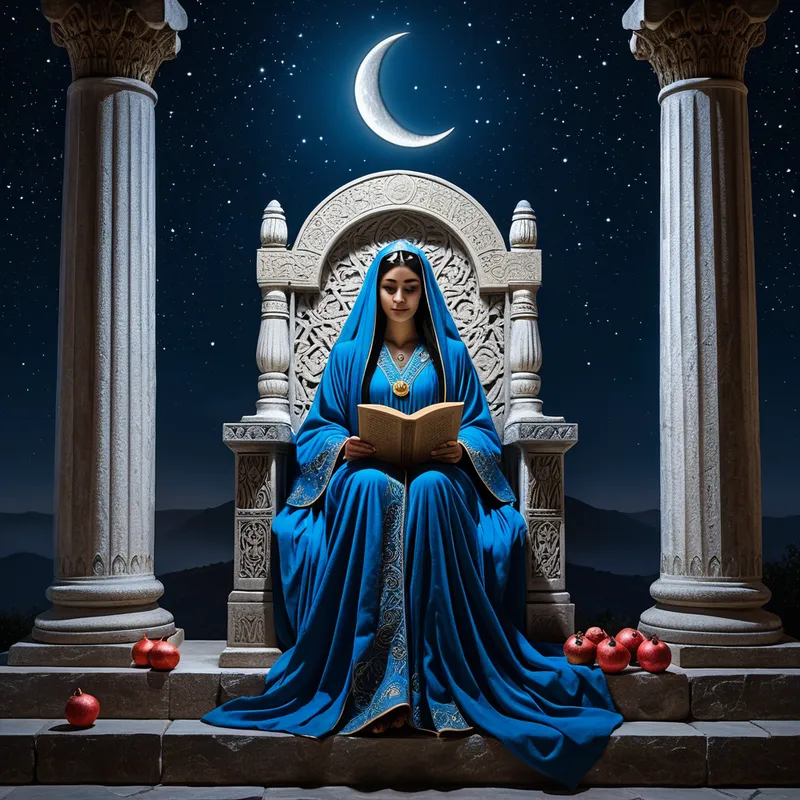
The veiled guardian of the liminal threshold, seated between the pillars of duality, holding the scroll of unspoken law and the key to the unconscious.
The Tale of The High Priestess
In the silent hour between the setting sun and the rising moon, when the world holds its breath, she is present. You do not find her; you are found by her, in that place where thought dissolves and knowing begins. She sits upon a cube of cold, hewn stone, a throne not of dominion but of witness. To her left, a pillar of obsidian, dark as a moonless midnight—Boaz. To her right, a pillar of alabaster, pale as a first dawn—Jachin. Between them hangs a veil, woven not of thread but of twilight itself, embroidered with pomegranates split open to show their ruby seeds.
Her robes are the blue of deep ocean trenches and the violet of distant nebulae, flowing like still water. In her lap rests a scroll, the Tora, its ends rolled tight, its central secrets pressed flat by her calm hand. She does not read it, for its words are written in the language of the root and the stone, the dream and the tide. A silver crescent moon cradles her feet, a boat upon a sea of shadows. Behind the veil she guards, waters rush—the Subconscious Sea from which all forms emerge and to which all return.
She speaks no greeting, offers no guidance. Her gaze, when you meet it, is not of this world; it is the gaze of the pool that reflects your own soul back to you, unmasked. The conflict here is not of clashing swords, but of confronting the silence. The rising action is the pounding of your own heart, the urge to tear aside the veil, to demand answers, to force the scroll to speak. The resolution… is her unwavering stillness. It is the understanding that the mystery is not a barrier, but the path itself. The key is not in her hand, but in your willingness to sit in the unknowing, to listen to the sound of the water behind the veil, and to recognize that the deepest truth wears the garment of silence.
Cultural Origins & Context
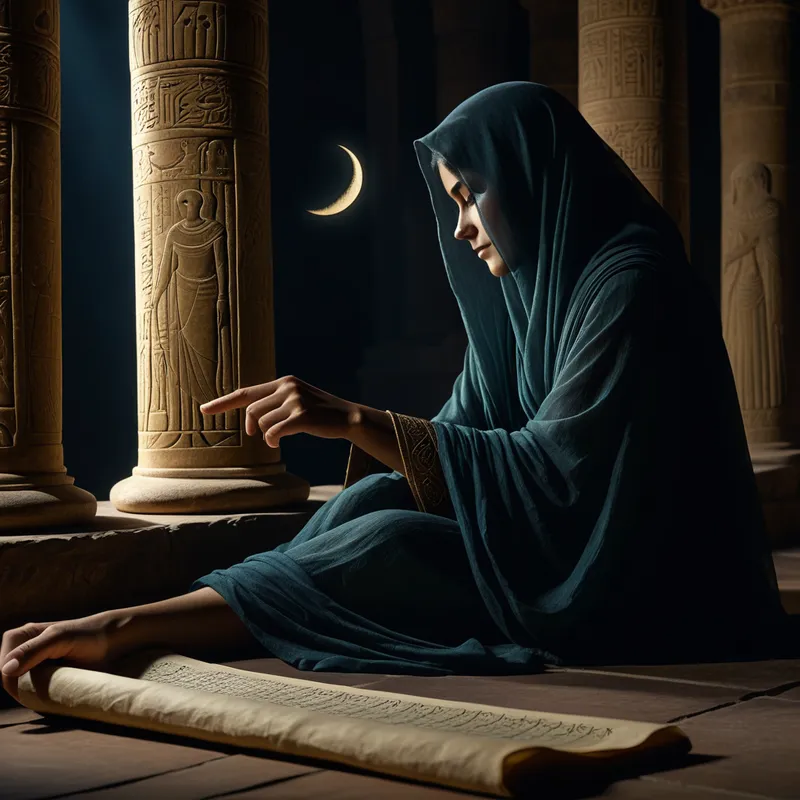
The figure of the High Priestess, as Card II in the Major Arcana, finds her roots in the esoteric revival of the late 19th and early 20th centuries, particularly within the Hermetic Order of the Golden Dawn. While the Tarot’s history is complex, weaving through Renaissance Italy and French occult circles, the mythic persona of the Priestess was crystallized by adepts like Arthur Edward Waite and artist Pamela Colman Smith in the iconic Rider-Waite-Smith deck. This was not a folk myth passed down orally, but a deliberately constructed mythogram, synthesizing Kabbalistic, alchemical, and astrological symbolism.
Her societal function was, and remains, initiatory. Within the secretive lodges, she represented a grade of spiritual attainment—the portal to the Sephirah Chokmah via the path connecting Binah. For the broader culture that adopted the Tarot, she became the mythic guardian of intuitive wisdom, a counterbalance to the overt action of The Magician (Card I). She was the story told to the seeker to illustrate that not all knowledge is seized; some must be received in stillness, at the threshold.
Symbolic Architecture
The Priestess is the archetypal embodiment of the unconscious mind in its potent, formative state. She is not the chaotic id, but the structured, latent potential that precedes creation. Her pillars, Boaz and Jachin, symbolize the fundamental duality of existence—passive and active, dark and light, subconscious and conscious—between which conscious awareness must navigate. The veil represents the liminal boundary between the known ego and the vast, unknown Self.
She is the silence between notes that makes the music.
The scroll (Tora) is divine law or cosmic truth, but it is partially concealed, indicating that wisdom is revealed in stages, through intuition rather than intellect. The crescent moon signifies cyclical rhythms, the feminine, and the reflective nature of the psyche. The pomegranates on the veil are ancient symbols of the underworld, fertility, and the intricate, seeded wholeness of the soul. Collectively, she represents the principle of Binah on the Tree of Life: the Great Mother who gives form to the raw energy of wisdom.
The Dreamer’s Resonance
When this myth surfaces in modern dreams, it often manifests not as a clear image of the card, but as its symbolic essence. The dreamer may find themselves in a vast library where the books are sealed, standing before a locked door with no visible keyhole, or conversing with a serene, knowing woman who answers questions with riddles or silence. There may be a strong somatic sense of suspension, coolness, or deep calm.
Psychologically, this signals a process of incubation. The ego is being asked to cease its frantic searching and to descend into a state of receptive listening. It is the psyche’s way of initiating a dialogue with the unconscious. The “conflict” felt in the dream—frustration at the silence, urgency to know—mirrors the conscious mind’s resistance to this descent. The dream is an invitation to develop a relationship with inner wisdom, to trust the intelligence that operates beneath the surface of linear thought. It often precedes a period of profound insight that seems to arrive from nowhere, once the struggle is relinquished.

Alchemical Translation
The alchemical process modeled by the High Priestess is solutio—dissolution into the unconscious waters—followed by coagulatio—the formation of new, intuitive understanding. Where The Magician (Card I) performs the active conjunctio of elements, the Priestess represents the necessary, preceding stage of returning to the primal soup, the materia prima.
The modern individual’s journey of individuation requires passing through her gate. We must move from a psychology of “doing and knowing” to one of “being and unknowing.” Her myth teaches that the key to psychic wholeness is not in adding more content to the conscious mind, but in developing the capacity to contain the tension of opposites (the pillars) and to listen for the subtle, form-giving whispers from behind the veil of the personal unconscious.
To sit with the Priestess is to allow the conscious mind to be fertilized by the unconscious, to let the moon-led tides reshape the shoreline of the self.
Her triumph is not an action, but a state of achieved receptivity. The alchemical gold she offers is not a final answer, but the living, intuitive function—a direct line to the Self. In integrating her myth, we learn that our deepest truths are not constructed, but received in the sacred silence we agree to keep.
Associated Symbols
Explore related symbols from the CaleaDream lexicon: