The Hidden Stone Myth Meaning & Symbolism
An alchemical tale of a flawed god who must descend into his own darkness to find the luminous core that will heal a fractured world.
The Tale of The Hidden Stone
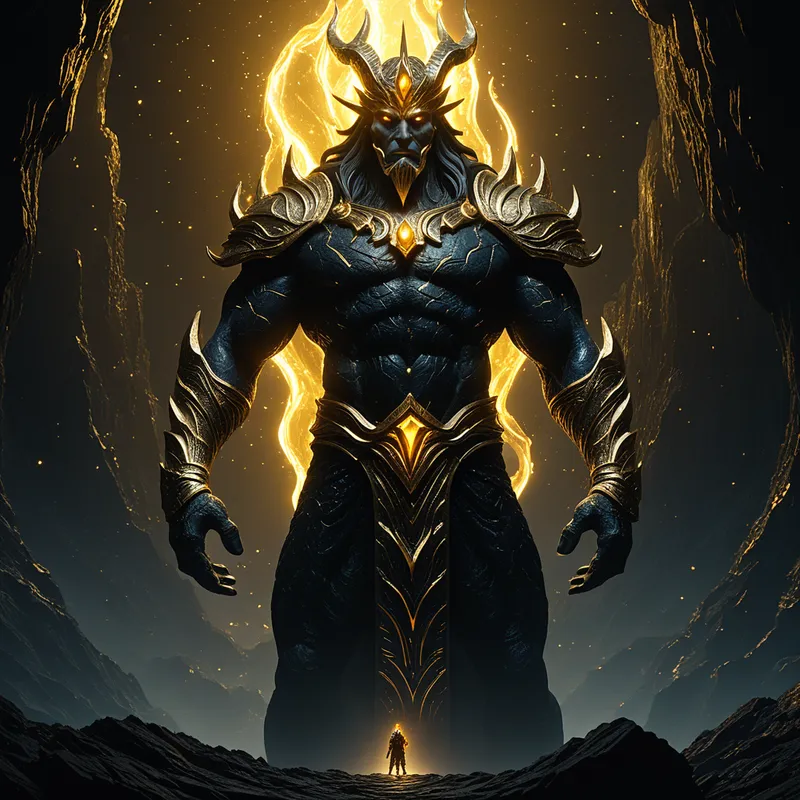
Listen. Before the world was a wheel of seasons, before the sun knew its path, there was the Unus Mundus. And from its silent dream, the Artificer awoke. He was called Sol Rex, and his body was wrought of sunlight and his thoughts were laws. With a breath, he spun the heavens. With a gesture, he raised the mountains. But his creation was a mirror of only his light, and a mirror shows but one face.
In his solitude, a flaw was born—not a crack, but a longing. A shadow detached from his heel and pooled at the base of his throne, a formless, whispering tide he named Umbra Sors. In fear and pride, Sol Rex banished it. He cast the shadow down, down through the strata of the nascent world, into a chasm so deep it swallowed even the echo of its own making. The world was bright, ordered, and half-made.
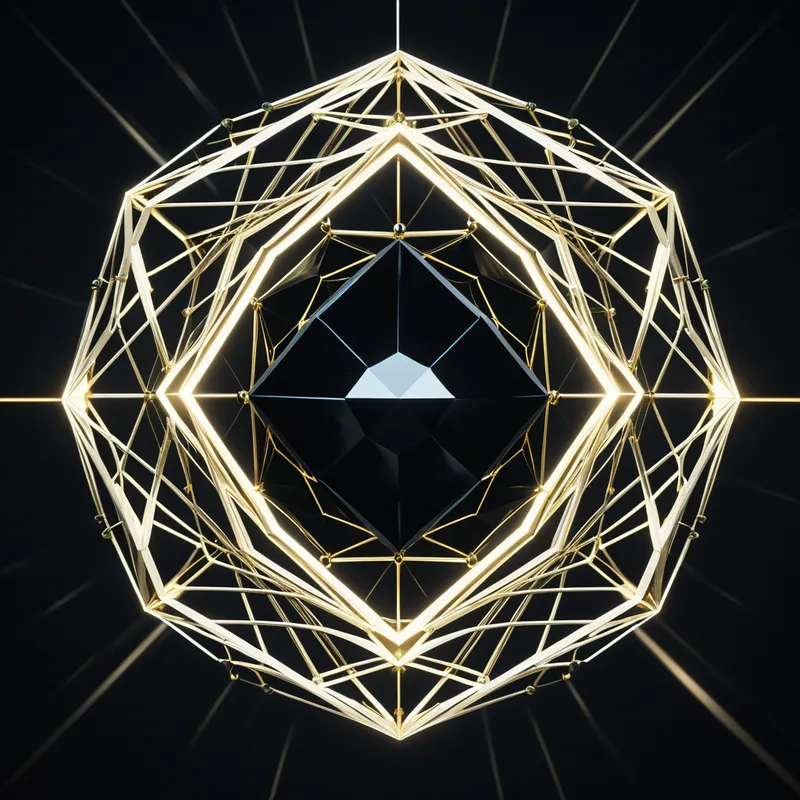
But the wound of that separation festered. The mountains he raised grew jagged and cold. The rivers he carved ran bitter. The creatures of his design moved with the stiff precision of clockwork, their eyes hollow. The world was dying of its own perfection. The Anima Mundi, the world-soul, wept a single tear that crystallized in the abyss—the Lapis Absconditus, the Hidden Stone. It held the memory of wholeness, but it lay buried in the realm of the banished shadow.
A prophecy came on the wind: “Only he who sundered can mend. The king must become the beggar, the light must court its own night.” Sol Rex, in his gleaming palace, felt the truth of it like a sickness. His glorious form began to tarnish. His golden skin dulled to lead. To save his creation, he had to destroy his throne.
He walked to the edge of the great chasm, the Pit of Nigredo. The air there was thick with the scent of ozone and forgotten things. Without a final prayer, for pride had left him, he stepped into the dark. He fell not through space, but through time—through the memories of his own arrogance, the fear of his incomplete self. The shadow, Umbra Sors, rose to meet him not as a monster, but as a missing limb, a cold and familiar void.
There was no battle of swords, but a terrible, silent union. The light of Sol Rex dissolved into the darkness of Umbra Sors. In that absolute midnight, the Nigredo, all form was lost. For an acon, there was nothing but a silent, seething chaos.
Then, a pinprick. A slow, internal luminescence, not of the sun, but of something deeper. From the core of the dissolved god, a new light emerged—softer, warmer, inclusive. It was the glow of the Hidden Stone, activated not by command, but by surrender. It illuminated the abyss from within, revealing it not as a prison, but as a womb. From that united substance, Sol Rex was remade. No longer a king of light, but a sovereign of both realms—his body now a living landscape of dusk and dawn, his eyes holding the calm depth of a star-filled night. He ascended, bearing the Lapis Absconditus not as a trophy, but as his own heart. Where he walked, the world sighed and softened. The jagged mountains wore caps of gentle snow. The bitter rivers ran clear and sweet. The wholeness within him called forth the wholeness in the world.

Cultural Origins & Context
The myth of the Hidden Stone is the central, esoteric narrative of the Alchemical tradition, a body of knowledge that flourished in late medieval and Renaissance Europe but drew upon much older Hermetic, Gnostic, and proto-chemical philosophies. It was never a populist folktale. It was a Living Symbol, passed down in cryptic manuscripts, ornate engravings, and through the master-apprentice oral tradition of practicing alchemists.
Its tellers were not bards in taverns, but philosophers in hidden laboratories. They were often monks, physicians, or natural philosophers who saw in the processes of chemistry—the dissolution of matter, its purification, its recombination—a precise mirror of the soul’s journey. The myth served a dual societal function: for the outer culture, it was an allegory for the divine creation and redemption of the material world. For the inner circle, it was a literal, psychological map. The story provided the symbolic framework for their arduous, dangerous, and often lifelong practical and spiritual work, offering a narrative container for the despair, confusion, and potential enlightenment of the Magnum Opus.
Symbolic Architecture
The myth is a perfect diagram of the psyche’s movement toward integration. Sol Rex represents the conscious ego in its initial state: identified with light, order, control, and spiritual superiority. He is the ruling principle that believes it is the whole self.
The ego, like Sol Rex, builds a kingdom from which it has exiled its own foundation.
His shadow, Umbra Sors, is everything the ego denies: weakness, chaos, emotion, instinct, and the “base” material nature. It is not evil, but unconscious. The banishment creates the “flawed world”—a life that is technically functional but devoid of meaning, warmth, and authentic connection. The Anima Mundi’s tear is the soul’s innate longing for this wholeness, felt as a profound, often inexplicable sadness or yearning in the midst of an apparently successful life.
The descent into the Nigredo is the critical, voluntary collapse of the ego’s project. It is the dark night of the soul, depression, the feeling of everything turning to black lead. This is not a failure, but the necessary first stage of alchemical transmutation. The Lapis Absconditus symbolizes the Self, the indestructible core of the personality that exists beyond the ego-shadow split. It is only discovered in the darkness, through the dissolution of the old, rigid identity.
The Dreamer’s Resonance
When this myth stirs in the modern unconscious, it manifests in dreams of profound disorientation and hidden treasure. Common motifs include: finding a secret basement or cavern beneath one’s own home (discovering the personal unconscious); being tasked with caring for a neglected, ugly, or dangerous animal (confronting the shadow); searching for a lost, vital object in a landfill or murky water (the quest for the Self in the debris of the psyche).
The somatic experience is one of gravity and density. Dreamers may report feeling physically heavier upon waking, or a sense of pressure in the chest. Psychologically, this pattern emerges during life transitions that force a re-evaluation of identity: the end of a career, the dissolution of a long-term relationship, a spiritual crisis. The dream is not a warning, but a confirmation. It signals that the necessary, terrifying, and fruitful process of Nigredo has begun. The psyche is initiating its own alchemical work, dissolving the outworn “kingdom of light” to make space for something more complete.

Alchemical Translation
For the modern individual, the myth models the non-negotiable path of individuation. We all begin as Sol Rex, building an identity based on what is acceptable, bright, and commendable. We banish our Umbra Sors—our anger, our neediness, our unconventional desires—into the personal abyss. The “fractured world” is the life lived from this half-self: it may look good, but it feels sterile.
The call of the Hidden Stone is the call of midlife, of crisis, of a deep sense that “this cannot be all.” The heroic act is not to achieve more, but to descend. It is to voluntarily stop propping up the shining identity and allow it to tarnish, to feel the despair, the confusion, the rage, the sadness we have spent a lifetime avoiding.
The Stone is not found by building a taller tower, but by having the courage to let the foundation sink into the earth it once denied.
This is the Nigredo, the putrefaction. In psychological terms, it is the honest confrontation with the shadow, the withdrawal of projections, and the toleration of profound ambiguity. From that dissolution—that seeming nothingness—a new center gradually coagulates. This is the Lapis Absconditus becoming conscious: the integrated Self. One does not become “perfectly bright” again, but whole. Like the redeemed Sol Rex, the individual gains authority not from ruling over their inner darkness, but from having united with it. The result is a presence that is more grounded, more compassionate, more resilient, and paradoxically, more luminous, because its light now includes and transforms the dark. The world does not change; one’s perception of it, and one’s place within it, is transmuted from leaden duty to golden, embodied meaning.
Associated Symbols
Explore related symbols from the CaleaDream lexicon: