
The Hermit's Hut Myth Meaning & Symbolism
A myth of a sage who builds a hut in the wilderness, discovering that true shelter is not in the structure, but in the boundless space of the heart.
The Tale of The Hermit’s Hut
Listen, and let the mists of time part.
In an age when emperors built palaces to touch the heavens and ministers hoarded silks to clothe their pride, there lived a man whose name the wind had long since stolen. He was once a scholar of great renown, his mind a library of the Five Classics, his tongue skilled in the arts of courtly debate. Yet, a hollow echo grew within his splendid halls. The clatter of ambition became a deafening gong; the silken robes felt like chains of finest thread.
So, he turned his back on the world of dust. He walked, with no destination but away. His feet, soft from palace life, grew hard on the mountain path. He forded streams that washed the courtly perfumes from his skin. He climbed until the cries of the market were replaced by the cry of the hawk, until the scent of incense was lost in the perfume of pine and damp earth.
In a high, lonely clearing, where clouds clung to the shoulders of the peaks, he stopped. Here, he said to the silent mountains. Here.
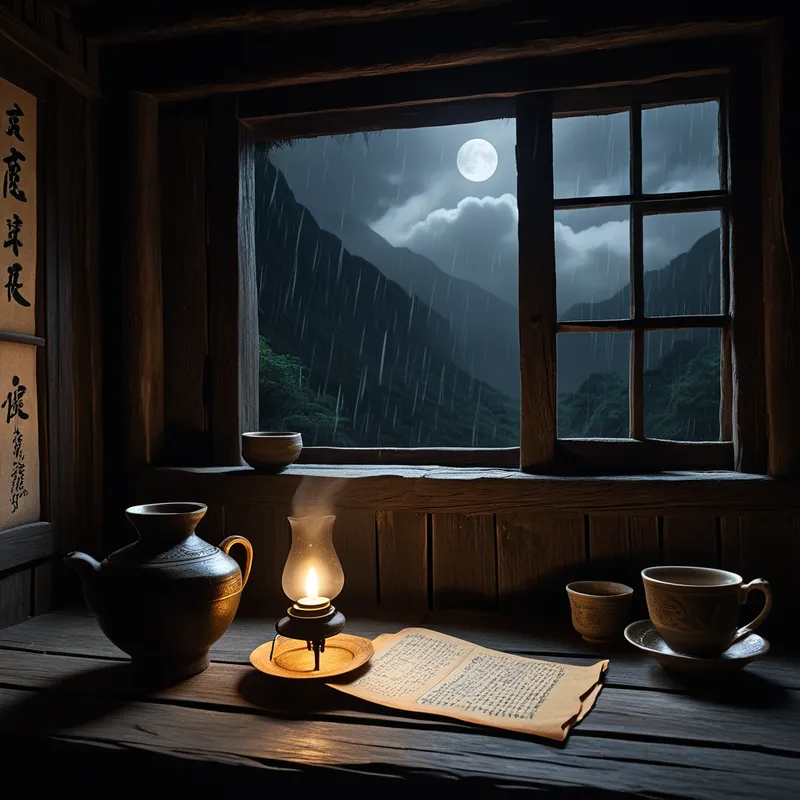
With his own hands, blistered and learning their strength anew, he built. He cut bamboo from the grove, gathered fallen branches, and thatched a roof with reeds from the marsh. He mixed river clay to seal the walls. He did not build a palace, nor even a sturdy house. He built a hut—a mere suggestion of shelter, a pause in the wind. A single room, with a floor of packed earth, a hearth of gathered stones, and a window that framed a single, perfect peak.
The first night, a storm descended. The wind howled like a wounded dragon, seeking entry. Rain lashed the thatch. The man, now a hermit, sat in the center of his fragile creation. He felt the cold, saw the walls tremble. He feared the hut would be torn apart, and he with it. In that moment of primal fear, he clutched at the idea of the hut—his shelter, his achievement, his last possession against the void.
But as the storm reached its fury, a strange thing happened. A corner of the thatch tore free. A sliver of the raging night sky was revealed. And in that breach, he did not see an enemy, but the cosmos itself—wild, indifferent, magnificent. He stopped clutching. He let go.
And in that letting go, the hut changed. It did not become stronger. It became… transparent. It was no longer a thing separating him from the storm, but a space within the storm. The creak of bamboo became part of the wind’s song; the drip of rain inside became a rhythm in the symphony of the night. The hearth fire was not a defiance of the dark, but a humble star burning in harmony with the distant ones glimpsed through the broken roof.
When dawn came, the storm had passed. The hut stood, battered but whole. The hermit stepped outside. He saw his shelter not as a conquest of the wilderness, but as an extension of it—a hollow log, a cave of human making. The true refuge, he understood, was not the bamboo and thatch, but the boundless, accepting stillness he had found within himself. The hut was just the finger pointing at the moon. He had mistaken the finger for the moon, until the storm broke his gaze, and he finally saw.
Cultural Origins & Context
This is not a myth of a single author, but a story woven from the very fabric of Taoist and Chan Buddhist practice. It is found in the anecdotes of Zhuangzi, in the poems of Tang Dynasty mountain recluses like Hanshan, and in the parables of Zen masters. It was passed down not in imperial libraries, but in the oral teachings from master to disciple, often as a response to a seeker’s question about the nature of practice or enlightenment.
Its societal function was profoundly counter-cultural. In a Confucian society structured by hierarchy, duty, and propriety, the myth of the hermit’s hut presented a radical alternative: the path of wu wei (effortless action) and return to simplicity. It validated the choice of withdrawal, not as escapism, but as a deeper engagement with reality. The hut was the physical manifestation of this inward turn, a critique of the elaborate, soul-wearying constructs of civilized life. It served as both an ideal and a practical model for those seeking spiritual clarity, illustrating that the ultimate goal is not to build a better cage, but to realize you were never truly caged.
Symbolic Architecture
The Hermit’s Hut is a master symbol of the psyche in transition. It represents the provisional structure of the ego, built from the materials of our upbringing, education, and social conditioning (the bamboo, the clay, the borrowed designs).
The hut is the conscious personality; the wilderness is the unconscious. Spiritual crisis occurs when the storm of the unconscious threatens the integrity of our carefully constructed self.
The initial, fragile construction symbolizes the first conscious attempt at creating an independent identity, separate from the collective “world of dust.” The coming of the storm is the inevitable confrontation with the contents of the personal and collective unconscious—repressed emotions, primal fears, archetypal forces that do not respect the neat boundaries of the ego. The tearing of the roof is the critical moment of breakdown, where the defensive structure of the personality is compromised. This is not a failure, but a sacred rupture.
The revelation is that the true center, the true shelter (Xin), is not the structure itself, but the spacious awareness that can contain both the structure and the storm. The hut, once a fortress, becomes a permeable vessel. This is the symbolic birth of the Self, which transcends and includes the ego.

The Dreamer’s Resonance
When this myth stirs in the modern dreamer, it often manifests as dreams of finding a small, secluded room, a cabin in the woods, a secret attic, or a safe closet within a larger, chaotic house. The dreamer may be furiously repairing this space, or hiding within it while something powerful rages outside. Alternatively, they may dream of the walls of their home becoming thin, transparent, or merging with a natural landscape.
Somatically, this can correlate with a felt sense of contraction or retreat in the body—a desire to curl up, to be small, to find a physical posture of safety. Psychologically, it signals a critical phase of introversion. The conscious mind is exhausted by the demands of the persona (the social mask) and is initiating a necessary withdrawal. The psyche is building its “hut”—creating a temporary, inner sanctum for processing, for holding the tension between the need for security and the call to a larger, more terrifying reality. The dream is an image of the psyche’s own retreat, where the alchemical work of dissolving old identifications can begin in protected solitude.

Alchemical Translation
The myth models the alchemical opus of individuation in three distinct stages: Nigredo, Albedo, and Rubedo.
The hermit’s journey to the mountain and the labor of building is the Nigredo, the initial separation and descent into solitude, often marked by depression, confusion, and the blackening of old values. The construction of the hut is the creation of the vas (the vessel), the conscious container for the work.
The storm is the fierce heat of the Albedo, the whitening. This is the stage of confrontation and purification. The ego, represented by the hut as a possession (“my achievement, my shelter”), is assaulted by the shadow and the archetypal forces of the unconscious (the storm). The goal here is not to win, but to be cooked, to have one’s identifications scorched away.
The ultimate transmutation is not from lead to gold, but from inhabitant to space. The self realizes it is not the thing contained, but the capacity that contains.
The resolution—the realization of the hut as permeable space—is the Rubedo, the reddening, the production of the philosophical gold. This is the birth of the integrated Self. The individual no longer identifies solely with the small, separate ego-hut. They realize their fundamental nature is the boundless mountain wilderness itself, within which the hut arises and passes away. The struggle for psychic security transmutes into the profound peace of being the secure ground. For the modern individual, this translates as moving from a life of building and defending a fixed identity, to living from a fluid, authentic center that can engage with the world without being captured by it. The hermit returns to the marketplace, but he never really left the hut, for he has discovered the hut was always, and only, within.
Associated Symbols
Explore related symbols from the CaleaDream lexicon: