The Hermetic Vessel Myth Meaning & Symbolism
An alchemical tale of a divine, sealed vessel containing the primal chaos, whose integrity is the key to the Great Work of transmutation and enlightenment.
The Tale of The Hermetic Vessel
Listen, and hear the tale not written in any book, but whispered in the steam of [the alembic](/myths/the-alembic “Myth from Alchemical culture.”/) and seen in the dance of the furnace flame.
In the time before time was measured, when [the world](/myths/the-world “Myth from Tarot culture.”/) was a broth of potential, the Demiurge gazed upon the swirling [Prima Materia](/myths/prima-materia “Myth from Alchemical culture.”/). It was a beautiful, terrifying chaos—a symphony of colors that had no form, a music of elements that refused to harmonize. To create, the chaos needed not a sculptor, but a womb. Not a force, but a space.
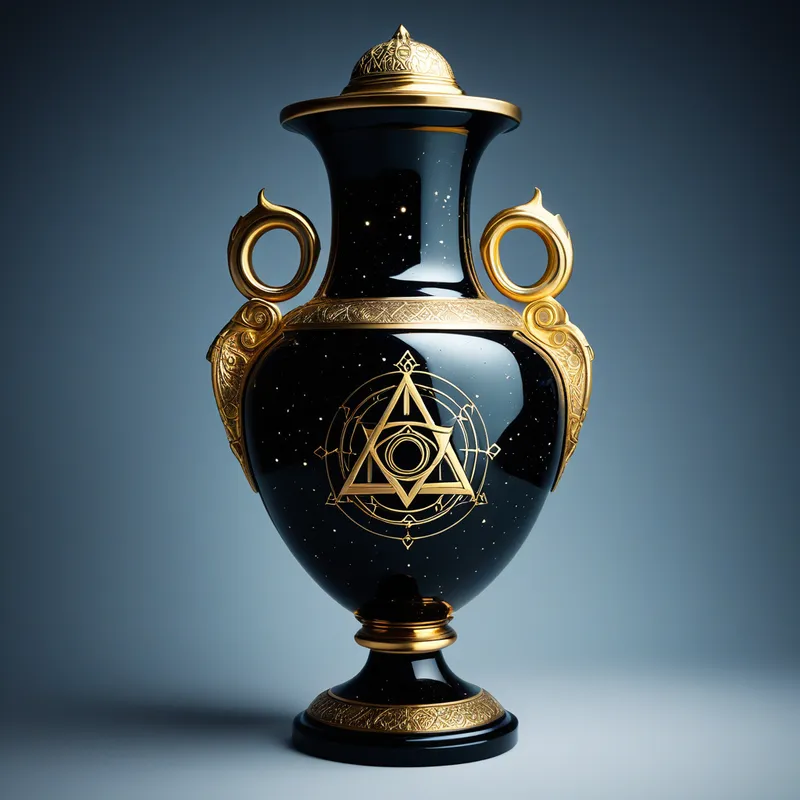
So, from the silence at the heart of the cosmos, [the Demiurge](/myths/the-demiurge “Myth from Gnostic culture.”/) drew forth the concept of [the Vessel](/myths/the-vessel “Myth from Alchemical culture.”/). It was not forged of metal or blown from glass, but crystallized from pure intention. Its substance was the paradox of [Mercurius](/myths/mercurius “Myth from Alchemical culture.”/) made solid, the fluidity of Sulphur given boundary, and the endurance of Salt made luminous. It was a perfect, seamless Vas, opaque and deep as a midnight sky, yet humming with an [inner light](/myths/inner-light “Myth from Buddhist culture.”/).
With a breath that was both a word and a sigh, the Demiurge gathered the roaring, seething Prima Materia. The chaos resisted, lashing out with tongues of elemental fire and geysers of formless [water](/myths/water “Myth from Chinese culture.”/). But the Vessel did not fight. It simply was. It received the storm. The chaos poured into its open mouth, a torrent of becoming, and when it was full to the brim with the unformed All, the Demiurse placed upon it the Seal.
This was no mere lid. It was [the Sigil](/myths/the-sigil “Myth from Global culture.”/) of [Hermes](/myths/hermes “Myth from Global/Universal culture.”/), a living pattern of intersecting circles and sacred geometry that sang a single, eternal note: As above, so below. With its placement, the Vessel became Hermetically sealed. The external world fell away. Inside, the chaos raged. It threw itself against the unyielding walls, seeking a crack, a flaw, a whisper of the outside. It condensed into rain of lead and erupted into suns of sulphur. It wept [mercury](/myths/mercury “Myth from Roman culture.”/) tears and froze into salt-crystal mountains.
For an acon, the Vessel contained the war of opposites. It withstood the pressure of infinite possibility. It did not act, but endured. And in that perfect, pressurized endurance, a miracle of stillness was born. The fighting elements, having no escape, began to see their reflections in the vessel’s inner surface. Fire saw it was also light. Water saw it was also mirror. Earth saw it was also foundation. Air saw it was also space.
They did not unite; they recognized they had never been apart. From their reconciled gaze, a new light was born—not the frantic flash of chaos, but the soft, unwavering glow of the [Lapis Philosophorum](/myths/lapis-philosophorum “Myth from Alchemical culture.”/). The sealed vessel, once a prison of potential, became [the womb](/myths/the-womb “Myth from Various culture.”/) of the perfected [thing](/myths/thing “Myth from Norse culture.”/). The work was complete. The vessel had not changed the chaos; it had provided the sacred, silent space in which the chaos could change itself.

Cultural Origins & Context
The myth of the [Hermetic Vessel](/myths/hermetic-vessel “Myth from Alchemical culture.”/) is the foundational narrative of Western alchemy, a tradition that flourished from Hellenistic Egypt through the Islamic [Golden Age](/myths/golden-age “Myth from Universal culture.”/) and into the European Renaissance. It is not a story told to the public, but a disciplina arcani shared between master and apprentice in the locked laboratorium.
Its roots are in the Corpus Hermeticum, which blended Egyptian god-making rituals with Greek philosophy. The vessel is the practical, physical counterpart to the Hermetic maxim “The All is One.” In a society where knowledge was often persecuted, the myth served a crucial sociological function: it encoded the entire spiritual process of [the Great Work](/myths/the-great-work “Myth from Alchemical culture.”/) into a single, tangible object. To speak of “sealing the vessel” was to speak of creating a sacred, introspective space safe from the corruption and distraction of the outer world—a necessity for both the experiment and the experimenter.
Symbolic Architecture
The Hermetic [Vessel](/symbols/vessel “Symbol: A container or structure that holds, transports, or protects something essential, representing the self, emotions, or life journey.”/) is the ultimate [symbol](/symbols/symbol “Symbol: A symbol can represent an idea, concept, or belief, serving as a powerful tool for communication and understanding.”/) of the container. It represents the bounded [space](/symbols/space “Symbol: Dreaming of ‘Space’ often symbolizes the vastness of potential, personal freedom, or feelings of isolation and exploration in one’s life.”/) where transformation becomes possible. Psychologically, it is the integrated ego, the conscious self strong enough to hold the contents of the unconscious without being shattered by them.
The self is not the storm of thoughts and feelings, but the silent, enduring vessel that contains the storm.
The unformed Prima Materia symbolizes the raw, undifferentiated [psyche](/myths/psyche “Myth from Greek culture.”/)—our chaotic mix of instincts, traumas, potentials, and shadows. The act of sealing it away represents the critical, often terrifying, step of introspection and containment. We must stop projecting our [chaos](/symbols/chaos “Symbol: In Arts & Music, chaos represents raw creative potential, uncontrolled expression, and the breakdown of order to forge new artistic forms.”/) onto the world (the solve, or [dissolution](/symbols/dissolution “Symbol: The process of breaking down, dispersing, or losing form, often representing transformation, release, or the end of a state of being.”/)) and instead draw it [inward](/symbols/inward “Symbol: A journey toward self-awareness, introspection, and the exploration of one’s inner world, thoughts, and unconscious mind.”/) for confrontation.
The raging conflict inside—the Coniunctio Oppositorum enacted as civil war—is the necessary [friction](/symbols/friction “Symbol: Friction represents resistance, conflict, or the necessary tension required for movement and transformation in dreams.”/) of individuation. Opposing aspects of [the self](/myths/the-self “Myth from Jungian culture.”/) (masculine/feminine, [spirit](/symbols/spirit “Symbol: Spirit symbolizes the essence of life, vitality, and the spiritual journey of the individual.”/)/[body](/symbols/body “Symbol: The body in dreams often symbolizes the dreamer’s self-identity, personal health, and the relationship they have with their physical existence.”/), love/anger) must clash within the safe container of [awareness](/symbols/awareness “Symbol: Conscious perception of self, surroundings, or internal states. Often signifies awakening, insight, or heightened sensitivity.”/). The vessel’s impermeability is crucial; it means no part of [the self](/myths/the-self “Myth from Jungian culture.”/) can be split off and denied. It must be faced.
The eventual [birth](/symbols/birth “Symbol: Birth symbolizes new beginnings, transformation, and the potential for growth and development.”/) of the [Philosopher’s Stone](/symbols/philosophers-stone “Symbol: The ‘Philosopher’s Stone’ represents the ultimate goal of transformation and enlightenment, symbolizing the quest for knowledge, wisdom, and the attainment of one’s true potential.”/) from this process symbolizes the emergent wholeness, the Self (with a [capital](/symbols/capital “Symbol: A capital city represents the center of power, governance, and national identity, often symbolizing authority, structure, and collective aspirations.”/) ‘S’) that arises when [consciousness](/symbols/consciousness “Symbol: Consciousness represents the state of awareness and perception, encompassing thoughts, feelings, and experiences.”/) successfully contains and integrates the totality of the psyche.
The Dreamer’s Resonance
When this myth stirs in the modern unconscious, it manifests in dreams of profound containment and pressure. One may dream of being in a room that is suddenly sealed, of a glass sphere holding a violent storm, or of one’s own body becoming a sealed capsule. There is often a somatic quality of tightness, of being “under pressure.”
These dreams signal a critical phase of psychological processing. [The ego](/myths/the-ego “Myth from Jungian culture.”/) is attempting to perform the alchemical sealing. It is pulling scattered psychic energy—perhaps a complex of rage, a tidal wave of grief, or a disowned creative power—back from the outer world and into the inner sanctum of the dreamer’s awareness. The feeling of pressure is the weight of this material coming home to roost. It is not a nightmare of entrapment, but a vision of necessary incubation. The dream is the psyche’s laboratorium, and the dreamer is both the vessel and [the alchemist](/myths/the-alchemist “Myth from Various culture.”/), learning to hold what they have long expelled.

Alchemical Translation
For the modern individual, the myth of the Hermetic Vessel models the non-action at the heart of deep change. Our cultural bias is toward doing—analyzing, fixing, expressing, solving. Alchemy suggests the first and most profound work is being—specifically, being a container.
The “sealing of the vessel” translates to the conscious creation of a sacred inner space through meditation, ritual, journaling, or therapy—a space where one commits to not acting out, but to holding the tension. When anger arises, instead of immediately blaming another (projecting the chaos), one contains it, feels its heat, and allows it to reveal its message. When grief swells, instead of numbing it, one lets it fill the inner vessel to the brim, trusting the integrity of one’s own soul to hold it.
Transmutation occurs not by force of will, but by the integrity of the vessel that allows the will of the Self to emerge.
This is the core of psychic transmutation. We do not turn lead into gold by beating on the lead. We place the lead (our base, heavy, problematic stuff) into the sealed vessel of attentive, compassionate awareness. We then apply the gentle, persistent heat of observation—the Circulatio. In that sealed space, under that consistent warmth, the dense matter of our suffering slowly, inevitably, reveals its hidden gold—the insight, the strength, the compassion that was its true nature all along. The goal is not to become something new, but to provide the perfect conditions for what we already are to perfect itself. We are the chaos, the vessel, and the stone.
Associated Symbols
Explore related symbols from the CaleaDream lexicon: