The Haruspices Myth Meaning & Symbolism
The myth of the haruspex, who reads the divine script written in the viscera of sacrifice, translating the raw chaos of life into a map of fate.
The Tale of The Haruspices
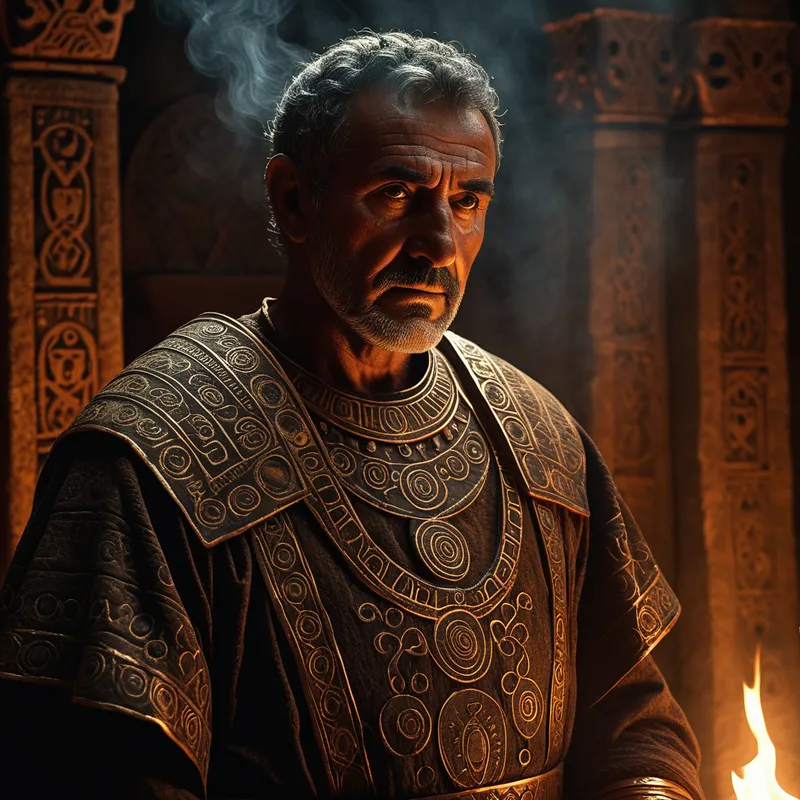
Beneath a sky the color of hammered bronze, the air is thick with the scent of crushed herbs, cold earth, and the metallic promise of rain. The crowd is a silent, breathing tapestry at the edge of the sacred precinct. All eyes are on the stone altar, stained dark by generations of offering. A bull, its coat gleaming like a wet river stone, stands placid, garlanded with wool. The priest, the haruspex, is not a king or a warrior, but a reader. His tools are not sword and shield, but basin, water, and a mind honed to see.
He approaches the bull, his movements a slow, deliberate dance. A murmur, a chant in a tongue older than Rome itself—the Etruscan litany to Tinia, to Nortia. The blade flashes, a silver arc against the grey day. It is not an act of violence, but of opening. A portal is made. The great beast sighs into the arms of its attendants, its life released not into nothingness, but into the waiting hands of the divine.
Now, the true work begins. With reverence that borders on intimacy, the haruspex reaches into the warmth. He does not grab; he receives. The liver, the hepar, is lifted forth—a dark, gleaming universe in the cup of his hands. He places it upon the altar. Water is sprinkled, cleansing, clarifying. He bends close, his shadow falling over the organ’s complex landscape.
Here is the cosmos in miniature. The lobe is the mountain. This fissure is the river of destiny. That dark spot, a portent of discord. His fingers, calloused and sure, trace the ridges and valleys, the texture of fat and vessel. He reads it as a shepherd reads the sky for storms. He sees in the pattern of the bile duct the alignment of armies; in the fullness of the caput iocineris, the favor of the gods. The crowd holds its breath. He is translating. The chaotic, visceral truth of life and death is being parsed into a sentence the city can understand. A crack in the gall bladder speaks of a traitor in the senate. The robust, healthy lobe promises a bountiful harvest. He looks up, his eyes seeing both this world and the next. His voice, when it comes, is clear and carries the weight of the revealed pattern. “The gods have spoken. The signs are favorable. Proceed.” And with that utterance, the terrifying mystery of divine will is given a shape, a boundary. The chaos is made legible. The future, for a moment, is held in the palm of a hand, still warm from the sacrifice.
Cultural Origins & Context
The practice of haruspicy was the profound intellectual and spiritual legacy of the Etruscan civilization to Rome. For the Etruscans, the universe was not a random occurrence but a meticulously designed sacred text, and the gods wrote their intentions directly into the fabric of the natural world—especially into the entrails of a consecrated sacrifice. This was not mere superstition; it was a sophisticated science of signs, a disciplina Etrusca. The mythos of the haruspex was not a single narrative tale like those of Greece, but a living, performative myth enacted at every critical juncture: before battle, at the founding of a temple, to interpret ominous prodigies like lightning strikes or monstrous births.
The knowledge was passed down through rigid, priestly lineages, from master to apprentice, in a sacred chain of interpretation. The famous Piacenza Liver, a bronze teaching model, stands as testament to this scholarly tradition. It is a map of the heavens mirrored in an organ, divided into regions assigned to specific deities. When Rome absorbed Etruria, it did not discard this art. The Roman Senate maintained a college of Haruspices, consulting them alongside their own augurs. The myth functioned as the ultimate societal regulator, a way to submit human ambition—whether of a general or a consul—to a higher, divine order. It answered the paralyzing question of “What does it mean?” by providing a ritualized framework to find meaning in the midst of chaos and bloodshed.
Symbolic Architecture
At its core, the myth of the Haruspices is a profound metaphor for the human confrontation with raw, unmediated reality—and the desperate, sacred need to find pattern within it. The sacrifice represents the necessary cost of knowledge. To understand the will of the cosmos, something of value must be surrendered, opened up.
The liver is the microcosm. It is the seat of life, of passion and blood, transformed into a tablet of fate. To read it is to accept that the divine script is written not in clean parchment, but in the moist, complex, and mortal flesh of existence.
The haruspex himself symbolizes the conscious ego attempting to interpret the messages of the deeper Self (the gods). He does not create the message; he humbly deciphers it. His skill is one of observation, correlation, and translation. The act signifies the transformation of inner, somatic reality—our gut feelings, our visceral fears and intuitions—into a coherent narrative that can guide action. The “favorable” or “unfavorable” reading is less about good or bad fortune and more about alignment or misalignment with the deeper, often paradoxical, flow of life’s destiny.
The Dreamer’s Resonance
When this myth stirs in the modern psyche, it often manifests in dreams of interior exploration and visceral revelation. A dreamer may find themselves in a clinical or ancient setting, compelled to examine their own internal organs, which may appear as intricate machines, decaying ruins, or luminous maps. They may dream of cutting something open—a book, a fruit, a wound—to find a shocking but meaningful truth inside.
These dreams signal a profound psychological process: the somaticization of a complex life situation. The dreamer is being invited to “look inside” at the emotional and instinctual truth they have sacrificed (a relationship, a career path, an old identity) to see what patterns it reveals. The feeling is often one of sacred dread mixed with curiosity. The dream-haruspex is the emerging function of intuition or inner wisdom, learning to read the “signs” written in the body’s tensions, illnesses, and energies. It is a call to stop projecting fate outward and to begin the terrifying, respectful work of divining it from one’s own lived experience.

Alchemical Translation
The alchemical journey modeled by the Haruspices is the opus of interpretatio—the work of interpretation that transmutes the materia prima of chaotic experience into the gold of meaning. The process begins with the sacrificium, the willing offering of a prized possession (an attachment, a certainty, a cherished self-image) to the fires of circumstance. This is the necessary dissolution.
The extracted “liver” is the retrieved core of that experience—the emotional truth, the raw data of failure or loss. The haruspex’s careful examination represents the separatio and contemplatio stages. Here, one must resist the urge to turn away in disgust or fear from the messy reality. Instead, one must gaze upon it with respectful attention, tracing the lines of cause and effect, the lobes of memory and affect.
The ultimate transmutation is not changing the event itself, but changing one’s relationship to it. By finding the pattern—the “why” embedded in the “what”—the chaotic event is integrated. It becomes part of the internal map, the Piacenza Liver of the soul, which guides future navigation.
For the modern individual, this is the heart of shadow work and individuation. We are all haruspices of our own lives, tasked with reading the divine, often distressing, script written in the viscera of our experiences. The triumph is not in controlling the message, but in developing the courage to look, the patience to learn the language, and the wisdom to speak the revealed truth, thereby transforming blind fate into a conscious dialogue with the depths.
Associated Symbols
Explore related symbols from the CaleaDream lexicon: