The Harmony of the Spheres Myth Meaning & Symbolism
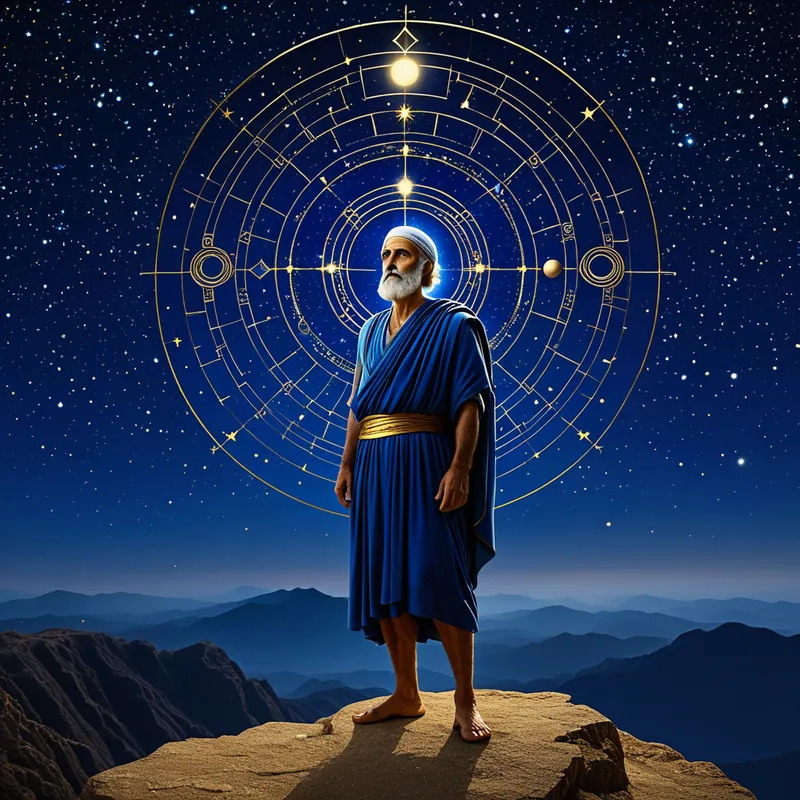
The philosopher Pythagoras perceives the cosmos as a divine instrument, its celestial bodies moving in perfect, inaudible musical intervals, revealing a universe of mathematical beauty.
The Tale of The Harmony of the Spheres
Listen. Beyond the clamor of the marketplace, past the sighing of the wind in the olive groves, there is a deeper silence. It is in this silence that the seeker must dwell. In the hallowed precincts of Croton, a man sits in the deep of night. His name is Pythagoras, and he has turned his back on the world of appearances. The oil lamp gutters, painting dancing shadows of sacred geometry upon the wall—the triangle, the square, the sphere.
He does not sleep. He listens. His ear is not pressed to the shell of the sea, but to the shell of creation itself. He has spent lifetimes measuring the intervals between notes on the monochord, finding that beauty, that divine proportion, in the simple ratios of string length: 2:1 for the octave, 3:2 for the perfect fifth. The music of earth is a pale echo, a shadow cast by a greater fire.
And then, in a moment where the veil between the mortal and the eternal grows thin, he hears it. No, hear is too crude a word. He perceives it. It is not a sound for the fleshly ear, but a resonance for the soul. He lifts his gaze through the stone of the roof, through the vault of the sky. He sees them—not as wandering stars, but as divine intelligences ensconced in crystalline spheres, each nested within the other, rotating with a majestic, eternal slowness.
The Moon, swift and silver, sings the highest note. Then Mercury, elusive and quick. Venus, with her lucent, loving tone. The Sun, the glorious, central tenor. Mars, with a brassy, martial cry. Jupiter, profound and kingly. Saturn, the slow, deep bass of time’s boundary. Each sphere, polished by the hand of the Demiurge, grinds against the aether, and from that friction—not of discord, but of perfect motion—arises a tone. A pure, mathematical frequency.
Together, these tones form a chord. A vast, encompassing, polyphonic harmony that is the very fabric of reality. It is the music of Kosmos. It is the song the universe sings to itself, a lullaby of perfect law. Pythagoras weeps, for his mortal ears are deaf to the splendor his soul now witnesses. He understands that humanity, mired in the cacophony of base matter and unruly passion, has forgotten this song. We are born hearing it, and we spend our lives in the desperate, aching nostalgia for that lost harmony, trying to recreate its echo in flutes and lyres, in the ordered lines of poetry, in the just city. The myth is not of a battle won, but of a truth remembered. The resolution is the haunting, beautiful, and tragic knowledge of the melody that forever plays just beyond the threshold of our noise.

Cultural Origins & Context
The myth of the Harmony of the Spheres, or the Musica Universalis, is a philosophical and mystical doctrine, not a narrative myth of gods and heroes in the Homeric tradition. Its primary source is the later Pythagorean and Platonic schools. While attributed to Pythagoras himself (6th century BCE), our most coherent accounts come from Plato’s Republic (the Myth of Er) and Timaeus, and later from philosophers like Cicero in his Somnium Scipionis.
It functioned as a foundational cosmological model for the intellectual elite. This was not a story told in the public agora, but one revealed in the inner circles of philosophical schools. Its societal function was profound: it provided a metaphysical basis for order (dike), beauty (kalon), and mathematics as the language of the divine. It argued that the universe was not chaos, but a rational, intelligible, and beautiful whole. This idea legitimized the pursuit of astronomy, mathematics, and music as sacred sciences—paths to purify the soul and attune it to the cosmic order.
Symbolic Architecture
At its core, the myth symbolizes the principle that true reality is founded on invisible, harmonious relationships. The spheres represent the layered structure of existence, from the sublunary world of change and decay to the immutable perfection of the heavens. The music is the emergent property of perfect motion according to divine law.
The soul is an exile from its native harmony, and all human art, science, and virtue is the attempt to remember and retune the instrument of the self.
The central conflict is not between characters, but between states of being: the noisy, fragmented perception of mundane life versus the silent, unified perception of the philosopher. Pythagoras, as the mythic figure, represents the awakened consciousness that can perceive the underlying pattern. The “deafness” of humanity is not a physical lack but a psychological and spiritual occlusion—a preoccupation with the material and the temporal that drowns out the eternal signal.
The Dreamer’s Resonance
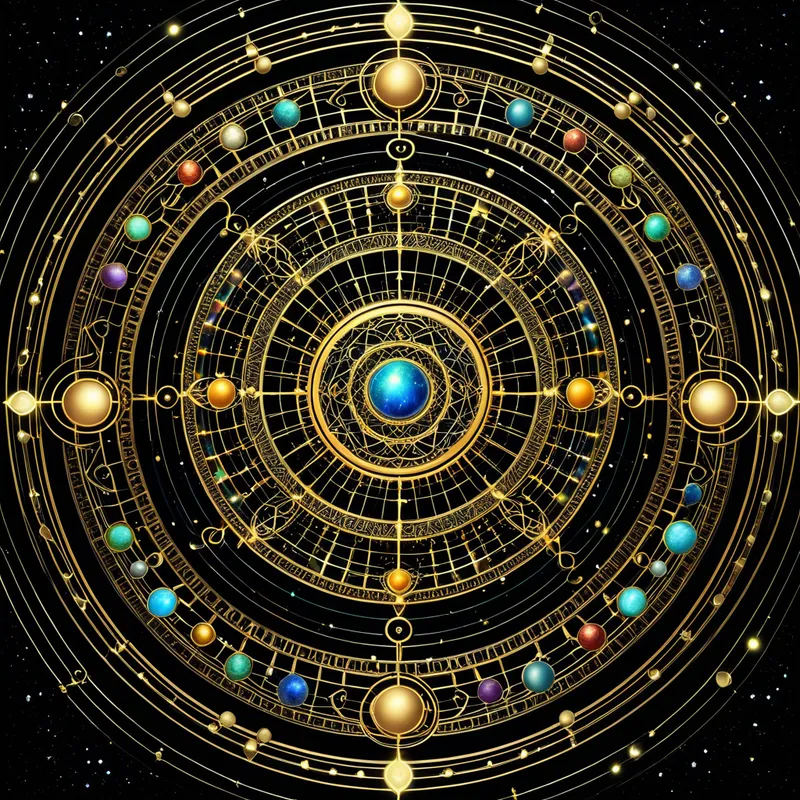
When this myth pattern stirs in the modern unconscious, it often manifests not as sound, but as a profound sense of synchronicity. A dreamer might experience visions of intricate, rotating mechanisms—gears, orbs, or gyroscopes—moving in flawless, silent coordination. They may dream of finding a room where everything is in perfect, aesthetic proportion, evoking deep peace. Alternatively, the shadow aspect appears as dreams of cacophony: instruments out of tune, machinery grinding violently, or a desperate search for a lost frequency in a world of static.
Somatically, this can correlate with a process of seeking inner equilibrium—recovering from burnout, seeking balance after a crisis, or during a deep meditative or therapeutic practice. The psyche is attempting to re-establish its own intrinsic order, to quiet the internal “noise” of anxiety, trauma, or conflicting desires, and listen for the core tone of the authentic self.

Alchemical Translation
The alchemical journey modeled here is one of attunement. The prima materia is the chaotic, discordant soul, identified with the noisy world. The opus is the long, disciplined work of introspection, study, and ethical living—the Pythagorean practices of purification. As one refines the base elements of the personality (through introspection—knowing thyself, and harmony—balancing opposites), the gross matter of the ego begins to resonate at a higher frequency.
Individuation is the process by which the personal psyche becomes a conscious participant in the cosmic symphony, no longer a discordant note but an intentional voice within the chord.
The “transmutation” is the shift in perception. One does not change the music of the spheres; one changes one’s capacity to hear it. The philosopher’s stone is this awakened faculty of perception—the “inner ear” of the soul. The triumph is the realization that the harmony was never lost, only obscured. The modern individual’s struggle is to turn down the volume of the personal and collective unconscious’s chaos, to create the inner silence necessary for the universal melody, the Self’s deep pattern, to become audible. In doing so, one does not escape the world but understands one’s rightful, resonant place within its grand and beautiful design.
Associated Symbols
Explore related symbols from the CaleaDream lexicon: