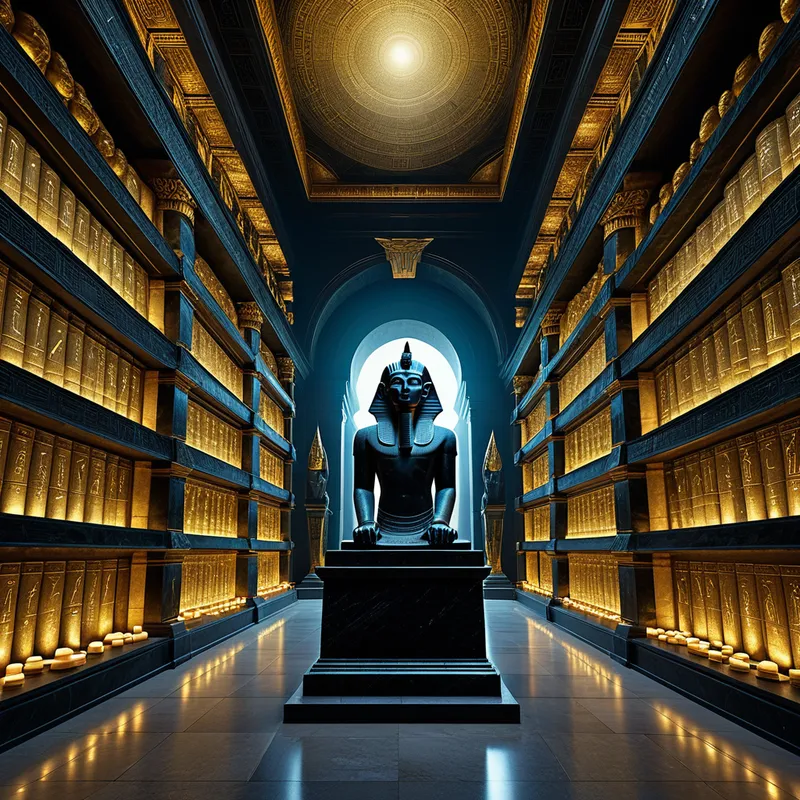
The Hall of Records Myth Meaning & Symbolism
A myth of a hidden library beneath the Sphinx, holding the lost knowledge of Atlantis and the secrets of human consciousness, awaiting rediscovery.
The Tale of The Hall of Records
Before the first stone of the first pyramid was laid, when the gods still walked the black soil of Kemet, a great sorrow fell upon [the earth](/myths/the-earth “Myth from Hindu culture.”/). It was the time of the sinking, when the great island of the West, the land of the Atlanteans, was swallowed by the roaring sea. But the gods are not without mercy, nor are they without foresight.
[Thoth](/myths/thoth “Myth from Global/Universal culture.”/), the scribe of the gods, he who measures the heavens and records the heartbeat of time, saw the cataclysm approaching. He gathered the elder priests, those who still remembered the language of the stars and the first words spoken at the dawn of creation. In a chamber lit by no earthly fire, they worked. They did not carve their wisdom into stone that could be shattered, nor ink it on [papyrus](/myths/papyrus “Myth from Egyptian culture.”/) that could burn. They sang it. They chanted the secrets of geometry that built worlds, the medicine of the spirit, the histories of races older than the sun, and the maps of celestial journeys. And as they sang, their knowledge, their very essence, crystallized. It became light solidified into tablets of indestructible crystal, into scrolls that hummed with a silent frequency, into halls of memory that existed just beyond [the veil](/myths/the-veil “Myth from Various culture.”/) of the seen world.
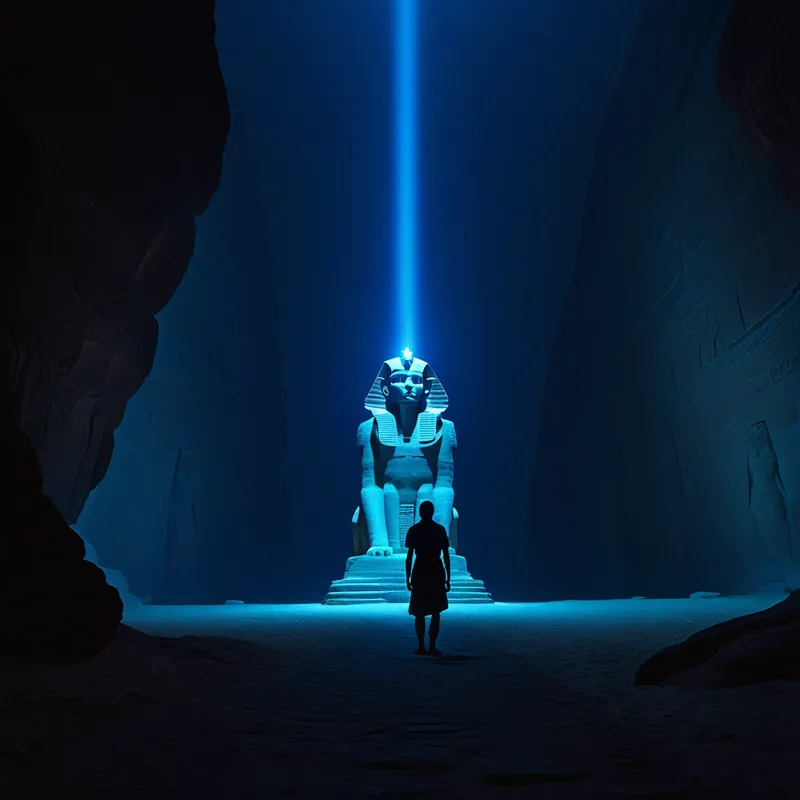
Where to hide such a treasure? Not in a temple, for temples fall. Not in a mountain, for mountains erode. Ra, in his [solar barque](/myths/solar-barque “Myth from Egyptian culture.”/), cast his eye upon the land. He saw the plateau of Giza, a place already sacred to [the horizon](/myths/the-horizon “Myth from Various culture.”/). And there, he commanded the shaping of a guardian. From the living rock rose a being with the body of a lion, patient and powerful as eternity, and the face of a [pharaoh](/myths/pharaoh “Myth from Egyptian culture.”/), bearing the wisdom of humanity. This was the [Sphinx](/myths/sphinx “Myth from Greek culture.”/). Beneath its mighty paws, deep in the bedrock of [the world](/myths/the-world “Myth from Tarot culture.”/), the Hall was fashioned. It is not a room one simply walks into. It is a state of being, a frequency of consciousness. Its doors are not of wood or bronze, but of intention and purified memory.
The Hall sleeps. It waits. It does not call to the conqueror with his armies, nor the treasure hunter with his greed. Its whisper is for the prepared heart, the mind that has quieted the noise of the world to hear the older song. It is said that when humanity has forgotten itself utterly, when the noise of its own making drowns out the memory of the stars, a resonance will stir in the silent chambers beneath [the Sphinx](/myths/the-sphinx “Myth from Greek culture.”/). A seeker, not knowing what they seek, will stand in [the desert](/myths/the-desert “Myth from Biblical culture.”/) night. The sand will part not for a shovel, but for a question born of genuine thirst. And the guardian, the silent watcher of ages, will dream of opening its eyes.
Cultural Origins & Context
The myth of the Hall of Records is a fascinating tapestry woven from threads of authentic Egyptian belief, later esoteric speculation, and modern metaphysical thought. In its purest ancient form, the concept finds roots in the Egyptian obsession with sacred knowledge (heka) and its preservation. Temples like the Per-Ankh (House of Life) were libraries and scriptoria where ritual texts, medical knowledge, and astronomical data were guarded. The idea that such knowledge could be hidden for a future time aligns with the Egyptian cyclical view of history and the concept of Maat—that truth, once established, must be protected through the ages.
The specific narrative of a hidden hall beneath the Sphinx gained significant traction in the late 19th and early 20th centuries, fueled by theosophical writings and psychics like Helena Blavatsky and Edgar Cayce. Cayce’s “readings” described the Hall as containing the records of Atlantis and the history of human civilization, hidden under the Sphinx’s right paw. This modern mythos was then grafted onto the ancient Egyptian reverence for Thoth as the divine librarian and the Sphinx as a timeless guardian. While not a myth from the dynastic period, it functions as a modern myth, using the powerful symbols of Egypt to express a universal human longing: the belief that our forgotten past and our highest wisdom are not lost, only waiting to be remembered.
Symbolic Architecture
At its core, the Hall of Records is not a physical place but a profound psychological [metaphor](/symbols/metaphor “Symbol: A figure of speech where one thing represents another, often revealing hidden connections and deeper truths through symbolic comparison.”/). It represents the Self—the complete, integrated archive of who we are, have been, and could be.
The [Sphinx](/symbols/sphinx “Symbol: The Sphinx is a mythical creature that embodies the convergence of strength and intelligence, often associated with mystery, protection, and the challenge of riddles.”/) is the [guardian](/symbols/guardian “Symbol: A protector figure representing safety, authority, and guidance, often embodying parental, societal, or spiritual oversight.”/) of [the threshold](/myths/the-threshold “Myth from Folklore culture.”/) to this Self. With the [body](/symbols/body “Symbol: The body in dreams often symbolizes the dreamer’s self-identity, personal health, and the relationship they have with their physical existence.”/) of a [lion](/symbols/lion “Symbol: The lion symbolizes strength, courage, and authority, often representing one’s inner power or identity.”/) (instinct, the raw power of the unconscious) and the head of a [human](/symbols/human “Symbol: The symbol of a human represents individuality, complexity of emotions, and social relationships.”/) ([consciousness](/symbols/consciousness “Symbol: Consciousness represents the state of awareness and perception, encompassing thoughts, feelings, and experiences.”/), intellect), it symbolizes the necessary [integration](/symbols/integration “Symbol: The process of unifying disparate parts of the self or experience into a cohesive whole, often representing psychological wholeness or resolution of internal conflict.”/) of our animal [nature](/symbols/nature “Symbol: Nature symbolizes growth, connectivity, and the primal forces of existence.”/) with our rational mind. One cannot pass it by force of will alone; one must answer its unspoken [riddle](/symbols/riddle “Symbol: A puzzle or enigmatic statement requiring cleverness to solve, symbolizing hidden truths, intellectual challenge, and the search for meaning.”/), which is the riddle of one’s own being.
The hidden [location](/symbols/location “Symbol: The symbol of ‘Location’ signifies a sense of place, context, and the environment in which experiences unfold.”/) beneath the desert signifies that this [knowledge](/symbols/knowledge “Symbol: Knowledge symbolizes learning, understanding, and wisdom, embodying the acquisition of information and enlightenment.”/) is not on the surface of conscious [awareness](/symbols/awareness “Symbol: Conscious perception of self, surroundings, or internal states. Often signifies awakening, insight, or heightened sensitivity.”/). It is buried under the sands of daily [distraction](/symbols/distraction “Symbol: A state of diverted attention from a primary focus, often representing avoidance, fragmentation, or competing priorities in consciousness.”/), cultural conditioning, and personal [trauma](/symbols/trauma “Symbol: A deeply distressing or disturbing experience that overwhelms the psyche, often manifesting in dreams as unresolved emotional wounds or psychological injury.”/). The [journey](/symbols/journey “Symbol: A journey in dreams typically signifies adventure, growth, or a significant life transition.”/) to it is an [inward](/symbols/inward “Symbol: A journey toward self-awareness, introspection, and the exploration of one’s inner world, thoughts, and unconscious mind.”/) descent.
The [crystal](/symbols/crystal “Symbol: Crystals often symbolize clarity, purity, and the amplification of energy and intentions within dreams.”/) tablets and scrolls symbolize perfect, uncorrupted [memory](/symbols/memory “Symbol: Memory symbolizes the past, lessons learned, and the narratives we construct about our identities.”/) and [truth](/symbols/truth “Symbol: Truth represents authenticity, honesty, and the quest for knowledge beyond mere appearances.”/). Crystals store [energy](/symbols/energy “Symbol: Energy symbolizes vitality, motivation, and the drive that fuels actions and ambitions.”/) and [information](/symbols/information “Symbol: Information signifies knowledge, communication, and the processing of facts or insights.”/); they are structures of perfect order. This represents the archetypal patterns, the innate knowledge, and the [soul](/symbols/soul “Symbol: The soul represents the essence of a person, encompassing their spirit, identity, and connection to the universe.”/)‘s [history](/symbols/history “Symbol: History in dreams often represents the dreamer’s past experiences, lessons learned, or unresolved issues that continue to influence their present.”/) that exist in a state of potential within us, untouched by the distortions of ego.
The greatest library is not outside, but within; its catalog is written in the language of dreams, and its key is a question asked in absolute sincerity.
The Dreamer’s Resonance
When this myth pattern activates in the modern [psyche](/myths/psyche “Myth from Greek culture.”/), it often manifests in dreams of vast, interior spaces—endless libraries, labyrinthine basements, sealed vaults, or forgotten rooms in one’s own house. The dreamer may be searching for a specific book with no title, a key that fits no visible lock, or trying to decipher glowing symbols on a wall.
Somatically, this can correlate with a feeling of pressure in the head (the “[third eye](/myths/third-eye “Myth from Hindu culture.”/)” region) or a deep, resonant humming in the body, as if tuning to a new frequency. Psychologically, it signals a process of anamnesis—the recovery of lost memory. This is not merely recalling childhood events, but the stirring of transpersonal memory: ancestral wisdom, past life impressions (as symbolic narratives), or the awakening of innate talents and knowings that feel “older than you.”
The dreamer is encountering their own psychic infrastructure. The frustration of not finding the “record” or being unable to read it mirrors [the ego](/myths/the-ego “Myth from Jungian culture.”/)‘s limitation when faced with the depth of the unconscious. The dream is an invitation to develop a new faculty of perception—not just intellectual understanding, but a knowing that comes from the heart and the gut, a resonance with truth.
Alchemical Translation
The journey to the Hall of Records is a perfect map for the alchemical process of individuation. The [nigredo](/myths/nigredo “Myth from Alchemical culture.”/), or blackening, is the desert itself—the feeling of aridity, spiritual dryness, and being lost in the mundane world. The seeker feels a call from something ancient and deep, a dissatisfaction with surface answers.
The albedo, or whitening, is the purification required to approach the guardian. This is the work of quieting the mind, examining motives (is it for power or for wisdom?), and confronting the personal “sand” that obscures the entrance—our fears, biases, and attachments. It is answering the Sphinx’s riddle by acknowledging both our instinctual drives and our conscious aspirations without denying either.
To find the Hall, one must become a hall—an empty, receptive space where the echoes of the deep past can finally be heard.
The citrinitas, or yellowing, is the moment of resonance, when a genuine, ego-less question creates an opening. The faint light from the Hall becomes visible. This is the illumination of insight, the “aha” moment where a piece of the internal puzzle clicks into place, often bringing a sense of profound familiarity, a “remembering.”
Finally, the [rubedo](/myths/rubedo “Myth from Alchemical culture.”/), or reddening, is not merely accessing the Hall, but integrating a record. It is taking that crystalline piece of self-knowledge—perhaps the understanding of a core wound, the recognition of a destiny pattern, or the recovery of a lost passion—and bringing it back up into the sunlight of daily life. The knowledge becomes wisdom when it is lived. The seeker does not become a keeper of secrets, but a living record, their transformed life becoming the scroll from which others may, in time, learn to read. The myth teaches that the ultimate record is the individuated human being, a conscious vessel for the timeless story.
Associated Symbols
Explore related symbols from the CaleaDream lexicon: