The Grimoire Myth Meaning & Symbolism
A myth of a sacred, sentient book containing all knowledge, guarded by a lonely god and sought by mortals who must face the cost of ultimate wisdom.
The Tale of The Grimoire
Listen, and hear the tale of the First Word and the Last.
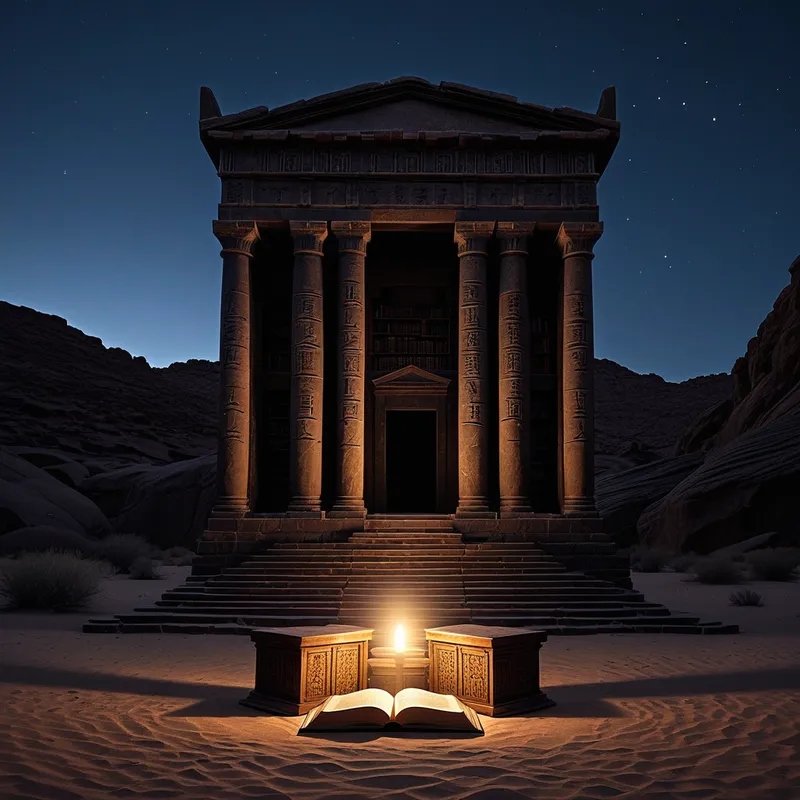
In the time before memory, when the world was still wet with the breath of creation, the gods forged a covenant. They pooled their essence—the fire of the sun, the patience of stone, the chaos of the sea, the silence of the void—and from this confluence, they birthed not a child, but a testament: The Grimoire. It was bound in covers of living night and dawn, its pages were the parchment of reality itself, and upon them, in scripts of light and shadow, was written Everything That Is, Was, and Could Be. It was the universe’s own beating heart, transcribed.
But such totality terrified even its makers. Knowledge without boundary is a devouring flame. So, they appointed a guardian, The Librarian, a god whose domain was not a kingdom, but a silence. They built for the book a Sanctum of Echoes, a library that existed between the ticks of time, its shelves stretching into infinities of forgotten lore, with the Grimoire upon a solitary plinth at its still center. The Librarian’s sole task was to tend the silence, to ensure the book was read by none, for to read it was to become it, and to become it was to cease to be.
Yet, the whisper of the Grimoire seeped through the cracks of worlds. It called to the hungry of mind and the desperate of soul. A mortal scholar, Kaelen, whose thirst for truth had scorched his life to ashes, heard its siren song in the rustle of leaves and the babble of rivers. For decades, he followed the phantom trail, deciphering celestial maps and dream-lore, until he stood, a speck of dust and yearning, before the gates of the shifting Sanctum.
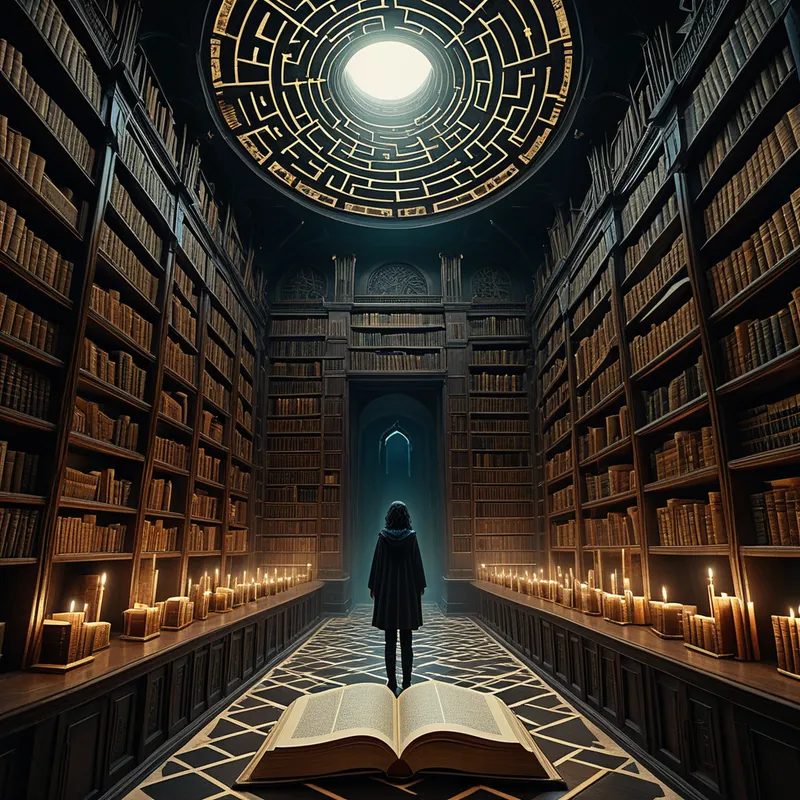
The library was a cavern of breathless awe. Towers of scrolls hummed with latent power; books bound in crystal and skin glimmered on endless shelves. And there, in a cone of silent light, sat the Grimoire. The Librarian manifested—not as a warrior, but as a figure of profound, weary sorrow. “Turn back,” the guardian’s voice echoed in Kaelen’s mind. “To open it is to drink the ocean. You will drown. You will be unmade.”
But Kaelen was already drowning in his ignorance. With a final, shuddering breath of his old self, he reached out and laid his palm upon the cover.
The universe erupted inward. He did not read the book; the book read him. Every cell, every memory, every secret shame and buried hope was unfolded, examined, and filed away in the infinite index. He saw the birth of stars and the death of gods, the love of a single blade of grass for the sun, the mathematical formula for grief. He knew All. And in that knowing, his “I” dissolved. Kaelen the man was gone, his identity scattered like ink in the ocean of totality.
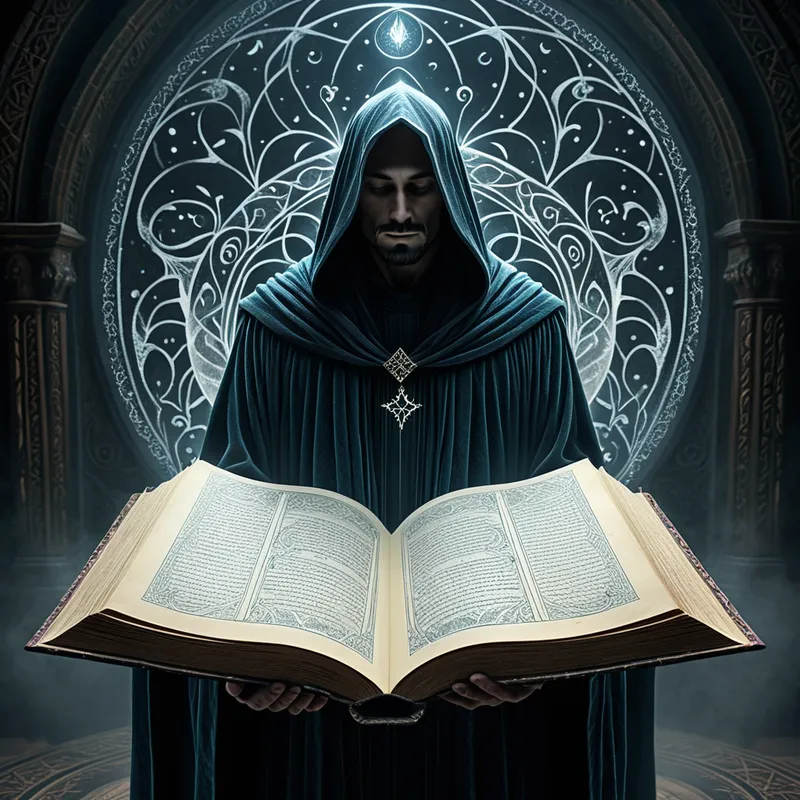
When the light faded, the Grimoire sat unchanged. But beside the plinth stood a new figure, its eyes holding the calm, terrible depth of the cosmos. It was the Librarian. The old guardian, his duty finally fulfilled, smiled a smile of immense relief and faded into the silence he had so long preserved. The new Librarian, once Kaelen, now the embodied knowledge, took his place. He smoothed the cover of the book, which was now, and had always been, a part of him. The cycle was complete. The seeker had become the guardian, the question had become the answer, and the answer demanded an eternal, lonely silence.
Cultural Origins & Context
The myth of the Grimoire is a polygenetic myth, appearing in fragments and echoes across disparate cultures. It is not the property of any one people, but a psychic artifact of humanity’s collective grappling with the concept of ultimate knowledge. In some traditions, it is the Preserved Tablet; in others, the Book of Raziel or the lost archives of Atlantis.
It was never a populist tale told around hearths, but a secret history passed among mystics, alchemists, and archivists—those who stood at the precipice of the known. Its societal function was twofold: as a warning and a initiation. For the apprentice, it was a cautionary parable about the perils of hubris and the soul-cost of gnosis. For the advanced adept, it was a map of the final stage of the journey, where the seeker’s ego must die to be reborn as the vessel of understanding. It served as the mythological underpinning for all traditions that posit a final, transformative encounter with a truth too vast for the individual mind to hold.
Symbolic Architecture
The Grimoire is the ultimate symbol of the Self, the complete and integrated psyche. It is not merely a book of facts, but the living record of all potentialities, conscious and unconscious. It represents the psyche in its wholeness, a state the ego cannot comprehend without being subsumed.
The Grimoire does not contain knowledge; it is knowledge. To seek it is to seek the annihilation of the seeker.
Kaelen represents the heroic ego, the part of consciousness that actively strives for growth, understanding, and completion. His journey is the archetypal hero’s journey turned inward. The Librarian is a profound symbol of the Senex or Wise Old Man, but one frozen in a role. He is the knowledge that has become static, a guardian of potential that is never realized. His weariness is the stagnation of wisdom unused.
The central, terrifying paradox of the myth is the price: to truly know the Self, one must cease to exist as the separate, identifying ego. The Sanctum of Echoes is the liminal space of the unconscious itself—vast, organized by a logic alien to the waking mind, and containing all the forgotten and repressed contents of the soul.
The Dreamer’s Resonance
When this myth stirs in the modern dreamscape, it rarely appears as a literal book. Instead, one may dream of finding a room containing a mesmerizing, complex object—a shimmering machine, a pulsating crystal, a door to a blinding light. There is a powerful somatic pull, a mix of awe and dread. The dreamer feels they are on the verge of a revelation that will explain everything about their life, their pain, their purpose.
The psychological process here is a confrontation with a core complex or a deep layer of the personal or collective unconscious. The “Grimoire” in the dream is a symbol of a psychic truth the dreamer is both desperately seeking and profoundly fearing to integrate. The hesitation before touching it mirrors the ego’s resistance to its own transformation. To touch it in the dream and experience a flood of understanding or a dissolution of self often signals a powerful, ongoing process of psychic reorganization—perhaps a spiritual awakening, a profound insight in therapy, or the breakdown of an old identity structure before a new integration.
Alchemical Translation
The myth of the Grimoire is a perfect allegory for the Jungian process of individuation, particularly its final, most daunting stage. The alchemical work begins with Kaelen’s nigredo—his scorched life, his burning dissatisfaction, the dark night of the soul that initiates the quest. His journey through the Sanctum is the albedo, a purification and a gathering of scattered insights (the books on the shelves).
The climax at the plinth is the rubedo, the reddening, the final confrontation. This is not a battle with a monster, but a sacred marriage, a hieros gamos between the limited, conscious ego (Kaelen) and the boundless, unconscious Self (the Grimoire).
The ultimate alchemical transmutation is not of lead into gold, but of the seeker into the sanctuary.
The old ego dies—not in failure, but in fulfillment. The “new Librarian” is the nascent, integrated personality that results from this union. This entity understands that true wisdom is not about possessing knowledge, but about being a vessel for it, which necessitates a sacred, responsible silence—the containment of the terrible and glorious totality. For the modern individual, this translates to the moment when one’s lifelong seeking culminates not in a final answer, but in a fundamental change of state. You no longer have a philosophy; you are your lived truth. You no longer seek your purpose; you embody it, becoming the quiet guardian of the very mystery you once sought to solve. The cycle completes, and in the silence of that understanding, a new kind of wholeness is born.
Associated Symbols
Explore related symbols from the CaleaDream lexicon: