
The Grim Reaper Myth Meaning & Symbolism
A skeletal figure with a scythe, the Reaper is the universal personification of death, a psychopomp who harvests souls and marks the ultimate transition.
The Tale of The Grim Reaper
Listen. There is a field that lies beyond the last hill you will ever climb. It is not a field of dread, but of utter stillness, where the wind carries no scent of life, only the soft rustle of completion. Here, at the hinge of worlds, He waits.
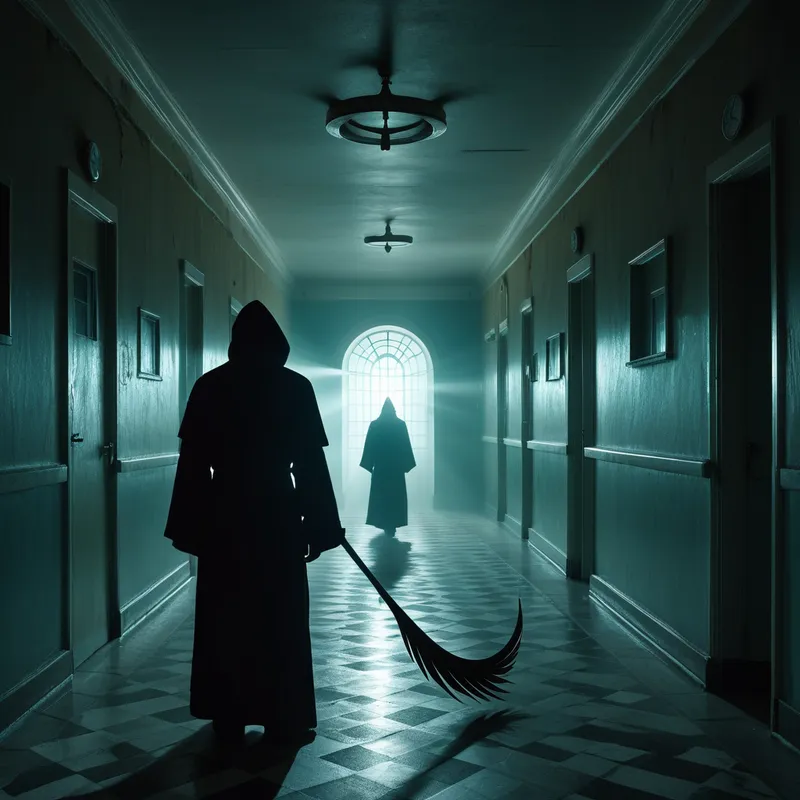
He does not stride; He is simply present, a column of deepest shadow against the grey-gold light of a sun that neither rises nor sets. His form is hidden within folds of a robe the color of a starless midnight, a garment that drinks the light and gives back only the chill of deep earth. From the cowl, no face peers out, only the faint, bone-white suggestion of a skull—not grinning, but set in an expression of infinite, patient focus.
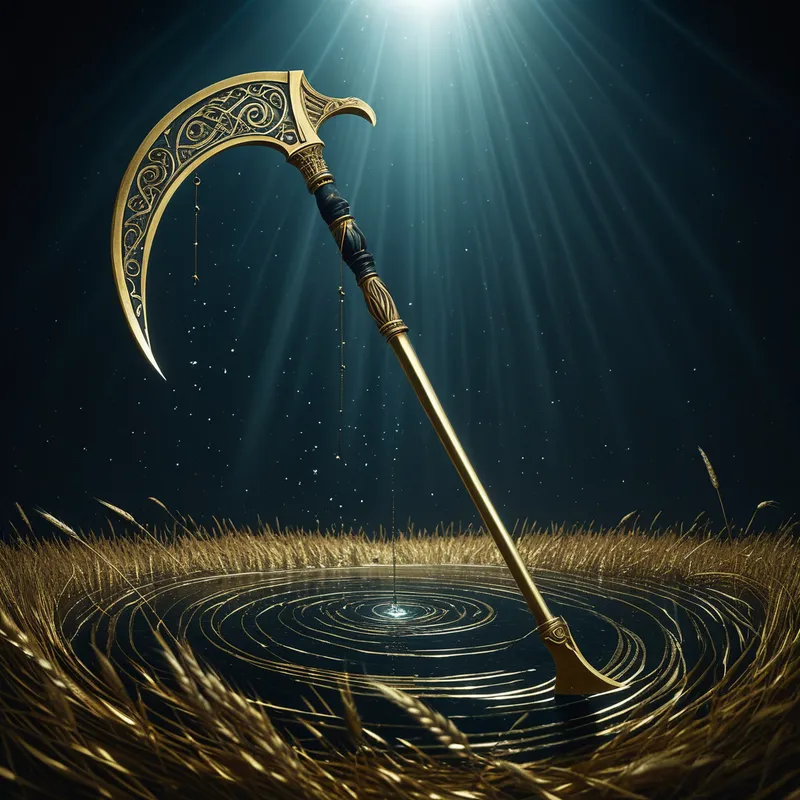
In His hands—long, articulated bones of polished ivory—He holds the Instrument. It is a scythe of ancient make, its haft of darkened wood worn smooth by eons of turning, its blade a crescent of cold, grey steel that sings a silent note too low for mortal ears. This blade is not meant for anger, but for precision. It is the final cut, the severing of the single thread.
You feel Him before you see Him. The warmth leaves your limbs not with violence, but like a tide receding from the shore. The sounds of the world—the laughter, the weeping, the rustle of leaves—fade into a profound silence, as if you are hearing them from the bottom of a deep well. Then, He is beside you. There is no chase, no flight. There is only the inevitable turning, the meeting of His hollow gaze.
He does not speak. He need not. His presence is the question and the answer. He extends a hand, not to grasp, but to guide. His touch upon the shoulder is as light as a falling leaf, yet it carries the weight of mountains. In that touch is the memory of every beginning and the echo of every end. The scythe does not swing in wrath; it moves in a slow, perfect arc, a harvest of the ripe moment. It passes through not flesh, but time itself.
And as it passes, the field, the twilight, the silent figure—all dissolve into a rushing wind that is both an ending and a doorway. The last thing you perceive is not darkness, but a profound release, the final sigh of a story completed, as the Reaper turns His attention to the next field, the next thread, the next inevitable, gentle harvest.

Cultural Origins & Context
The figure we know as the Grim Reaper is not the product of a single culture or scripture, but a folkloric amalgam that coalesced in late medieval Europe. Its roots are tangled in the soil of plague, war, and a pervasive Christian eschatology that grappled with the physicality of death. Earlier personifications, like the Charon of Greek myth who ferried souls, or the Pluto who ruled it, were deities with domains. The Reaper is different; it is Death itself, made manifest as a worker.
This image emerged from a world intimately acquainted with mortality. The Black Death of the 14th century made death a constant, visible neighbor. In this context, the allegorical “Dance of Death” (Danse Macabre) paintings and poems showed a skeleton leading emperors, peasants, and popes alike in a final procession. The Reaper was the central conductor of this dance. The scythe, a common peasant tool for harvesting grain, became the perfect symbol: life is cut down when it is ripe, gathered in, and the harvest is universal. This was not a theological doctrine handed down by priests, but a story told by the people, in woodcuts, tavern tales, and funeral art, to give a face—however stark—to the great unknown, and to assert a chilling equality before its gaze.
Symbolic Architecture
Psychologically, the Grim Reaper is far more than a Halloween monster. It is one of the most potent archetypal images of the animus of the cosmos, representing the principle of necessary ending that makes new beginning possible.
The scythe does not destroy the field; it completes the cycle of the grain. Without the harvest, there is only rot and no seed for the next season.
The Skeleton signifies the ultimate truth beneath the flesh, the irreducible framework of existence. It is the blueprint stripped of all illusion, status, and vanity. The Robes shroud this truth in mystery, representing the unfathomable nature of what lies beyond the transition. The Scythe is the symbol of time, of the decisive moment (Kairos), and of the harvest of a life’s experiences. Crucially, the Reaper is rarely portrayed as malicious, but as impartial and inevitable—a psychopomp whose duty is to escort the soul from one state of being to another. It is the ultimate agent of transmutation, enforcing the law that all forms must change.
The Dreamer’s Resonance
When the Reaper appears in a modern dream, it is rarely a simple portent of physical death. More often, it signals a profound psychological ending. The dreamer may be undergoing the death of an identity (the end of a career, a relationship, a long-held belief), a phase of life, or an outmoded way of being. The somatic feeling is often one of chilling stillness, a freeze response that speaks of confronting something immutable.
The Reaper in a dream asks the dreamer: What has reached its natural end? What must be released? What old “skin” are you clinging to that is preventing rebirth? Its appearance can correlate with depression or deep grief, not as a cause, but as an unconscious depiction of the process underway—the necessary, painful harvesting of the past. To dream of facing the Reaper without fear, or even of taking the scythe oneself, can indicate a powerful integration of this archetype: an acceptance of one’s own agency in ending cycles and making necessary cuts in one’s life.
Alchemical Translation
The individuation process, the journey toward psychic wholeness, requires many “deaths.” The myth of the Reaper provides the core model for this alchemical nigredo stage. To become whole, the ego must relinquish its claim to absolute control and sovereignty. It must allow parts of itself to “die.”
The true harvest of the Reaper’s scythe is not the soul, but the illusion of the permanent, separate self.
The alchemical work is to internalize the Reaper. This means developing the inner capacity to consciously end things: toxic patterns, draining commitments, childhood narratives that no longer serve. It is the cultivation of a sober, honest inner voice that can say, “This is finished,” and make the clean cut. This is not self-destruction, but self-pruning. The integrated Reaper archetype becomes the inner Senex, the part of us that understands limits, respects time, and values essence over appearance. It grants the courage to face endings not as failures, but as the solemn, sacred completions that alone create space for the new seeds of the psyche to sprout. In this light, the Grim Reaper is the ultimate sage—the silent teacher whose lesson is the liberating truth of impermanence.
Associated Symbols
Explore related symbols from the CaleaDream lexicon: