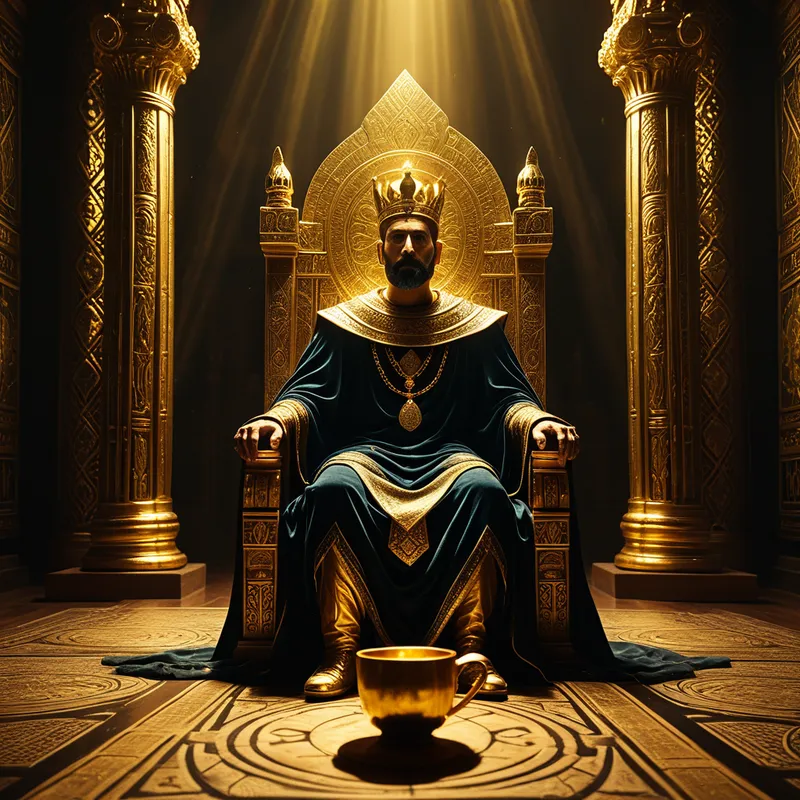
The Greek myth of Midas Myth Meaning & Symbolism
A king's wish for a golden touch becomes a curse, teaching that what glitters can starve the soul and petrify the heart.
The Tale of The Greek myth of Midas
Hear now the tale of Midas, king of Phrygia, a man whose name became a whisper for both fortune and folly. His kingdom was rich, his gardens lush, but in his heart dwelled a hunger that no earthly treasure could sate—a hunger for more.
It began not in his hall, but in a wild, vine-tangled grove. The old satyr Silenus, tutor to the god Dionysus, had strayed from his revels, drunk and lost. Midas found him, not with scorn, but with reverence. For ten days and nights, the king hosted the ancient being with feasts and music, recognizing the divine spark within the stumbling old form. When Dionysus, frantic for his lost companion, came to Phrygia, he found Silenus honored, not imprisoned. Overflowing with gratitude, the god of ecstasy offered Midas any reward his heart desired.
And what did the king’s heart desire? He did not ask for wisdom, or longevity, or peace. His eyes, accustomed to the gleam of coin and crown, saw only one answer. “Grant me this,” Midas proclaimed, his voice echoing in the silent hall. “Let everything I touch be turned to gold.”
Dionysus, his brow furrowed with a knowing sadness, assented. “So be it.”
The morning sun found Midas giddy. He reached for his bedpost—it solidified into a pillar of cold, yellow metal. A thrill shot through him. He touched a stone, a table, a linen cloth—all transformed with a chime-like ring into perfect, immutable gold. He laughed, running through his palace, turning his world into a monument to his own power. He summoned a great feast to celebrate his infinite wealth.
But when he raised a cup of wine to his lips, it hardened into a golden chalice before the liquid could touch him. When he reached for a succulent fig, it became a jeweled bauble in his hand. His hunger grew, a sharp pang in his belly, as the aroma of roasted meat turned to the scent of cold metal. His joy curdled into panic.
Then, his young daughter, hearing her father’s distress, ran to him and threw her arms around his neck. As he embraced her, a terrible rigidity seized her form. Her warm, living flesh grew cold and still. Her loving smile froze into a serene, golden mask. In his arms, he held not his child, but a priceless, horrifying statue. The king’s wail of despair echoed through his golden palace, the sound of a man entombed in his own desire.
This was the gift of Dionysus. This was the curse of Midas.

Cultural Origins & Context
The myth of Midas is not a singular, frozen story but a river of narrative flowing from ancient Anatolia. Our primary sources are Greek, recorded by poets like Aristophanes and historians like Herodotus, but they point to a historical kernel: a powerful King Midas of Phrygia who ruled in the 8th century BCE. The Greeks, master myth-weavers, absorbed and transformed this historical figure into an archetypal cautionary symbol.
The myth functioned as profound social commentary in the Greek world, a society grappling with the rise of coinage, trade, and material wealth. It was a story told not just to entertain, but to interrogate the very nature of olbos (prosperity) and hybris (arrogant excess). Performed in symposia and public theaters, it asked its audience: What is true wealth? What happens when the means of life (food, drink, human touch) become incompatible with the objects of desire? Midas served as a universal warning against the disordering of natural priorities, a tale where the divine punishment is the literalization of the fool’s own wish.
Symbolic Architecture
At its core, the myth of Midas is an alchemical parable gone wrong. Alchemy seeks to transmute base matter into spiritual gold—the Philosopher’s Stone. Midas performs the inverse: he transmutes the living, the nourishing, and the loved into dead, material gold. His touch is not enlightenment, but entropy.
The golden touch is the fantasy of absolute control, the desire to imprint one’s will so completely upon the world that it loses all will of its own.
The gold itself is symbolic of frozen value, arrested life. It represents not fluid wealth, but static hoarding. Food becomes inedible, drink undrinkable, a child unloving. Each transformation is a small murder, a sacrifice of function and relationship on the altar of appearance. Midas’s palace becomes a mausoleum, his body a prison of golden isolation. The myth maps the psychological process where an obsession—be it with money, status, or power—severs our connection to the organic, messy, and vital sources of real sustenance. Midas is the archetype of the man who, in gaining the world, loses his soul, quite literally feeling that loss in the emptiness of his stomach and the cold weight in his arms.

The Dreamer’s Resonance
When the pattern of Midas stirs in the modern dreamer, it often manifests not with literal gold, but with a sensation of sterile transformation or toxic influence. One might dream of touching a beloved pet and watching it become a stuffed toy, or embracing a partner and feeling them grow cold and rigid. The dream environment may be one of opulent, empty spaces—gleaming mansions with no food in the kitchen, luxurious cars that cannot be driven.
Somnially, this signals a profound somatic and psychological process: the recognition that a pursued goal or ingrained behavior is costing the dreamer their life. It is the psyche’s rebellion against a “Midas complex”—a mode of being that converts relational, nourishing experiences into dead trophies or transactional outcomes. The body in the dream feels the hunger and the paralysis; it is a direct experience of emotional and spiritual malnutrition. The dream is a crisis, a moment where the unconscious screams that the current path, however glittering its rewards, is a curse that will ultimately petrify the dreamer’s capacity for love, nourishment, and joy.

Alchemical Translation
The path of individuation, the alchemical work of the soul, requires not the granting of Midas’s wish, but the seeking of its antidote. The myth itself provides the map for this psychic transmutation. Midas’s salvation comes only when he acknowledges the curse, when his hubris breaks into humility and he begs for release. He is directed to the river Pactolus, where he must immerse himself. This is the critical operation: the dissolution of the golden ego in the waters of the unconscious.
The cure for the golden touch is not to reverse the magic, but to be washed by the river. One must submit the hardened, isolated self to the fluid, cleansing, and humble flow of life itself.
Psychologically, this translates to the conscious surrender of a toxic identification—with wealth, with control, with a persona that kills spontaneity. The “river” represents the therapeutic process, honest relationship, or a return to nature and instinct, where the hardened, defensive structures of the personality are eroded and washed away. What is left is not the poor king he was before, but a humbled, wiser man. The myth suggests that the gold itself, the power of the complex, is not destroyed but transformed; historically, the sands of the Pactolus were said to be rich with gold dust thereafter. In the psyche, the energy once bound in a sterile obsession (the Midas complex) is freed and can now flow into the world as creative, life-affirming force. The triumph is not in having the touch, but in learning, through terrible consequence, what is truly worth touching.
Associated Symbols
Explore related symbols from the CaleaDream lexicon: