The Greek chorus in Athenian t Myth Meaning & Symbolism
The mythic voice of the city, a collective of elders who witness, lament, and guide the hero's tragic dance with destiny.
The Tale of The Greek Chorus in Athenian t
Hear now, and listen not with your ears alone, but with the blood that remembers. We gather not on a stage of wood and paint, but in the hollowed earth of the Theatre of Dionysus, where the scent of crushed thyme and spilled wine hangs thick in the twilight air. The sun bleeds behind the Acropolis, and the first star is a cold, watching eye.
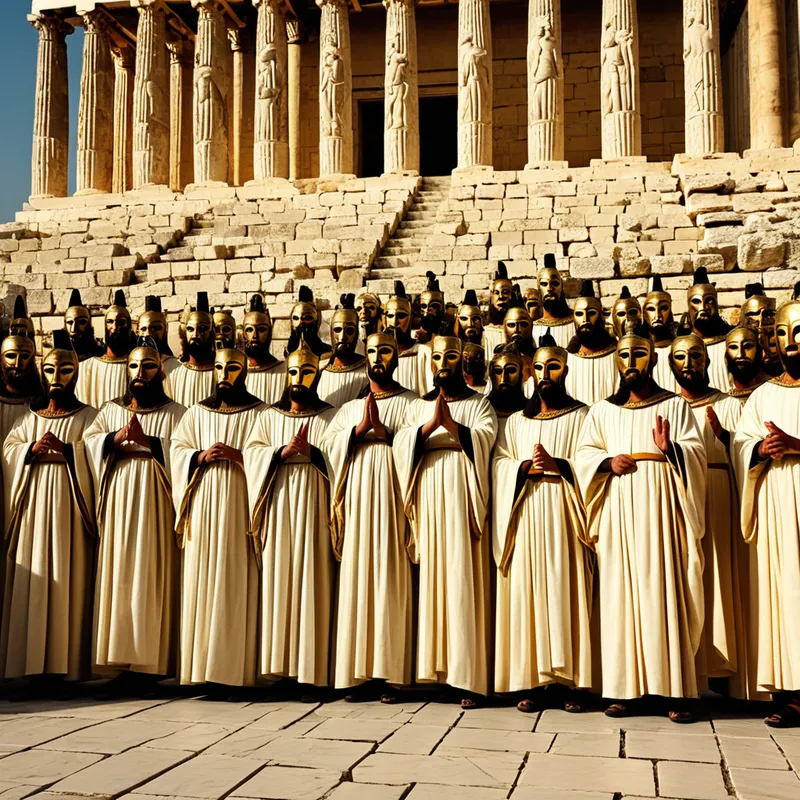
They enter not as men, but as a single breath made flesh. Fifteen, twenty, fifty—the number matters less than the unity. They are the Chorus of Elders of Thebes, of Argos, of Corinth. Their feet, bound in soft buskins, move as one—a slow, measured pulse against the sacred orchestra, the dancing circle of beaten earth. Their faces are not their own; they are hidden behind masks of linen and plaster, each one a frozen river of grief or awe, carved with the stylized tears of all who have ever wept. Their robes are identical, a wash of somber color that flows like a single, mournful river.
They do not act; they are. They are the city’s walls given voice, the marketplace’s gossip distilled into prophecy, the ancestral graves stirring to song. When the hero, radiant in his hubris, strides onto the skene to declare himself master of fate, the Chorus does not confront him. They turn to one another, a rustle of shared dread, and their song begins—a low thrum of lyre and breath that rises from the earth itself. “Beware, O King,” they chant, “the gods are not blind. The wheel of Nemesis turns.”
They witness the unraveling. As the hero’s certainty cracks, so does their strophe. Their dance, once a gentle sway, becomes a shuddering, fragmented thing. They cry out to Zeus</ab title>, to Themis, their voices splintering into a harmony of despair. They become the hero’s forgotten conscience, the lament of the slain he does not see, the memory of the oath he broke. In their unified voice, you hear the gasp of the crowd, the heartbeat of the polis itself, laid bare.
And when the final, terrible revelation comes—the corpse revealed, the eyes put out, the exile proclaimed—it is to them the broken hero clings. They do not embrace him. They form a living, breathing barrier between his suffering and the audience’s gaze. Their final ode is not a judgment, but a sigh woven into wisdom: “Count no man happy until he is dead. Look upon this, children of Cadmus, and learn.” Then, step by synchronized step, they retreat, a single entity dissolving back into the shadows from which it came, leaving only the echo of their warning hanging in the smoky air, a taste of ash and sacred wine.
Cultural Origins & Context
This mythic presence was born in the specific, fertile ground of 5th century BCE Athens, during the Great Dionysia festival. The chorus was not merely a theatrical device; it was a profound religious and civic institution. These were not professional actors, but citizens—often wealthy ones funding the production as a liturgy (public service)—who underwent rigorous training in song, dance, and recitation. They performed in the theatre dedicated to Dionysus Eleuthereus, a space that was as much a temple as a venue.
The chorus served as the vital bridge between the audience and the mythic, superhuman events on stage. They represented the collective “we”—the community of Athens processing, in real time, the terrifying questions of their age: the nature of justice, the limits of human power, the caprice of the gods, and the fragile bonds of the family and state. Through their choral odes (stasima), they provided the lyrical, philosophical backbone of the tragedy, offering time for reflection, invoking shared cultural myths, and directly engaging the citizen-audience in a communal act of moral and emotional reckoning. They were the living memory and the civic conscience, performing a ritual that sought to purify (katharsis) the city’s own fears and passions through shared witness.
Symbolic Architecture
At its core, the chorus symbolizes the collective psyche. It is the voice of the tribe, the superego of the culture, the accumulated wisdom and warning of the ancestors. Psychologically, it represents everything the individual hero must both engage with and ultimately transcend.
The chorus is the shore against which the wave of individual will crashes; it defines the shape of the breaking, and records the sound of the aftermath.
It embodies the principle of connection versus isolation. The hero’s tragic flaw (hamartia) is often a radical act of isolation—defying the gods, breaking familial bonds, placing the self above the community. The chorus constantly pulls against this, reminding the hero (and us) of the web of relationships, laws, and divine ordinances they are severing. They are the symbolic weight of the known world, the “should” and the “must” that the heroic “I” seeks to overthrow.
Furthermore, they represent pattern recognition. They are the ones who see the cyclical nature of fate, who remember the old stories of pride and fall. While the hero is trapped in the linear urgency of their own plot, the chorus views events from a circular, mythic perspective. They are the human attempt to find meaning and precedent in chaos, to sing a form into the formless terror of existential suffering.
The Dreamer’s Resonance
When this mythic pattern stirs in the modern unconscious, it rarely appears as literal figures in robes. Instead, one dreams of being observed by a faceless crowd whose judgment is felt, not heard. One might dream of speaking in a vast hall where one’s own voice echoes back, distorted by a hundred whispering overlays. Or perhaps of trying to make a critical, personal decision while surrounded by family portraits whose eyes all seem to follow you, or by a committee of shadowy figures who speak in unison.
This is the somatic signature of the inner chorus at work. The dreamer is undergoing a process where a deeply personal impulse, desire, or truth is coming into conflict with internalized collective values—the “shoulds” installed by family, culture, or tradition. The chorus in the dream is the psychological embodiment of that pressure. The anxiety, the feeling of being watched or judged in the dream, mirrors the somatic tension of trying to individuate—to become oneself—against the gravitational pull of the collective psyche. The dream chorus is not an enemy, but a witness to the struggle, marking the point where the individual psyche grapples with its embeddedness in a larger whole.
Alchemical Translation
The journey of individuation, as modeled by this myth, is not about heroically silencing or defeating the chorus. That is the hubris that leads to tragedy. The alchemical work is in transforming one’s relationship to it.
Initially, the chorus is experienced as an external, oppressive authority—the voice of parents, society, dogma. The first step is to internalize this voice, to recognize it as a part of one’s own psychic architecture, the inner critic or the moral conscience. The next, more profound step, is to differentiate from it. One must learn to hear the chorus, to respect its wisdom (for it often carries legitimate warnings and cultural memory), but not be governed by its unified dictate.
The goal is not to become a solitary hero on an empty stage, but to learn to stand in the orchestra, hear the full polyphony of the chorus—fear, wisdom, tradition, warning—and then, from a centered self, speak one’s own line with clarity and responsibility.
This is the psychic transmutation: turning the leaden weight of collective expectation into the gold of conscious choice. The integrated individual can acknowledge the chorus within (“I hear your fear, I remember the stories of failure”) without letting it write the script. They move from being a character observed by the chorus to becoming, in a sense, the chorus leader (koryphaios) of their own life—able to engage with the collective voices, synthesize their message, and step forward to deliver a new stanza that honors both the tradition and the unique necessity of the present moment. The chorus thus moves from being a barrier to becoming a backdrop, a rich context against which authentic, individual consciousness can finally, and responsibly, emerge.
Associated Symbols
Explore related symbols from the CaleaDream lexicon: